
Directed by Carmela Cucuzzella and Alessandra Mariani
Non classé
Évènement de lancement du livre « Concourir à l’excellence en architecture / Éditoriaux du CCC 2006-2016 » – en
Lancement du livre « Concourir à l’excellence en architecture / Éditoriaux du CCC 2006-2016 », sous la direction de Jean-Pierre Chupin. L’évènement se tiendra à l’Université de Montréal, de 17h30 à 19h00, au local 1150.
Vernissage de l’exposition accompagnant la conférence « Sculpture, salon ou Shed» – en
La conference (Sculpture, salon ou shed, 11 octobre 2016) est accompagnée d’une exposition conçue par Nicholas Roquet et Jacques Plante (professeur agrégé à l’École d’architecture de l’Université Laval) qui rassemble 36 réalisations et projets contemporains pour des musées et centres d’interprétation. Intitulée Architectures d’exposition au Québec, elle permet de comprendre les défis que relèvent, avec ingéniosité, les architectes québécois. L’exposition est présentée au local 2081 du pavillon de la Faculté de l’aménagement du 4 au 14 octobre. Vernissage, le 11 octobre après la conférence.
Évènement d’annonce des résultats du concours « En plus d’attendre le bus / More than waiting for the bus » – en
Mardi 18 avril à la Maison du développement durable se tiendra l’évènement d’annonce des résultats du concours « En plus d’attendre le bus / More than waiting for the bus » organisé par la Chaire IDEAS-Be Concordia University (Carmela Cucuzzella) et la Chaire de Recherche sur les Concours UdeM (JPC) en collaboration avec CRE-Montréal.
Doctoral Thesis Defence – – Jonathan Lachance (Director Louis Martin) – March 17th 2017
« Les fondements architecturaux et écologiques de l’Environmental Design aux États-Unis : 1953-1975 »
<p/p>Under the supervision of professor Louis Martin at UQAM, the thesis examines the nature of the intersection in between Environmental Design and the natural sciences, and its effects on architecture both as a discipline and as a profession in the 1960s’. The first chapter retraces the origins of the discipline of Environmental Design in the 1950s’ in the teachings of Serge Chermayeff at Harvard and in the College of Environmental Design in Berkeley created by William W. Wurster, and it gives an overview of its successive development, dissemination and gradual institutionalization throughout the United States in the 1960s’. The two following chapters are case studies of two landscape architects who have introduced ecology, biology and other natural sciences in their discourse during this last decade: Ian McHarg from the University of Pennsylvania and Lawrence Halprin from San Francisco. My thesis shows that, although McHarg and Halprin approaches ecology from two different points of view, the aim of the intersection with the natural sciences in the 1960s’ was to help formulate a new unified theories of design and sciences which gives the landscape architect the responsibility to both solve the environmental crisis through enlightened and inclusive design practices, and solve the internal problems of post-war American architecture through the dissemination, among the anglo-saxon architectural culture, of a new definition of architecture as «natural process» rather than «design object».
Launching of the new Cahiers de recherche du LEAP Research Notebooks
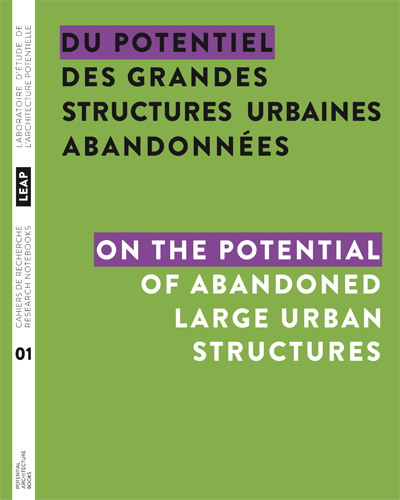
Launching of the new Cahiers de recherche du LEAP Research Notebooks (Du potentiel des grandes structures urbaines abandonnées / On the Potential of Abandoned Large Urban Structures) with heads of schools represented at LEAP. April 5th, 2017, AME room 1150, 18h00.
Abandoned building, modern ruin, urban ghost, skeleton property, deserted structure … these are some of the words used in an attempt to circumscribe the phenomenon of abandoned city fragments. This abandonment, whether partial or total, temporary or long-term, is examined through the “potential” that the survival of these structures would offer. This first edition of the LEAP Research Notebooks gathers 12 case studies, each structured around a common theme in the disciplines of architecture, art history, and semiotics. From Montreal to Berlin, from Detroit to Turin, the various contributions are structured around four tensions calling into question the status of these structures (monumental / monument), their scale (architectural / city planning), the figures they materialize (utopia / ruin) and the poetics they embody (resistance / potential).
As revealed by the authors, these large abandoned urban structures are far from being inert. Not only are they vectors of a collective memory, of potential projects, of multiple imaginations, but they also act as a trigger for a critical re-evaluation of our contemporary societies. Therefore, the large abandoned structure cannot be restricted to the fields of economy or land planning: such complex interweaving of material, technical, social and cultural dimensions calls for architects to reflect on its survival.Issue coordinated by Jean-Pierre Chupin and Tiphaine Abenia
- Texts by : Tiphaine Abenia, Georges Adamczyk, Denis Bilodeau, Pierre Boudon, Jean-Pierre Chupin, Jean-Louis Cohen, Anne Cormier, Camille Crossman, Carmela Cucuzzella, Louis Destombes, Cynthia Hammond, Bechara Helal, Jonathan Lachance, Alessandra Mariani, Louis Martin, Marie-Saskia Monsaingeon, Michel Max Raynaud, Nicholas Roquet, David Theodore
Doctoral Thesis Defence – – Bechara Helal (Director Jean-Pierre Chupin) – January 30th 2017
« The Laboratories of Architecture – Epistemological Inquiry into a Historical Paradigme »
Architectural sites and practices are commonly described in terms borrowed from the arts (studio, creation, masterpiece) and yet, the architectural field relies increasingly on scientific terms (laboratory experimentation, research). This contemporary interest in activities related to scientific research appears to coalesce around the now common notion of “architectural laboratory”. Its first materialization dates back to the late nineteenth century and its presence has greatly increased since the recent “digital turn”, although this term remains, to this day, still not properly defined. What is an “architectural laboratory”? What elements form its theoretical model? What are the issues related to the emergence of the figure of the “architectural laboratory”? Why and for what purpose do architects refer to the figure of the laboratory?
<p/p>
- President of the Jury: Lachapelle, Jacques, Ph. D. Faculté de l’aménagement – Architecture Thesis Director: Chupin, Jean-Pierre, Ph. D. Faculté de l’aménagement – Architecture
- Jury members : Boudon, Pierre, Ph. D. Faculté de l’aménagement – Architecture, External reviewer : Galvin Terrance, Ph. D. École d’architecture McEwen de l’Université Laurentienne, Dean Representative : Torres Michel, Juan José, Ph. D. Faculté de l’aménagement, Vice-Dean
Vernissage de l’exposition Une architecture du Québec Moderne 1958-1974 (PGL) – en
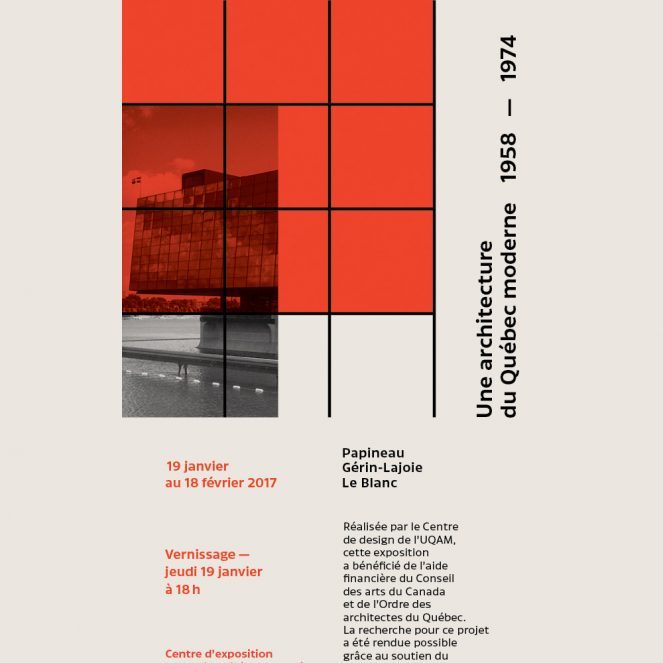
Vernissage de l’exposition organisée par Georges Adamczyk et Louis Martin (et Réjean Legault) au Centre d’exposition de l’Université de Montréal : Une architecture du Québec Moderne 1958-1974 (PGL). Exposition soutenue par le LEAP.
Round Table and Exhibition : « Une architecture du Québec Moderne 1958-1974 (PGL)»
Round Table and Exhibition organized by Georges Adamczyk and Louis Martin (and Réjean Legault) : « Une architecture du Québec Moderne 1958-1974 (PGL) »
Exhibition promoted by the LEAP, Université de Montréal
- Animation : Jean-Pierre Chupin (UdeM).
- Including : Georges Adamczyck (UdeM), Louis Martin (UQAM), Carlo Carbone (UQAM), Réjean Legault (UQAM)