Date and time: August 25, 2026 from 10:00 am to 12:00 pm.
Held at: Room 1150
Avec Virginie Picon-Lefebvre, professor and researcher at the ENSA Paris Belleville

LABORATOIRE d'ÉTUDE de l'ARCHITECTURE POTENTIELLE
Interuniversity Research Team Based in Montreal
Date and time: August 25, 2026 from 10:00 am to 12:00 pm.
Held at: Room 1150
Avec Virginie Picon-Lefebvre, professor and researcher at the ENSA Paris Belleville
Date and time: August 24, 2026 from 2:00 to 4:15 pm.
Held at: Room 1150
With Antoine Picon, professor of the Histoire of Architecture and Technology, and director of the doctoral programs of the Graduate School of Design de l’Université de Harvard
Date and time: March 18, 2026 from 1:30 to 5:00 pm.
Held at: LEAP, 2064
With Dr. Marie Cecile Kotyk, Assistant Professor, School of Architecture, Planning and Landscape Architecture (SAPL), University of Calgary and member of the Design Justice Research Chair
Presenting PhD Students:
Juliane Alexandre Colmado, étudiante au doctorat individualisé en architecture, Université de Montréal
The Phonotope : shaping sound for a (un-)silenced architecture
Olivia Daigneault Deschênes, étudiante au doctorat individualisé en architecture, Université de Montréal
From Tlachiuak, Montreal (Tiohtià :ke) to Lucha y Siesta, Roma : Architecture as complicit in emancipatory struggles
Yolene Handabaka Ames, étudiante au doctorat individualisé en architecture, Université de Montréal
Between demolition and adaptative reuse : social value as a lever of bottom-up heritage-making
Paloma Castonguay-Rufino, étudiante au doctorat individualisé en architecture, Université Montréal
From post-industrial obsolescence to civic space : reconversion cultures and the architectural reuse of industrial heritage in Canada
Shantanu Biswas Linkon, étudiant au doctorat individualisé en architecture, Université de Montréal
Indexing social value in architecture : comparing community centers and libraries both in Bangladesh and Canada through inclusiveness and spatial justice
Raquel Fernandez, étudiante au doctorat individualisé en architecture, Université de Montréal
Women’s collective housing : a feminist approach to housing
Cyrille Jérôme Tchango Ngamaleu , étudiant au doctorat individualisé en architecture, Université de Montréal
The intention to support care through architecture : a comparative study of the tectonics of the Maggie Centers’ Pavilions
In discussion with :
Dr. Jean-Pierre Chupin, Professor, School of Architecture, Université de Montréal
Canada Research Chair in Architecture, Competitions and Mediations of Excellence
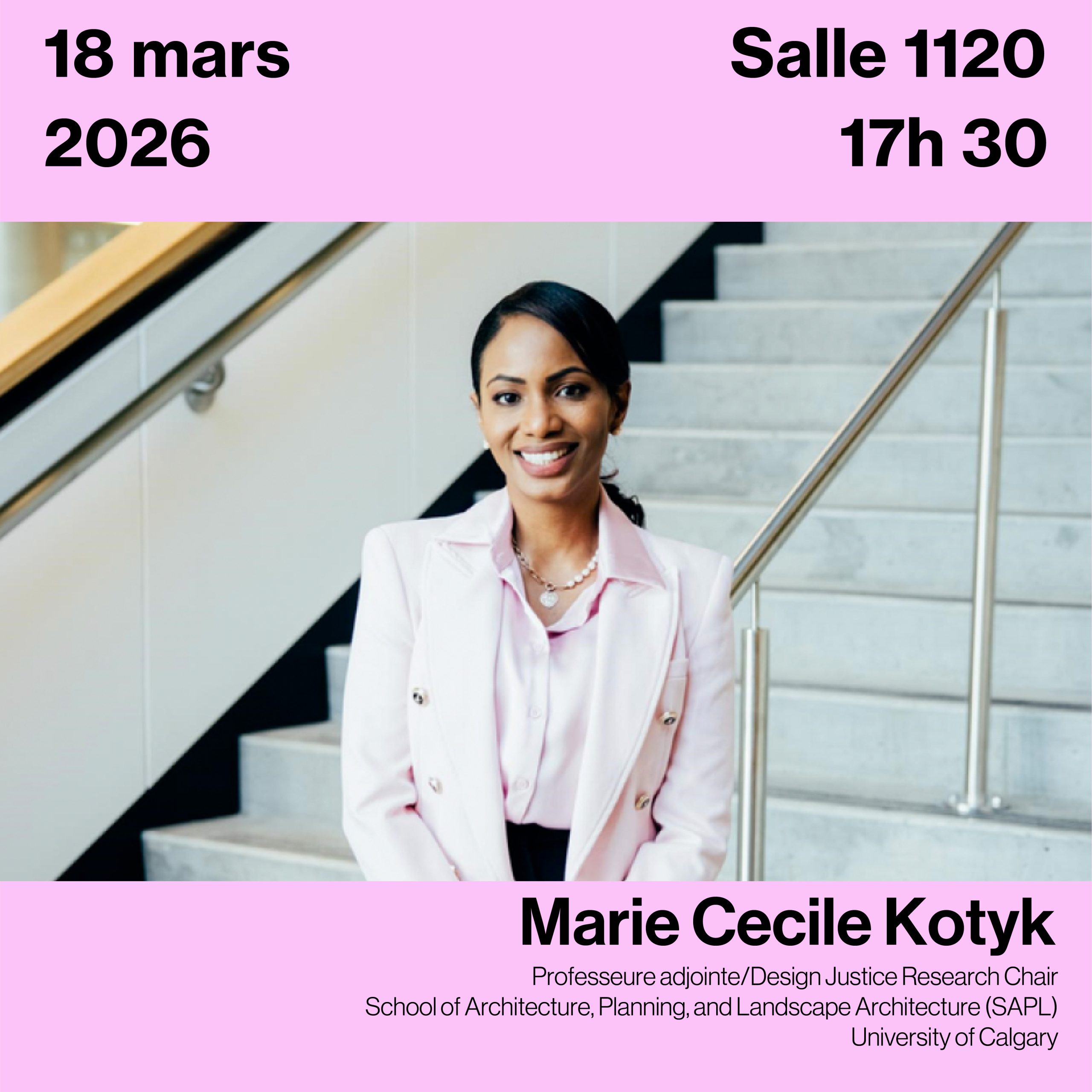
Lecture by Marie Cécile Kotyk, University of Calgary
Date : Wednesday, March 18th at 5.30pm
Location : Université de Montréal, Faculté de l’Aménagement, Amphi 1120
Lecture series of the LEAP and the École d’architecture
From Design Injustice to Design Justice: Why the Built Environment Must Change
Architecture and urban planning have historically produced inequalities, but designing projects from a “spatial justice” perspective makes it possible to envision more equitable, inclusive, and community-oriented built environments.
Design is never neutral. From outright discrimination through urban renewal to hostile architecture and exclusive zoning, the built environment has historically been used to reinforce inequalities in access to housing, safety, mobility, and opportunity. This presentation introduces the concept of “justice through design” as a critical framework for confronting this legacy and transforming the way we plan, design, and govern cities. Historical examples, contemporary case studies, and community initiatives in the areas of housing, public spaces, climate resilience, and education show how design can shift from perpetuating injustice to actively redistributing power. Based on lived experience and participatory practice, the lecture explains why justice in design is not optional, but essential to creating inclusive, equitable, and just communities.
Dr. Marie Cecile Kotyk
Assistant Professor / Design Justice Research Chair
School of Architecture, Planning, and Landscape Architecture (SAPL)
University of Calgary
Marie Cecile Kotyk is an award-winning urban planner, housing professional, and spatial justice researcher with over 15 years of experience promoting equity in the public and nonprofit sectors. As a leading figure in community-based research and spatial justice, her work addresses the systemic forces that produce racial inequalities in the built environment, particularly for Black, Indigenous, and structurally marginalized communities. Her doctoral research led to the creation of the Black Housing Equity Framework, which aims to combat anti-Black racism in housing policy and design. Through her leadership in creating the UDesign Justice initiative at the University of Calgary, Dr. Kotyk is establishing a transdisciplinary center that brings together academics, community members, and practitioners to co-create equity-focused solutions for spatial, social, and systemic transformation.
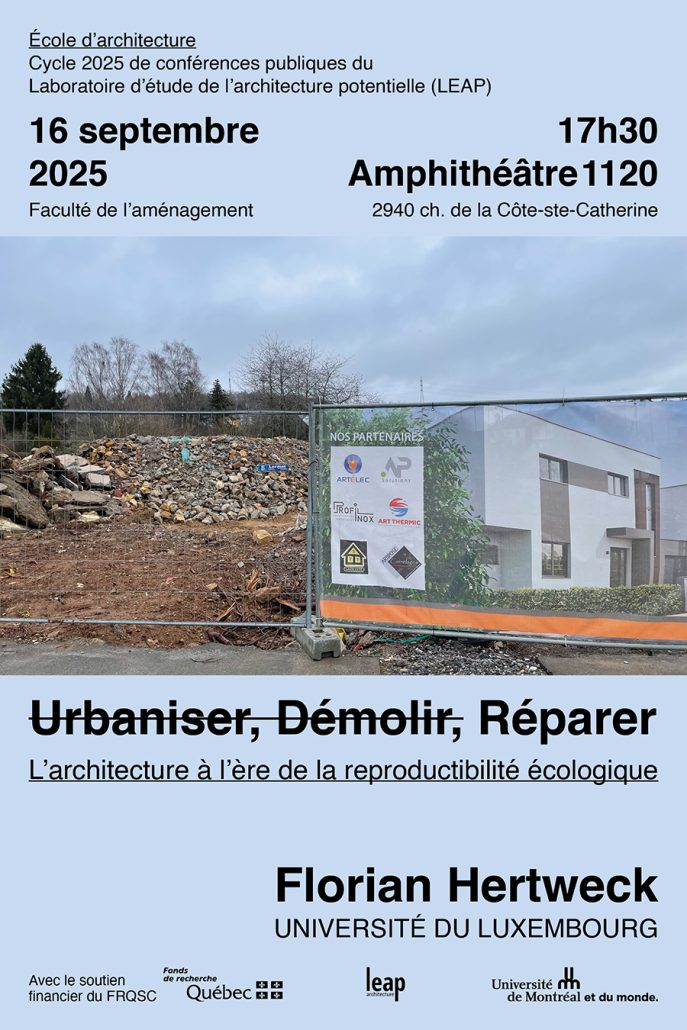
Conference by Florian Hertweck, Université du Luxembourg
Date: Tuesday, September 16th at 5:30 pm.
Location: Amphitheatre 1120, Faculté de l’aménagement, Université de Montréal
Lecture series of the Laboratoire d’étude de l’architecture potentielle
Architecture in the Age of Ecological Reproducibility
Summary:
In the face of climate change and resource scarcity, two practices that have been commonplace in spatial development until now seem obsolete: the expansion of urban areas and the demolition of existing buildings in order to build denser and more modern structures.
Does this spell the end of architecture?
This conference explores how it is still possible to produce architecture under these conditions and on what theoretical basis a socio-ecological architecture can be founded.
Florian Hertweck is a professor of architecture at the University of Luxembourg and co-founder of Less Yellow architecture urbanisme. He has led consortiums of architects, urban planners, and researchers for the Luxembourg in Transition and Greater Geneva Consultation foresight programs. He is a member of the Luxembourg Higher Council for Spatial Planning and the scientific committee of the German Institute for Energy Transition Research (IKEM). Among other projects, he designed the Luxembourg pavilion for the 16th Architecture Biennale and the exhibition The Great Repair at the Akademie der Künste in Berlin and the Pavillon de l’Arsenal in Paris. He is also an organizing member of the European initiative HouseEurope! against demolition and for renovation. Hertweck is the author of numerous publications on the socio-ecological production of space, the most recent of which are The Great Repair. Politics of the Repair Society (Spector Books 2023) and Architecture on Common Ground. Positions and Models on the Question of Land (Lars Müller Publishers 2020).
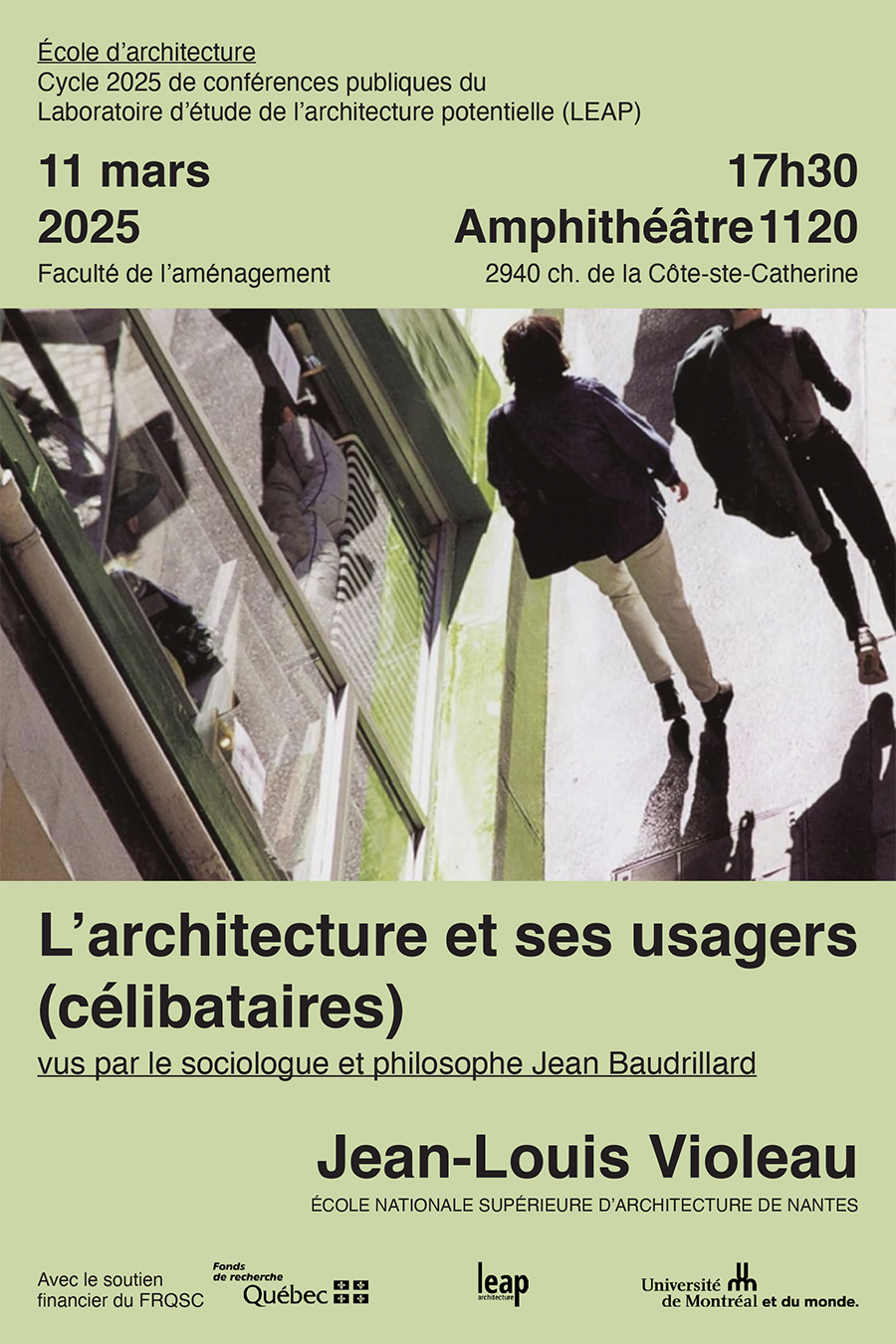
Conference by Jean-Louis Violeau, École Nationale Supérieure d’Architecture de Nantes
Date: Tuesday, March 11th at 5:30 pm.
Location: Amphitheatre 1120, Faculté de l’aménagement, Université de Montréal
Lecture series of the Laboratoire d’étude de l’architecture potentielle
Summary:
How does one go about exploring Jean Baudrillard’s intimate yet suspicious relationship with architecture? One begins, as one should, with Disney, moves on to the duck and the Venturis, stops at the figure of the (architectural) monster, moves on to Jean Nouvel and the ambiguities of transparency, and finally arrives at some contemporary projects, notably the highly condemned Europacity. Along the way, Baudrillard raises two questions: what has become of architectural postmodernism, and the persistence of the notion of the author in architecture. Baudrillard was more of an imaginary sociologist, intuitive and detached, an interpreter who amused himself by drawing the dotted lines of the present, overdoing it and regularly tending to paroxysms. Hence his interest in architectures that resist interpretation and seem to take on a life of their own, as if detached from their designers: the Twin Towers of the World Trade Center, the Biosphère II project, the Beaubourg, the Guggenheim Bilbao, and some of Jean Nouvel’s architecture. Behind the scenes: obscure and ironic, every stage has its backstage, every scene is reversible, every project calls for its counter-project. The cursed part always bides its time. Culture for Beaubourg, globalization for the WTC, the planet for Biosphère II, the commodification of cities for the Guggenheim Bilbao… The ambivalence grows as these projects strive to saturate reality. What all these untamed concretions have in common, however, is that they seek first and foremost to bring the edge of difference to bear on generalized equivalence. In an age of no-fake and a shared quest for authenticity, this sociological perspective is meeting with renewed interest, particularly in the ambivalent choices and behaviors of digital children.
The sociologist Jean-Louis Violeau is a professor at the Ecole Nationale Supérieure d’Architecture de Nantes and at the Urban School of Sciences Po Paris. He is a researcher at CRENAU (CNRS UMR AAU).
He is a regular contributor to architectural magazines, in particular AMC-Le Moniteur architecture and L’Architecture d’aujourd’hui, as well as more general magazines such as Esprit, Place Publique Nantes-Saint-Nazaire and Urbanisme. He is also a member of the editorial board of the latter two magazines.
His dissertation Les architectes et mai 68 was published in 2005 by Recherches, the distant heirs of the journal of the same name founded under the aegis of Félix Guattari and the CERFI. The sequel, his HDR (Habilitation à Diriger des Recherches) on Les architectes et mai 81, was published by Recherches in 2011.
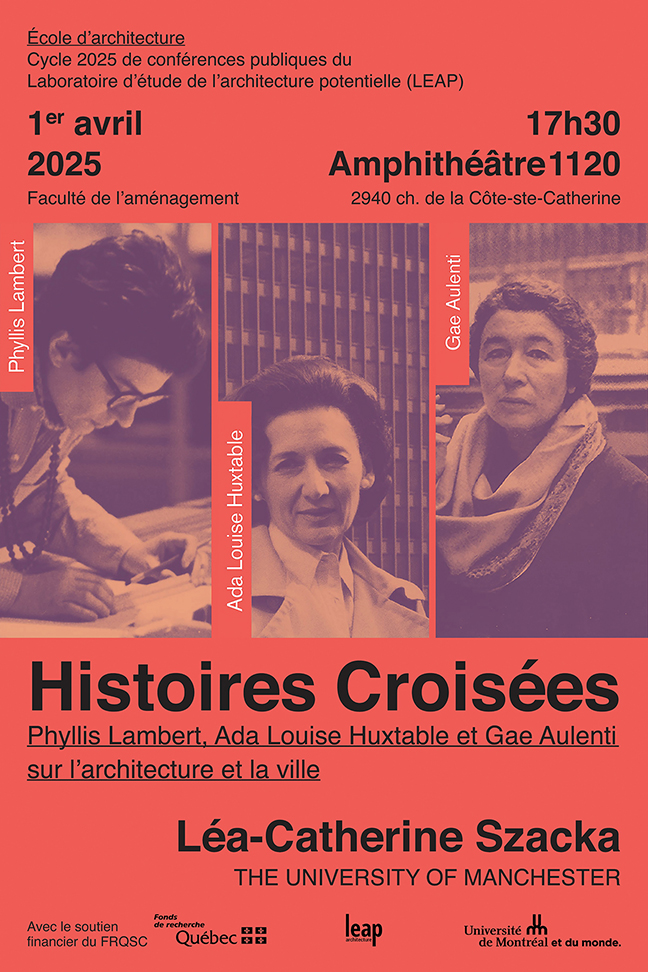
Conference by Léa-Catherine Szacka , University of Manchester
Date: Tuesday, April 1st at 5:30 pm.
Location: Amphitheatre 1120, Faculté de l’aménagement, Université de Montréal
Lecture series of the Laboratoire d’étude de l’architecture potentielle
Summary:
Born in the 1920s, architects Gae Aulenti and Phyllis Lambert and critic Ada Louise Huxtable were among the most influential figures in post-war architecture and design. Pioneers in a largely male-dominated field at the time, and key players in the transition from modernism to postmodernism, they set out to conquer and shape public space. This talk retraces the history and careers of these three women, who are the focus of the exhibition Crossed Histories, presented until May 2025 at the Canadian Cultural Centre in Paris.
Léa-Catherine Szacka:
Senior Lecturer (Associate Professor) in Architectural Studies, University of Manchester
Director of the Manchester Architecture Research Group (MARG)
Vice-President, European Architectural History Network (EAHN)
Co-Founder, PASZA – Platform for Architectural Research
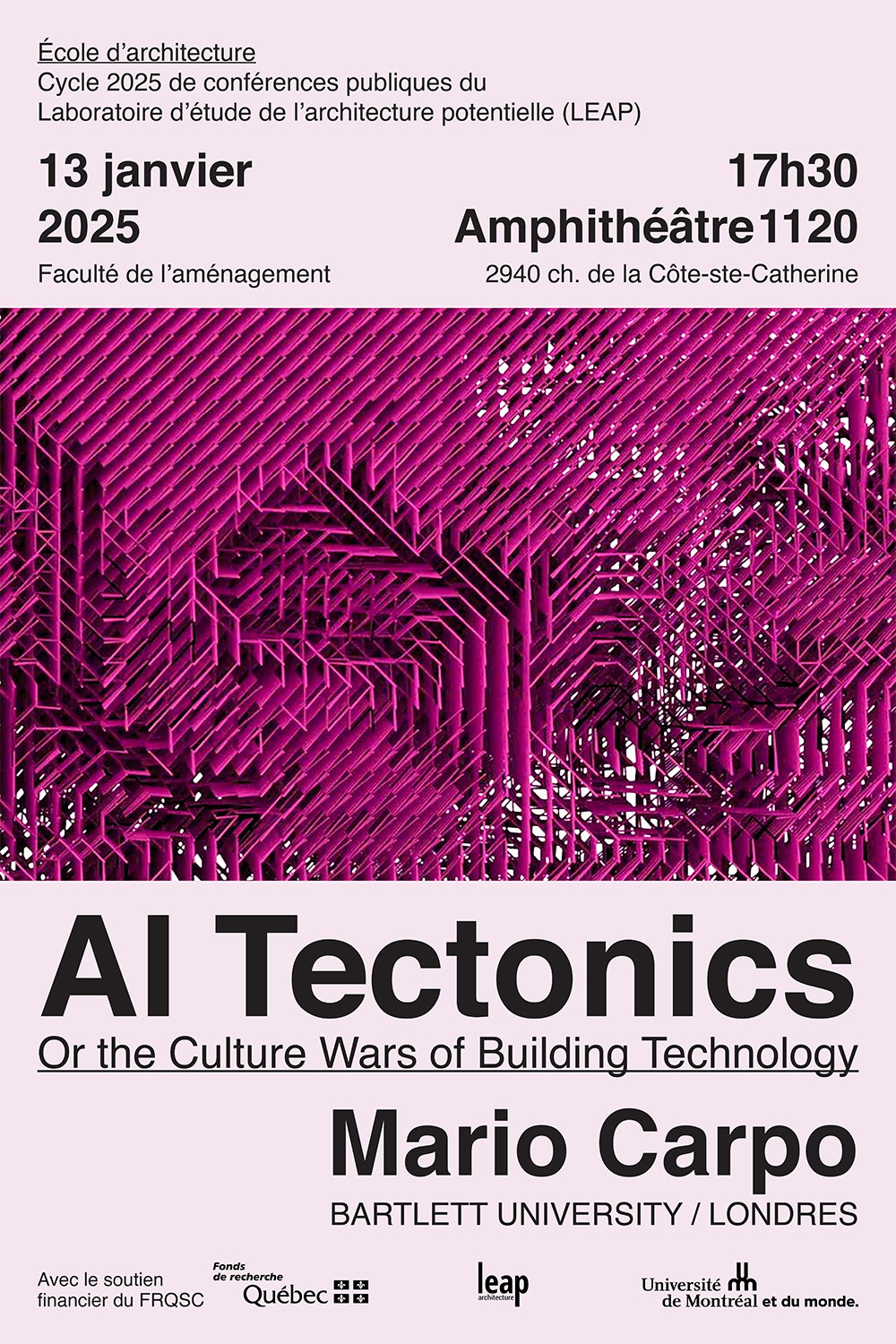
Presented by Professor Mario Carpo, Bartlett University, London
Date: Monday, January 13th, 2025 at 5:30 p.m.
Location: Amphitheatre 1120, Faculté de l’aménagement, Université de Montréal
Public conference organised by the Laboratoire d’étude de l’architecture potentielle
Date: April 3, 2024, 4-6 p.m.
Location: Room 2064, Faculté de l’aménagement, Université de Montréal
Seminar presented by Judith le Maire, professor at the La Cambre Horta faculty of architecture at the Université libre de Bruxelles and director of CLARA – Centre des Laboratoires Associés pour la Recherche en Architecture and the Clara magazine, accompanied by professor Victor Brunfaut.
Description
Visits to architectural archives from the colonial and contemporary periods will help us to understand how they are classified and inventoried. The LEAP and CCA centers visited will enable us to determine and discuss epistemologically the specificities of architectural archiving. The architectural archive is founded on a paradox: the impossibility of archiving buildings on a 1:1 scale necessitates mediation due to their scale, drawings, models, objects with a sibylline status…
The decolonization of archives and the question of their restitution and my research projects imply an ethical and reflexive positioning. This relates to my research object, named by V.Y. Mudimbe “the colonial library,” which brings together all the documents archived by the colonizers in the Congo and brought back to Belgium. Thinking about the archiving of post-colonial or pre-colonial (traditional) architecture, reflecting on its reception, omission or restitution is usefully done by comparison, for example with Canadian institutions at the forefront of these issues. The aim is to submit a PDR in July with colleagues from the ULB Faculty of Architecture, and then to be able to propose a G3 project.
Our faculty is strongly positioned in the research and doctoral training of students from North Africa, Benin and Congo. For this reason, their research training and management requires reflection that goes well beyond Belgian borders, and indicates this research in innovative institutions on these subjects.
I’m looking for traces of traditional Congolese architecture, a vernacular architecture that has been depreciated to the point where it is today unknown, unstudied and unhistoriographed. Where, for example, is Kongo architecture to be found in the archives of Belgian explorers in the Congo? Prince Albert of Belgium, for example, stayed in the Congo and made virtually no mention of the traditional buildings or villages he visited. His archives and the archives of the Belgian state nevertheless contain numerous traces and representations of traditional Congolese architecture from the early 20th century.
Date: May 21, 2024, 9 a.m. to 5 p.m.
Location: École de design de l’UQAM, 1440, rue Sanguinet, Montréal
Aménager la proximité (Designing proximity) is an activity organized as part of the L’Architecture municipale comme interface citoyenne project led by the Bureau d’étude de pratiques indisciplinées (BēPI), at UQAM’s École de design. The project is funded by the Social Sciences and Humanities Research Council of Canada (Développement savoir grant) and supported by the Union des municipalités du Québec. The activity was also supported by the Villes Régions Monde (VRM) network, the Laboratoire d’étude de l’architecture potentielle (LEAP) and the École de design de l’UQAM.
Senior Researcher
Collaborating Researchers
Assistants, Research Assistants from the École de design de l’UQAM
PROGRAM OF MAY 21
9 a.m.
Introduction to the day and presentation of the project
9:30 a.m. – Architectural forms of citizen interaction
Moderator: Anne Cormier, Université de Montréal
11 a.m. – Municipal cores and their urban context
Moderator: Guillaume Éthier, UQAM
1:30 a.m. – The future of local municipal services
Moderator: Hiên Pham, UQAM
3 p.m. – Towards new research questions and challenges
Moderator: Thomas-Bernard Kenniff, UQAM
5 p.m.
The day concludes with a 5 à 7 at Espace Ville Autrement, 201 rue Sainte-Catherine Est.
For further information: https://amenagerlaproximite.info/#journeedetude