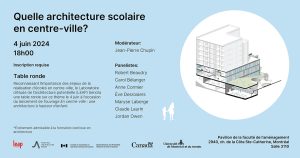
LEAP Round Table @UdeM (2024/06/04): What kind of school architecture in the city center?

Date: Tuesday, June 4th, 2024 at 6:00 p.m.

Location: Room 3110, Faculté de l’aménagement, Université de Montréal

“From business districts almost exclusively reserved for commercial and professional activities, Canadian downtowns are increasingly becoming living spaces. Yet there are few elementary schools, which are essential to inclusive urban development. And for good reason: the traditional model of the single-purpose, low-rise school building, with a large playground at ground level, is at odds with a high-density, high-value environment. The heart of metropolises attracts developers, all the more so as urban planning regulations allow them to erect high-rise buildings, a source of significant revenue. So what kind of school architecture can we imagine for our city centers? And what might it offer schoolchildren?”

– A. Cormier, A. Paré and G. Adamczyk, En centre-ville : une architecture à hauteur d’enfant, Potential Architecture Books, Montreal, 2024

The Laboratoire d’étude de l’architecture potentielle (LEAP) recognizes the importance of the stakes involved in building schools downtown, and held a round table on this theme to mark the launch of the book En centre-ville : une architecture à hauteur d’enfant.

Moderator

Jean-Pierre Chupin, Architect and Professor at the School of Architecture, Université de Montréal, Chair Holder of the Canada Research Chair in Architecture, Competitions and Mediations of Excellence and Director of the LEAP

Panelists

  • Robert Beaudry, Montréal city councillor, Member of the Executive Committee, Responsible for OCPM urban planning and homelessness
  • Carol Bélanger, Chief Architect, City of Edmonton
  • Anne Cormier, Architect, Professor at the School of Architecture, Université de Montréal, Researcher at the LEAP
  • Ève Desrosiers, Architect, Héloïse Thibodeau architecte
  • Maryse Laberge, Architect, nfoe
  • Claude Laurin, Architect, Real Estate Planning and Development Coordinator, Centre de services scolaires de Montréal
  • Jordan Owen, Junior Developer, Mondev

Registration is mandatory: https://forms.gle/7ZwFtNcqvDzw3keB8

The round table is supported by the Social Sciences and Humanities Research Council of Canada (SSHRC), the Vice-rectorat à la recherche, à la découverte, à la création et à l’innovation de l’Université de Montréal (VRRCDI) and the Laboratoire d’étude de l’architecture potentielle (LEAP).

LEAP Seminar @UdeM (2024/01/16): Pierre Chabard, Building, Editing, Thinking. On the Path of a Few Architect-Publishers

Conference by Pierre Chabard, Professor and director of Éditions de la Villette.

Date: Tuesday, January 16th, 2024 at 5:30 pm.

Location: Amphitheatre 1120, Faculté de l’aménagement, Université de Montréal


Building, Editing, Thinking
On the Path of a Few Architect-Publishers


Summary:

While the history of those who write architectural books is now well documented, it often tends to overshadow the history of those who publish them. By investigating the careers of a number of French-speaking architects and publishers, Pierre Chabard will examine the role of this publishing practice in the production of architectural culture, and question the homology between the act of publishing a book and that of designing a building.


Pierre Chabard is an architect, historian and critic. With a doctorate in architecture, he is a lecturer at Ensa Paris-la Villette. A contributor to several art and architecture magazines and author of several books, he was a member of the magazine Le Visiteur (2001-2003), before co-founding Criticat (2007-2018). Since 2019, he has been director of Éditions de la Villette.

LEAP Seminar @Udem (2023/11/06): Claire Petetin, SocialMachine, user-friendly tools for participatory design

Date: November 6th, 2023, 4:30-6:00 pm.

Location: Room 2064, Faculté de l’aménagement, Université de Montréal

Presented by Claire Petetin, professor at ENSA Versailles


SocialMachine, user-friendly tools for participatory design

Social Machine is an experimental, interdisciplinary and multiscalar teaching and research project, motivated by the vocation of training architects and designers in the pedagogy of architectural design for civil society. This training is part of the democratization of architectural culture. It questions the architect’s know-how in a society marked by systemic crises, which puts the architect to the test of degrowth and commitment to a sustainable world. These questions open up new perspectives on how to design differently, giving it a new social and collaborative meaning through creative experimentation with architectural pedagogical culture.

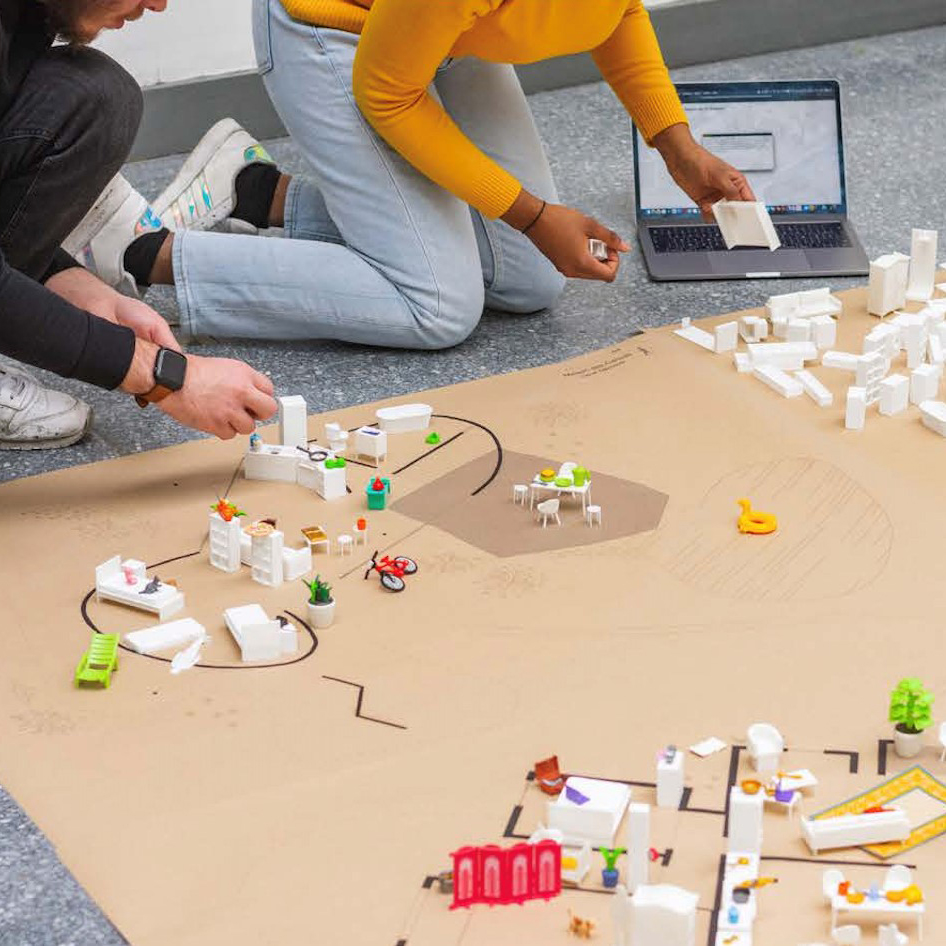
We propose that our students design collaborative design protocols that are similar to malleable representations, permeable to the expression of the imaginations of all stakeholders, or playable design aids that draw on the formats and rules of playful interactivity, to invent new dynamics of co-ideation and socialization between the various stakeholders.  Potential design protocols leave room for intuition, randomness, error, dysfunction, feedback and iteration. They take a variety of forms, halfway between collaborative and speculative drawings embellished with models or figurines in the style of tangible board games, computational self-design software for non-specialists, and video games generating architectural drawings in plan or axonometry.

Social Machine is now involved in research, within the Léav (Research Laboratory of the Ecole Nationale Supérieure d’Architecture de Versailles), with the aim of combining the sciences of architecture with those of education. As part of a partnership with the Petite école d’architecture de Versailles (founded by ensav in 2021), the Maréchalerie Centre d’Art Contemporain, and the French Ministry of Culture, prototypes of playful participatory design tools are being tested in various public venues and schools.

This practice of in situ experimentation provides considerable theoretical material for understanding the relational process of the stakeholders involved in the project process, and the role of the architect in creating empathy and dialogue, building a common culture and fostering creativity and the confrontation of ideas between different players.

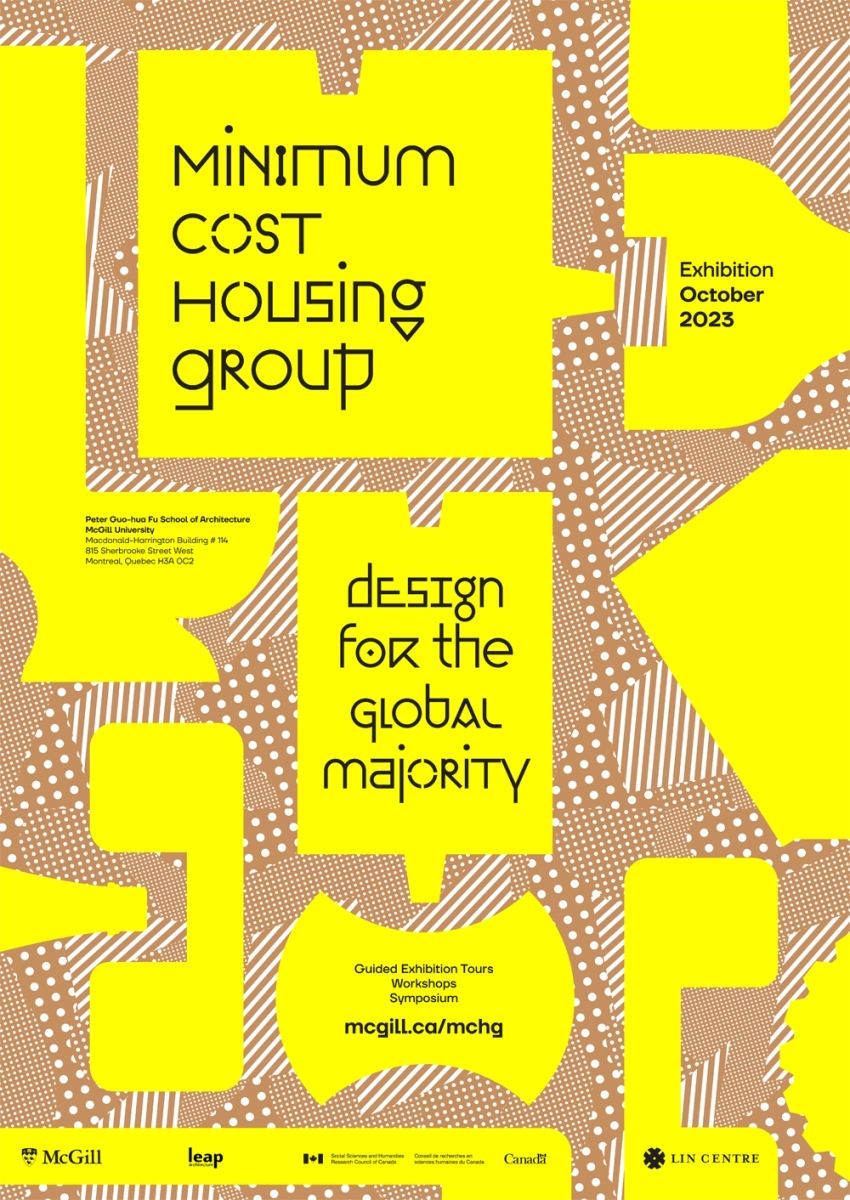
Seminar @McGill (2023/10/19-2023/10/20) : Design for the Global Majority

Event 1

Title: “Thousand Million Clients” Keynote by Vikram Bhatt (McGill) in Conversation with Ipek Türeli (McGill) and Carmela Cucuzzella (UdeM)

Date: Thursday, October 19, 2023

Time:   Vernissage at 5 pm (Room 114) followed by keynote at 6 pm (Room G-10)

Location: Peter Guo-hua Fu School of Architecture, Macdonald-Harrington Building, 815 Sherbrooke St W, Montreal, Quebec H3A OC2

Description: This event is part of the Design for the Global Majority project. Exhibition vernissage will be followed by a keynote talk by Vikram Bhatt, Professor Emeritus, McGill University, and former director of the MCHG, and conversation with Ipek Türeli, Associate Professor and Canada Research Chair in Architectures of Spatial Justice, McGill University, and Carmela Cucuzzella, Dean of the Faculté de l’aménagement, Université de Montréal.


Event 2

Title: “Design for the Global Majority” Symposium

Date: Friday, October 20, 2023

Time: 9 am – 4 pm

Location: Thomson House, 3rd floor, 3650 McTavish St, Montreal, Quebec H3A 1Y2

Description: This event is part of the Design for the Global Majority project. International symposium with presentations by MCHG alumni and scholars.


Event 3

Title: “Green Before Green” Closing keynote by Witold Rybczynski (UPenn)

Date: Friday, October 20, 2023

Time: 6 pm

Location: Faculty of Law, New Chancellor Day Hall (Room 100), 3644 Peel St, Montreal, Quebec H3A 1W9

Description: This event is part of the Design for the Global Majority project. Closing keynote by Witold Rybczynski, Martin and Margy Meyerson Professor Emeritus of Urbanism, University of Pennsylvania, and former director of the MCHG.

LEAP and CRC-ACME Seminar @UdeM (2023/08/29): What is the use of the model in architecture?

Date: August 29th, 2023, 8:30am. to 5:30pm.

Location: Room 1150, Faculté de l’aménagement de l’Université de Montréal.

Organization: Denis Bilodeau and Virginie LaSalle

The LEAP study day, which poses the question What is the use of the model in architecture? is intended as an initial exploration of the theme and its potential from multiple perspectives. Speakers are invited to present their reflections and research in the form of short talks (15 minutes) on specific situations or cases involving the use of models in different contexts – professional, artistic, educational or other. The aim of this study day is to open up a multidisciplinary field of investigation into a common practice whose cognitive, cultural and communicative dimensions have yet to be elucidated. Three round-table discussions, each lasting 1.5 hours, will address the day’s title question through a series of intersecting general themes.

Program of the day:

8:30-9:00 Arrival and installation

9:00-10:30 Table 1: SIMULATE AND LEARN
• Bechara Helal
• Anne Cormier and Paloma Castonguay-Rufino
• Maurilio Lima Lobato
• Izabel Amaral
Respondent during the discussion: Lucie Palombi

11:00-12:30 Table 2: TRANSMITTING AND DIALOGUING
• Georges Adamczyk
• Ipek Tureli
• Virginie LaSalle and Victorian Thibault-Malo
• Morteza Hazbei and Carmela Cucuzzella
Respondent during the discussion: Maurilio Lima Lobato

12:30-2:00 Lunch break

2:00-3:30 Table 3: THINK AND UNDERSTAND
• Denis Bilodeau
• Aurelien Catros
• Jean-Pierre Chupin and Joelle Tétreault
• Louis Martin
Respondent during the discussion: Paloma Castonguay-Rufino

4:00-5:30 Open discussion (participants and audience)

LEAP Seminar @UdeM (2023/01/31): Seminar and discussion on the history of architecture schools in France and Quebec

Date: 31 January 2023, 5.30 pm. Venue: Amphitheatre 1120, Faculty of Planning, Université de Montréal. To mark the 2022 publication of L’architecture en ses écoles, an encyclopaedia, we are delighted to welcome Daniel Le Couédic, architect and historian, professor at the University of Western Brittany, and co-editor of the volume. Hosted by Lucie K. Morisset, a professor at UQAM and holder of the Canada Research Chair in Urban Heritage, this lecture and discussion will also bring together two Quebec-based contributors to the encyclopaedia: François Giraldeau, honorary professor at the UQAM School of Design, and Jean-Pierre Chupin, professor at the UdeM School of Architecture and holder of the Canada Research Chair in Architecture, Competitions and Mediation of Excellence,
· Anne-Marie Châtelet, Amandine Diener, Marie-Jeanne Dumont and Daniel Le Couédic (eds.), L’architecture en ses écoles (an encyclopaedia of architectural education in the 20th century), Châteaulin, Éditions Locus Solus, 2022.
· Jean-Pierre Chupin and François Giraldeau, article ‘Québec, relations and exchanges’, p. 568.

Abstract
With its 704 pages and 341 entries written by 147 authors, this volume is the result of a vast collective effort to compile and explore, in a way never seen before, a body of knowledge that had previously been fragmented. This history of architectural education in France during the 20th century addresses a range of dimensions – pedagogical, professional, regional, political, institutional and material – and covers a spectrum of institutions involved in architectural training, such as engineering schools. In France, the history of architectural education was long reduced to its supposed shortcomings and to the narrative of the battle that the champions of modernity were said to have waged against the École des Beaux-Arts in Paris. The upheaval of 1968 buried even the memory of that bygone era. The revival came from the United States, where the École had once enjoyed great prestige, but initially concerned only the nineteenth century. It was not until the 1980s that the complexity of the issues debated and experimented with in the 20th century began to be shed light upon and, above all, that investigations into architecture, its teaching, the profession and its practice were brought into relation with one another. As part of this movement, there was a rediscovery of the long and heated debate between architects defending the Parisian monopoly and their colleagues in the provinces, which had preceded the establishment of the first regional schools in 1903. The Rennes Regional School of Architecture — which became the Brittany Regional School of Architecture in 1984 — was the second to open its doors; its history therefore provides an insight into every stage of this bumpy journey which, far beyond the realm of architecture, sheds light on the reinvention of higher education in France and on the role it has played ever since in shaping the national landscape. The discussion will also draw on another book by our guest: Daniel Couédic and André Sauvage, The Brittany School of Architecture: A Century of Architect-Making, Châteaulin, Locus Solus, 2022.

Weekly doctoral seminar at LEAP@Next Generation Cities Institute (2022/04/06): IDEAS-BE

This seminar will be held by Albena Yaneva, Professor of Architectural Theory at the University of Manchester and Director of the Manchester Architecture Research Group [MARG]. Date and time: April 6, 2022 from 2:30 to 6:00 pm. Held at: Next Generation Cities Institute, 2155 Rue Guy, 14th floor, Montreal, Quebec. Presenting PhD Students and Candidates:  Morteza Hazbei, PhD student, INDI Program, Concordia University Measuring the unmeasurable: A proposal for parameterizing urban and architectural qualities. Aristofanis Soulikias, PhD student, INDI Program, Concordia University A Touch of Place: Feeling and expressing the city through handmade film animation. Fatemeh Mehrzad, PhD student, INDI Program, Concordia University Social media as a means of exchange to influence, collect and enable social values for urban regeneration. Moh Abdolreza, PhD student, INDI Program, Concordia University Where is Homeless? When is Homeless? Time-space analysis of OECD definitions of Homelessness. Aurélien Catros, PhD candidate in architecture, Université de Montréal Thinking through models: The phenomenon of projection in architectural design processes. Lucie Palombi, Ph.D. candidate in architecture, Université de Montréal L’architecte en concours, un écrivain ou un écrivant ? In discussion with : Dr. Jean-Pierre Chupin, Professor, School of Architecture, Université de Montréal Canada Research Chair in Architecture, Competitions and Mediations of Excellence Dr. Carmela Cucuzzella, Professor, Design and Digital Arts, Concordia University Concordia University Research Chair in Integrated Design and Sustainability for the Built Environment (IDEAS-BE), Co-Director and Founder, Next Generation Cities Institute (NCGI) Event organized by:  Concordia University Research Chair in Integrated Design Ecology and Sustainability for the Built Environment (IDEAS-BE).