Understanding the Awards of Excellence (Issue 191 of Architecture Québec magazine) : Researchers from LEAP and the Canada Research Chair in Architecture, Competitions and Mediations of Excellence present some results of their recent work on awards of excellence in all areas of design

This special issue on Awards of Excellence does not introduce new winners or reveal any results that were not previously known. Its purpose is to call for more attention to a phenomenon – the celebration of excellence – on which there is strangely little critical attention. What is to be understood from the plethora of award-winning projects, achievements and practices year after year? Certainly, the images are part of an intense ballet at each local, regional or national award ceremony. Images of architectural excellence, no doubt about it. However, it is necessary to “freeze frame” the images to begin to question the definitions of quality that they are supposed to summarize, symbolize, perhaps measure. The reader who would like to be convinced of the extent of the phenomenon in a few figures can start this issue at the end, as we draw up an unprecedented statistical portrait of it, revealing in particular the exponential increase in the number of organizers and prizes in a decade.

Georges Adamczyk first of all proposes to shift the “waiting horizon” from the reception of architects or the public to the interest of the academic world. In fact, he takes award-winning projects as models: “projects that are judged excellent by their peers for their exemplary aesthetic and functional qualities are also potential projects for learning about design and production in architecture”. David Theodore places the Quebec awards in a broader Canadian context. While Quebec architects do indeed distinguish themselves in Canada and even abroad, his survey shows that it is certain types of buildings and architectural practices that are distinguished, rather than excellence or the best buildings in general. Paradoxically, he wonders whether the awards really promote good architecture. This is confirmed by Aurélien Catros‘ reflections on heritage distinctions. The recent history of the categories of excellence in conservation first reveals the fluctuations of the underlying policies. And what could be more up-to-date than a policy for school architecture? On this point, Alexandra Paré‘s retrospective look shows that school architecture remains a poor relation of awards. She agrees with the conclusions of Theodore and Adamczyk in inviting us to conceive of prices as a true school of architectural quality. The articles by Sherif Goubran and Carmela Cucuzzella question the growing importance of ecological and environmental criteria in contemporary quality recognition. The statistics compiled by Goubran shed light on the multiplication of definitions of sustainability. Cucuzzella’s analyses show in detail that certain awards literally force the use of ever more “eco-didactic” visibility. She concludes that awards would not only play a recognition function, they would determine a form of excellence. In essence, this inversion is the game proposed by Lucie Palombi who, by temporarily obliterating the images of the prize-winning projects, wonders what a foreign visitor to three prize-winning libraries might understand by considering only the rare comments of the juries. We’ll let you guess.

For as long as the lists of prize-winning projects are not accompanied by the reasons, analyses, judging criteria and therefore the jury reports, there is a risk that the prizes will remain nothing more than nice celebrations and not stages in the full and effective recognition of an “architectural quality policy”.


Editorial: Prices, freeze frame! (Jean-Pierre Chupin, Professor, Université de Montréal)

Taking Home the Prize: Distinguishing Québec in Architectural Awards (David Theodore, Professor, McGill University)

Three award-winning libraries (the reverse visit) (Lucie Palombi, doctoral student, Université de Montréal)

School architecture, the poor relation of prizes (Alexandra Paré, doctoral student, Université de Montréal)

Learning from excellence in residential architecture (Georges Adamczyk, Professor, Université de Montréal)

Quebec in the Canadian sustainable development awards concert (Sherif Goubran, PhD student, Concordia University)

The allegory of heritage through the filter of awards of excellence (Aurélien Catros, doctoral student, Université de Montréal)

What is the purpose of architectural awards?  (Jean-Pierre Chupin, Professor, Université de Montréal)

“Eco-education”: Are “green awards” forcing the visibility of green devices? (Carmela Cucuzzella, Professor, Concordia University)

CANADIAN MAP OF AWARD-WINNING BUILDINGS AND PLACES

More than 2,800 award-winning projects – designed by more than 1,000 architectural, urban planning and landscape architecture firms in Canada – first recorded in an Atlas of Architectural Excellence (AEA)

At the initiative of the Canada Research Chair in Architecture, Competitions and the Mediation of Excellence (CRC-ACME), the Atlas of Excellence in Architecture (AEA) is taking shape with the publication of the first historical directory of award-winning projects and achievements.

A prototype of a decentralized and collective digital platform, the AEA is intended to gather data on the quality of built environments. In conjunction with the establishment of a research network, it is intended to offer the information necessary for the dissemination, understanding, training and constitution of quality mediation policies and actions aimed at excellence at all levels. The data, information, analyses, comparisons and visualizations that will gradually be delivered on the open access platform will be based on all the award-winning achievements in Canada. Thanks to the coordination of the awarding institutions and professional teams, the general public can already take the measure of the repertoire of best practices in all areas of the built environment.

Sherif Goubran appointed as an instructor at the American University in Cairo (AUC-Egypt)

Sherif Goubran, PhD Candidate in the Individualized program working under the supervision of Dr. Carmela Cuccuzzella at Concordia University, will commence his appointment as an instructor at the Department of Architecture at AUC this fall. In his new assignment, he will be teaching and expanding the department’s research activities in the area of sustainable and green building design

Carmela Cucuzzella holds the Concordia University Research Chair (CURC) IDEAS-BE

The Concordia University Research Chair (CURC) of Carmela Cucuzzella in IDEAS-BE is renewed from July 2020 to July 2025.

The Concordia University Research Chair in Integrated Design, Ecology And Sustainability for the Built Environment (ideas-be)  focuses on the study of design projects and practices for the built environment situated at the crossroads of cultural, social, environmental and economic concerns. It considers sustainability as a paradigm crossing the main disciplines and professions concerned with design for the built environment (urban design, architecture, and landscape). This research program identifies, categorizes and disseminates strategic transformations of sustainable intentions in the design of the urban built environment. Our main objective is to better understand how designers go beyond current injunctions of environmental norms and policies in order to achieve a creative balance between design ethics and aesthetics in their public space projects – a question that has remained largely unaddressed in recent design theory.


Louise Pelletier receives a new grant

Louise Pelletier obtains a PAFARC research grant (part 10) on the exhibition of design worth $17,000 for the period 2019-2023 at the Université du Québec à Montréal

Carmela Cucuzzella published a new book

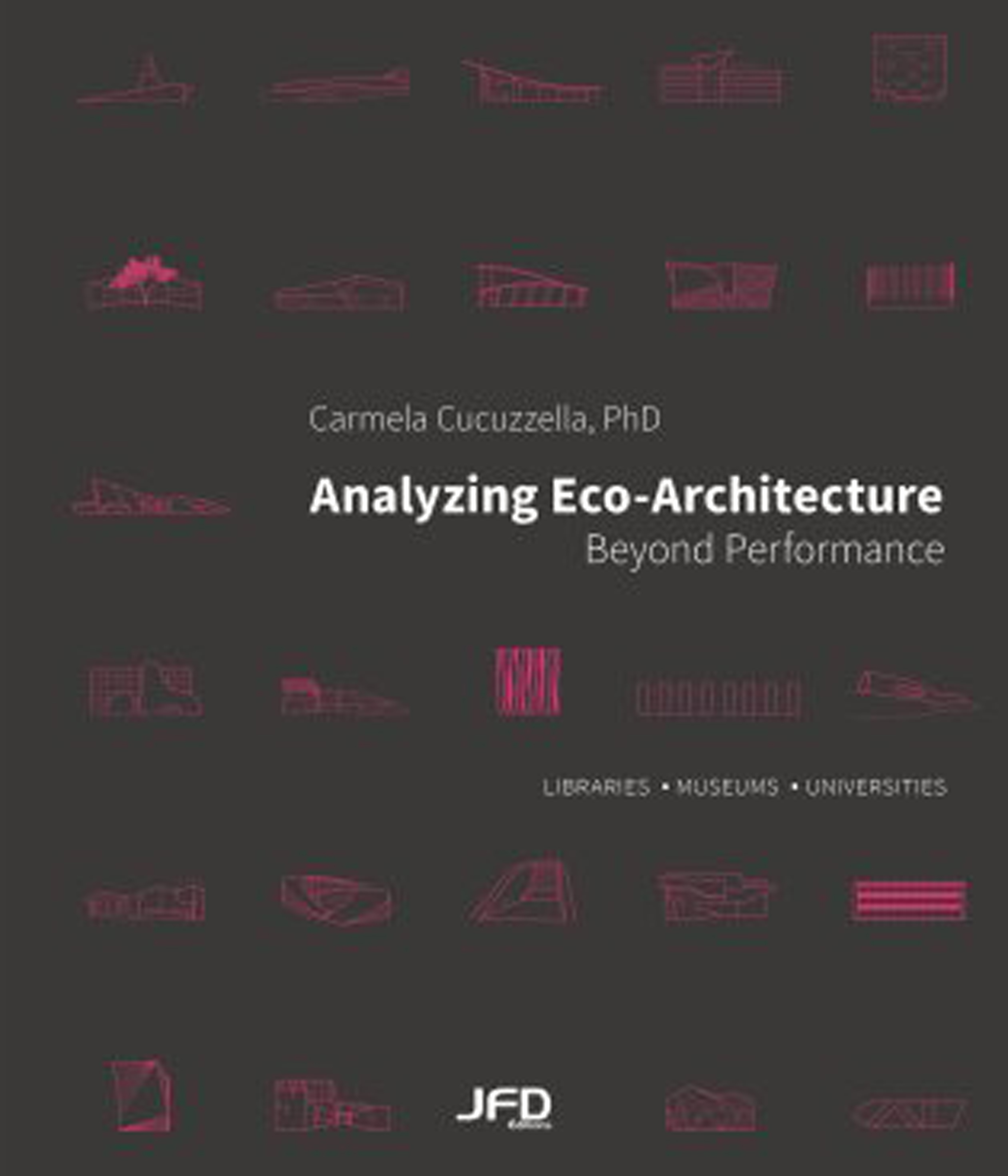
Carmela Cucuzzella published a new book, Analyzing Eco-Architecture Beyond Performance, at JFD Editions.

At a time when environmental architecture is proliferating in all its forms around the world, adopting ever more complex sets of tools, this book provides an overview of the state of the field. It provides a critical introduction to the study of environmentalism in architecture. Written especially for students and researchers who work in the field of environmental architecture, this book reveals the spectrum of approaches practiced today.

The text includes:

  • An abridged history and overview of environmentalism in the field of architecture.
  • A clear methodology for analyzing the included 29 cases, which can also be adopted for further guidance in a variety of architectural design projects.
  • Assessments of 29 buildings: 10 libraries, 10 museums and 9 university buildings from around the world.
  • Analyzing Eco-Architecture: Beyond Performance is essential reading for students, researchers and practitioners involved in the study and design of environmental architecture today.

Lucie Palombi, doctoral student, receives a FRQSC scholarship for her research project

Lucie Palombi, individualized doctoral student under the supervision of Jean-Pierre Chupin, receives a doctoral research scholarship from the Fonds de Recherche Société et Culture du Québec, worth $77,000 over 4 years (from 2020 to 2024) for the research project entitled “La mise en compétition de l’écriture en architecture. Herméneutique du texte gagnant et de l’ouvrage primé”, attached to the Research Chair in Architecture, Competitions and Mediations of Excellence.