

Aurélien Catros and Maxime Leblanc jointly wrote a paper on reconstructive game models. Their research was based on a comparison between the video game Assassin’s Creed III and a 1775 map of Boston, with the goal of determining how closely historical cities are reproduced in video games. The pair are both doctoral students in Architecture. Their research will have highlighted the fact that a feeling of verisimilitude is achieved not through complete accuracy but through specific combinations of sufficiently accurate historic elements. Aurélien Catros is studying at the Université de Montréal, while Maxime Leblanc is studying at McGill University. If you wish to access this publication, it is available free of charge on the CRC-ACME website’s open access publications page.[vc_btn title=”ACCESS THE PUBLICATION” align=”center” button_block=”true” link=”url:https%3A%2F%2Fleap-architecture.org%2Fwp-content%2Fuploads%2F2021%2F07%2F32.2-TDSR_Spr-21_4_Catros-LeBlanc_print.pdf”]
Non classé
Lucie Palombi, PhD student, participates in a conversation with Phyllis Lambert and Joseph Hillel about the documentary “City Dreamers”

Where: Online activity, via Zoom.
On the themes of the classroom, the gathering space and the relationship to the context, 3 videos from the CRC-ACME put into debate teams from the 5 competitions organized by LabÉcole for new elementary schools in Quebec
Produced by the Canada Research Chair in Architecture, Competitions and Mediations of Excellence, this set of 3 videos presents excerpts from 3 roundtables recorded in January and February 2021 with design teams of the projects submitted to the 5 competitions organized by Lab-École.
These winning projects, finalists or submitted in the first phase of the competitions for the sites of Saguenay, Shefford, Maskinongé, Rimouski and Gatineau in 2020 were presented in the exhibition Devoirs d’architecture at the Centre de design de l’UQAM from September 2020 to February 2021. The pandemic did not allow the general public to discover these 160 projects for new elementary school in Quebec. These debates allow us to take the measure of the richness of the proposals.
1 – The round table on the theme of The Classroom and Collaborative Spaces presents different physical and spatial devices imagined by Quebec architects to rethink spaces dedicated to teaching and learning.
– Panelists : Étienne Bernier, Christian Bisson, Jean-Pierre Chupin, Andréanne Dumont, Jérôme Duval, Bechara Helal, Sergio Morales, Alexandra Paré, Hubert Pelletier, Nathaniel Proulx Joannisse
– Special thanks to Bechara Helal
– Organization: Jean-Pierre Chupin and Alexandra Paré
– Video editing : Julien Bouthillier
– The organizers thank the three main partners of the exhibition: Lab-École, Centre de design de l’UQAM, Laboratoire d’étude de l’architecture potentielle
2021 – Canada Research Chair in Architecture, Competitions and Mediations of Excellence (www.crc.umontreal.ca)
2 – The round table on the theme of The Gathering Space presents a few variations and the dilemmas faced by the design teams become evident. Between spaces dedicated to very specific activities and “all-purpose spaces”, architects must harmonize proposals. The versatility of spatial devices has its qualities, but it can quickly demonstrate its limitations.
– Panelists: Randy Cohen, Katarina Cernacek, Jean-Pierre Chupin, Virginie LaSalle, Marie-Hélène Nollet, Alexandra Paré, Charles Laurence Proulx, Geneviève Riopel
– Special thanks to Virginie LaSalle
– Organization: Jean-Pierre Chupin and Alexandra Paré
– Video editing : Julien Bouthillier
– The organizers thank the three main partners of the exhibition: Lab-École, Centre de design de l’UQAM, Laboratoire d’étude de l’architecture potentielle
2021 – Canada Research Chair in Architecture, Competitions and Mediations of Excellence (www.crc.umontreal.ca)
3 – The roundtable on the theme of The School and its Context shows that a standard cannot satisfy the complexity and richness of a given site, and even more so that architectural programs need to be always adapted to their context.
– Panelists: Philippe Ashby, Martin Brière, Jean-Pierre Chupin, Thomas-Bernard Kenniff, Guillaume Marcoux, Catherine Milanese, Lucie Paquet, Jessy Paquet-Methot, Alexandra Paré
– Organization: Jean-Pierre Chupin and Alexandra Paré
– Video editing : Julien Bouthillier
– Special thanks to Thomas-Bernard Kenniff
– The organizers thank the three main partners of the exhibition: Lab-École, Centre de design de l’UQAM, Laboratoire d’étude de l’architecture potentielle
2021 – Canada Research Chair in Architecture, Competitions and Mediations of Excellence (www.crc.umontreal.ca)
TO ACCESS THE 3 VIDEOS: https://vimeo.com/showcase/7619270
An international student competition launched by the Concordia University Chair of Integrated Design, Ecology, and Sustainability for the Built Environment (IDEAS-BE) and the Canada Research Chair in Architecture, Competitions, Mediations of Excellence (CRC-ACME) at Université de Montréal
How can design accelerate the transition from the end of the pandemic to a new experience of public transportation?
This design competition is part of a joint research initiative. The Concordia University Chair of Integrated Design, Ecology, and Sustainability for the Built Environment and the Canada Research Chair in Architecture, Competitions, Mediations of Excellence at Université de Montréal are working together to mobilize the creativity of young designers of the built environment in order to stimulate debate on the renewed experiences of public transportation for increased urban resiliency.
This 2021 edition is done in collaboration CRE-Montreal and ARTM. The Conseil régional de l’environnement de Montréal (CRE-Montreal) promotes sustainable development for the City of Montreal. The Autorité régionale de transport métropolitain (ARTM) is the transportation authority, which plans, funds, and promotes public transit and paratransit services for the Montréal metropolitan area.
This ideas competition seeks to gather:
- narratives of renewed experience of public transportation;
- design idea(s) for encouraging the use of public transportation;
- series of design principles for implementing a renewed experience of public transportation.
February 1, 2021: Competition Launch online + Registration Opens
March 1, 2021: Registration Closes
April 12, 2021: Competition Submission Deadline at 5:00PM EST
May 17, 2021: Event for the Announcement of the Winners.
For more information : www.ideas-be.ca/project/competition-reimagining-public-transport
Aurélien Catros, doctoral student in architecture, wins the Academy of Architecture Prize for the best paper of the SCAN’20 conference
After evaluating the quality of the research, scientific writing and oral presentation during the two-day conference, the members of the Academy’s prize jury selected the winner of the prize for the best paper. This jury was chaired by Paul Quintrand, Former President of the Academy of Architecture. The Academy of Architecture Prize for the best paper of the SCAN’20 conference was awarded to Aurélien Catros, doctoral student in architecture at the Université de Montréal, under the supervision of Jean-Pierre Chupin and Bechara Helal, for his paper entitled: “A categorization of BIM models within scientific models”.
New book « Sustainable Architecture – Between Measurement and Meaning » by Carmela Cucuzzella and Sherif Goubran
Carmela Cucuzzella (Concordia University) and Sherif Goubran (American University in Cairo) co-edit a new book, “Sustainable Architecture – Between Measurement and Meaning”.
Sustainable Architecture – Between Measurement and Meaning takes a step back to reflect on how sustainability in the built environment can be theorized and practiced critically. This book exposes that architecture remains a human and social science that lies at the intersection of measurements and meanings. It reveals that sustainable architecture can still operate in a dialectic space of expression, rather than serving as a manifesto for either the technical or socio-cultural extremes. It purports that the human intuition, senses, and skills still holds the key to unravelling alternative futures of sustainable built spaces. And that most importantly, humans still have a place in sustainable architecture.
It includes chapters from Anne Cormier (Université de Montreal), Nada Tarkhan (Massachusetts Institute of Technology (MIT)), Tom Jefferies (Queen’s University Belfast), Laura Coucill (Manchester School of Architecture), Izabel Amaral (Laurentian University), Ted Cavanagh (Dalhousie University)
Louis Martin publishes a chapter in the book The Figure of Knowledge: Conditioning Architectural Theory, 1960s-1990s
“It is a major challenge to write the history of post-WWII architectural theory without boiling it down to a few defining paradigms. An impressive anthologising effort during the 1990s charted architectural theory mostly via the various theoretical frameworks employed, such as critical theory, critical regionalism, deconstructivism, and pragmatism.
Yet the intellectual contours of what constitutes architectural theory have been constantly in flux. It is therefore paramount to ask what kind of knowledge has become important in the recent history of architectural theory and how the resulting figure of knowledge sets the conditions for the actual arguments made.
Contributors: Matthew Allen (University of Toronto), Karen Burns (University of Melbourne), Ole W. Fischer (University of Utah), Philip Goad (University of Melbourne), Hilde Heynen (KU Leuven), Rajesh Heynickx (KU Leuven), Paul Holmquist (Louisiana State University), Sandra Kaji-O’Grady (University of Queensland), Peter Lang (Royal Institute of Art, Stockholm), André Loeckx (KU Leuven), Sebastiaan Loosen (KU Leuven), Louis Martin (Université du Québec à Montréal), Joan Ockman (University of Pennsylvania), Carmen Popescu (ENSAB, Rennes), Ricardo Ruivo (Architectural Association, London), Andrew Toland (University of Technology Sydney).
Tiphaine Abenia wins the prize of the thesis in co-tutorship 2020

On October 19, 2020, the Consulate General of France in Quebec City, following the recommendations of the evaluation mission of the Ministry of Higher Education, Research and lʼInnovation, designated Tiphaine Abenia as the French winner of the 2020 cotutelle thesis prize. The French and Quebec cotutelle thesis prizes, in the amount of $1,500, will be awarded at the Gala organized by Acfas (Association francophone pour le savoir) to be held virtually on December 9.
Jean-Pierre Chupin named honorary member of the AAPPQ 2020
It was at the launch of the 2020 Reference Manual of the Association des architectes en pratique privée du Québec (AAPPQ) that the name of the honorary member she has chosen was unveiled, a title granted to a person who contributes to promoting architectural quality and enhancing the importance of architects in society. According to Anne Carrier, President of the AAPPQ, “this title is awarded to a committed individual who, through his or her career, contributes to promoting the architectural quality of the built environment and the importance of architects in society in general. This year, the Board of Directors of the AAPPQ wished to emphasize the importance, for the private practice of architecture, of cooperation with the university community. The contribution of research, based on knowledge, is indeed essential to identify, qualify and define best practices. This year’s honorary member has played a pioneering role in researching and documenting the role of competitions as tools for creating and improving quality in architecture. » During this event, the 25 achievements selected by the Reference Manual selection committee were presented. Among them, the Science Complex of the MIL Campus of the Université de Montréal, realized by Menkès Shooner Dagenais Le Tourneux Architectes | Lemay | NFOE, in consortium.
The 5 competitions of the LABécole fully documented exclusively on the CCC
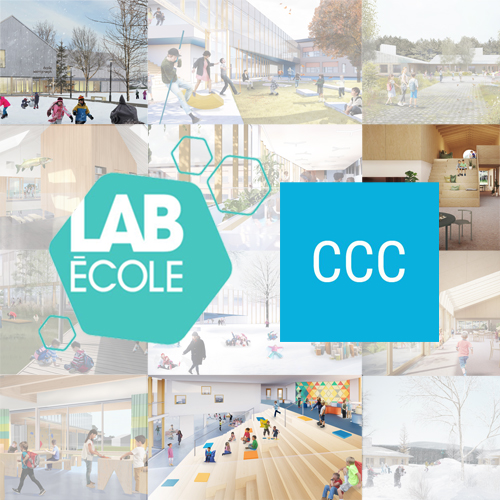
As part of a collaboration with the LABécole organization, the Canadian Competitons Catalogue is the first to deliver all 160 projects submitted in 2019 to the 5 competitions for the construction or expansion of elementary school in Shefford, Rimouski, Gatineau, Maskinongé and Saguenay. The official unveiling of the winners took place on Monday, August 24.
LAB-ÉCOLE | Agrandissement et rénovation de l’école Saint-Joseph à Maskinongé
LAB-ÉCOLE | Rénovation et agrandissement de l’école primaire Pierre Elliott Trudeau à Gatineau
LAB-ÉCOLE | Construction d’une nouvelle école primaire à Shefford
LAB-ÉCOLE | Construction d’une nouvelle école primaire à Rimouski
“In 2020, judging by the number of architecture competitions held in Quebec over the past two decades and the number of award-winning buildings, it is easier to find an excellent library than an elementary school worthy of the name. This series of 5 competitions – open and in two phases – organized by the LAB-École organization therefore confronted two contradictory convictions: the certainty that places of schooling forge and shape what we are since early childhood and this conviction, widespread among public decision-makers, that we could basically study and teach anywhere. Particularly well organized by LAB-École, these competitions show, on the contrary, that architecture is not a luxury, but a necessity. For contexts as different as Saguenay, Maskinongé, Rimouski, Gatineau and Shefford, the proposals prove to be rich in reflections demonstrating that the question of primary school remains complex and cannot be circumscribed in models that can be repeated – in blue, wood or aluminum – whatever the context.”
Thanks to the teams of students from Université de Montréal working on the CCC and to CRC-ACME for this intense digital documentation work.