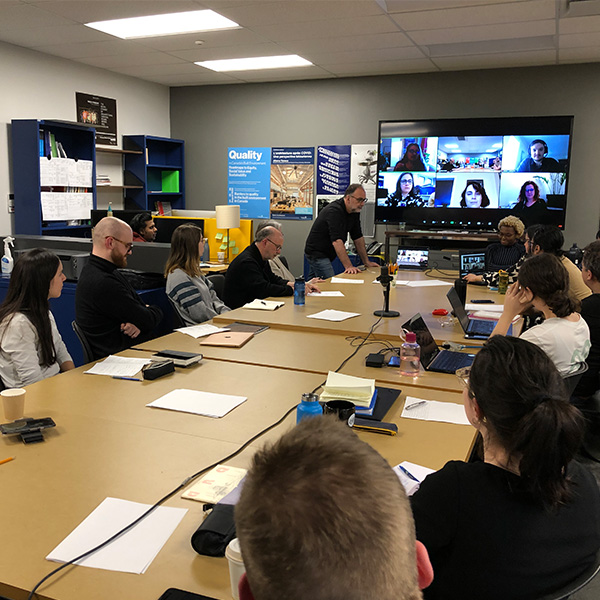
The CRC-ACME coordinates a major research partnership funded by the SSHRC

Funded by the Social Sciences and Humanities Research Council of Canada until 2027, a major research partnership on quality in the built environment brings together – for the first time – 14 universities, 70 researchers and 68 public and private organizations at the municipal, provincial and national levels.

The total value of this partnership will be $8.6M ($2.5M from SSHRC, $6.1M from partners including $4.2M in-kind contributions). Such an investment confirms the commitment of all partners and the importance of the collaborative process.

The partnership will stimulate a vital dialog demonstrating how those active in considering and creating the built environment across Canada can contribute to a redefinition of quality that moves us to heightened equity, more social value and greater sustainability at a critical moment for our societies and for our planet.


Coordinated, from the University of Montreal, by the Canada Research Chair in Architecture, Competitions and Mediations of Excellence (CRC-ACME), the partnership Quality in Canada’s Built Environment: Roadmaps to Equity, Social Value and Sustainability addresses the diversity of public environments impacting the everyday life of millions of Canadians in urban spaces, buildings and landscapes.


The program has three aims:

  1. Analyzing the current limitations of environmental norms and sustainability models to bring us closer to the United NationsSustainable Development Goals (SDGs).
  2. Co-designing new paths to equity, diversity and inclusion in the built environment.
  3. Defining new frameworks for the definition of quality so as to enhance the social value of the built environment through roadmaps to quality.


To achieve these objectives, the partnership brings together methodologically 4 sets of stakeholders concerned with the use, scientific study, planning, design, construction and management of built environments:

  • Citizens (representatives of communities including minorities and underrepresented populations).
  • Cities (national, provincial and municipal actors in the public procurement of built environments).
  • Organizations assessing quality (professional associations, award granting institutions, councils, cities).
  • Universities (interdisciplinary research teams).


For the first time and at an unprecedented scale in the design disciplines in Canada, the project gathers 14 universities including all of the schools of architecture as well as most landscape architecture and environmental design departments. It mobilizes 23 disciplines concerned with the impact of built environments on citizens. Sixty-eight partner organizations including national institutions and not-for-profit will join in a conversation pertaining to 4 thematic clusters to address urgent considerations on quality relative to:

  1. Spatial justice and heightened quality of life.
  2. Integrated resilience, material culture and adaptative reuse.
  3. inclusive design for health, wellness, aging and special needs.
  4. processes and policies supporting the reinvention of built environments.


This extraordinary collaborative effort will stimulate training, internships and connections between hundreds of students and communities of practice. The partnership will engage in cross-sectoral co-creation of knowledge whose outcomes will take the form of “roadmaps to quality” (guidebooks, analyses of exemplary case studies, resources for design thinking and proposals for public policies, etc.). These will constitute a bilingual Living Atlas on Quality in the Built Environment set on a digital platform created with the support of the Canada Foundation for Innovation. Designed as a public forum on the social, economic and environmental value of quality, the Living Atlas will offer open access to repertories of award-winning projects, case studies, comparative analyses, scientific resources and articles, interpretative didactic podcasts, analogical maps and visualizations.

SSHRC Partnership Grant # 895-2022-1003


To see the full list of official co-applicants, collaborators, and partners:

Link to the SSHRC platform: 

https://www.sshrc-crsh.gc.ca/results-resultats/recipients-recipiendaires/2021/pg-sp-eng.aspx


Steering Committee (2022-2023)


Josie C. Auger, PhD, Adjunct professor, Athabasca University
Jean-Pierre Chupin, PhD, Professor, Université de Montréal, SSHRC partnership director
Carmela Cucuzzella, PhD, Professor, Concordia University
Doramy Ehling, CEO, Rick Hansen Foundation
Terrance Galvin, PhD, Professor, Laurentian University
Thierry Montpetit, OAQ OAA, Public Services and Procurement Canada
Lyne Parent, Directrice, Association des architectes en pratique privée du Québec
Brian Robert Sinclair, PhD, Professor, University of Calgary
Federica Goffi, PhD, Professor, Carleton University
Robert M. Wright, MLA, Professor, University of Toronto


Dimitri Weibel, MSc Pol. Sc., SSHRC partnership coordinator

The FRQSC renews LEAP’s team subvention until 2027

The project, entitled Potentials of Architectural Quality: Equity, Sustainability and Cultural Openness, will have Jean-Pierre Chupin (Ph. D.) as team coordinator. The amount of the subvention granted to the LEAP by the FRQSC (support to research teams/university renewal) for this project is $423,420 and will be spread over a 4-year period, thus until 2027!

For 2022-2027, the programming of the Laboratoire d’étude de l’architecture potentielle is based on three research chairs to address a central issue that directly impacts the daily lives of millions of citizens: the quality of built environments.

The program of the Potentials of Architectural Quality: Equity, Sustainability and Cultural Openness project is based on three axes:

  • Axis 1: Equity, spatial justice and improvement of the quality of life (linked to the Canada Research Chair (2) on spatial justice, McGill);
  • Axis 2: Sustainability imperatives and material qualities of built environments (linked to the Research Chair in ecological and integrated design, Concordia);
  • Axis 3: Cultural openness and the process of recognizing architectural quality (linked to the Canada Research Chair (1) in Architecture, Competitions and Mediations of Excellence, Montreal).

The collective reflection on quality intends to paint a global and coherent portrait of our discipline and its renewal, but also, and perhaps more importantly, to demonstrate how actors in the built environment can contribute to a redefinition of quality at a critical moment in our collective history. The team is composed of researchers from four Montreal universities.

  • Université de Montréal: Jean-Pierre Chupin, Georges Adamczyk, Izabel Amaral, Denis Bilodeau, Anne Cormier, Bechara Helal, Virginie LaSalle
  • Concordia University: Carmela Cucuzzella, Cynthia Hammond
  • McGill University: Ipek Türeli
  • UQÀM: Thomas Bernard Kenniff, Louis Martin

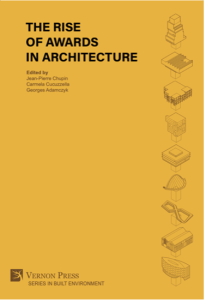
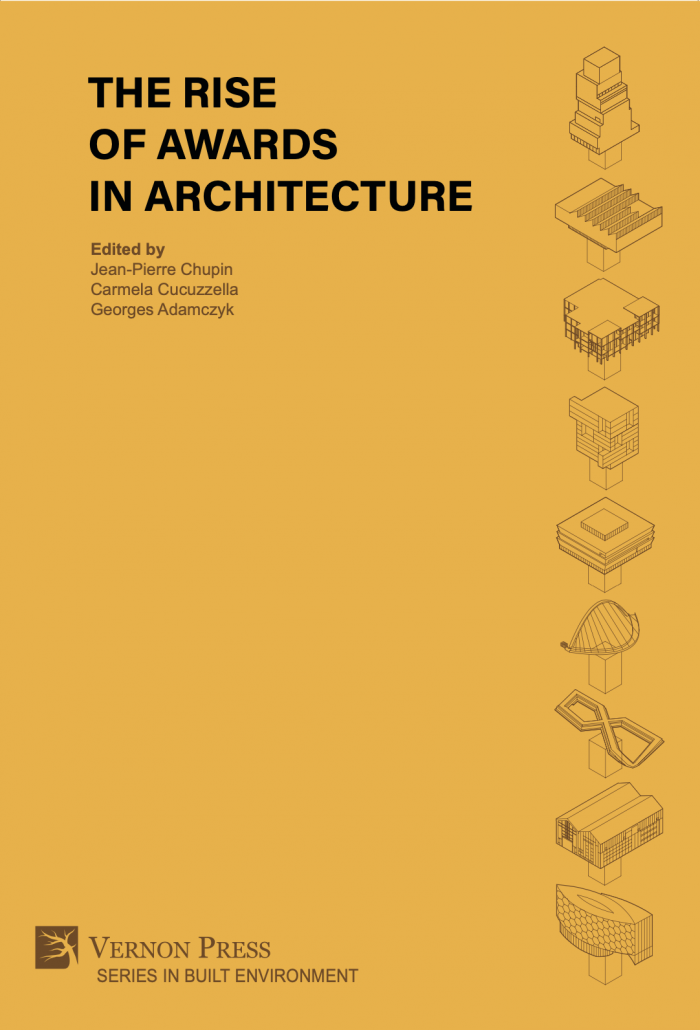
The Rise of Awards in Architecture, a new book edited by Chupin, Cucuzzella and Adamczyk

This book is the first scientific study to focus on awards in architecture and the built environment investigating their exponential growth since the 1980s. The celebration of excellence in architecture and related fields remains a phenomenon on which there is strangely little scientific scrutiny. It is now necessary to take a critical distance to question what awards are meant to embody, symbolize, and perhaps measure. Each of the 10 chapters in this volume is centered on one question related to themes as varied as the comparison of Pritzker and Nobel Prizes, the Prix de Rome, the redefinition of quality through awards, green awards and sustainability, the multiplication of sustainable awards, heritage awards, architecture book awards, the awarding of school architecture, awards as mediations and awards as pedagogical devices. [vc_btn title=”ACCESS THIS BOOK’S INFORMATIONS” align=”center” button_block=”true” link=”url:https%3A%2F%2Fvernonpress.com%2Fbook%2F1507|target:_blank”]

Praise

This book offers an in-depth analysis of the widespread practice of acknowledging the quality of architecture works with prizes, awards, and project competitions given to individuals, collective works, and constructions. This timely study considers a contemporary culture of recognition that is largely taken for granted and not yet grasped as a global and rising phenomenon that has seen exponential growth since the 1980s. The contributors thus address the controversies, ambiguities, and shortcomings surrounding this context, including issues of gender biases, cultural diversity, transparency, and how media, politics, and financial prizes impact architectural awards. The authors provide scholarly insights that cannot be found elsewhere, proving a timely contribution to knowledge that will further our understanding of the context in which contemporary architecture practices operate.

Federica Goffi, Ph.D.,
School of Architecture (Carleton University)

This book raises, in quite a healthy and rational fashion, the vexed question of the judgment of quality in the arts, lifting the lid on the very human and sometimes unseemly tendency to favor winners and follow the money, while yet allowing some hope for continuing development of mechanisms that permit valid judgments, promote genuine quality, and encourage current and future practitioners. This is an unusually balanced point of view. This is a useful guide to understanding how things have worked and to acting intelligently to make things fairer.

David Vanderburgh, Ph.D.,
Laboratory of Architecture and the Built Environment (Université catholique de Louvain)

Authors and Editors

Jean-Pierre Chupin, Carmela Cucuzzella, Georges Adamczyk (Eds.)

by Dana Buntrock (University of California, Berkeley), Marco Polo (Ryerson University), Jean-Pierre Chupin (Université de Montréal), Carmela Cucuzzella (Concordia University), Sherif Goubran (The American University in Cairo, Egypt), Aurélien Catros (Université de Montréal), Adélie de Marre (Université de Montréal), Lucie Palombi (Université de Montréal), Alexandra Paré (Université de Montréal), Typhaine Moogin (Université Libre de Bruxelles), Georges Adamczyk (Université de Montréal)

Block 2 design competition

Hello,
The Canada Research Chair in Architecture, Competitions and Mediations of Excellence having had the honor of being associated with the preparation and implementation of this historic competition, I am pleased to extend to you this invitation to the public presentations of the 6 internationally renowned teams that will take place online on April 11, 2022.
Jean-Pierre Chupin
http://crc.umontreal.ca[vc_separator color=”black”]In May 2021, Public Services and Procurement Canada (PSPC) launched an architectural design competition to redevelop Block 2, a full city block directly opposite Canada’s parliament buildings, just south of Parliament Hill.

The renewal of Block 2 is a critical piece of PSPC’s Long Term Vision and Plan for the Parliamentary Precinct. The design competition ensures that the final design for this city block brings forward new vitality to a significant part of Confederation Boulevard. The goal is to transform this mix of buildings into an innovative complex that will meet the needs of Parliament and the public now and into the future.

On April 11, the six design team finalists will present their design concepts for Block 2 through a virtual public presentation. We would be grateful if you would share the invitation below about the public presentation with your networks.[vc_single_image image=”24481″ img_size=”large” alignment=”center”]Few sites carry the significance of Block 2, a full city block directly opposite Canada’s parliament buildings, just south of Parliament Hill. To the north, it faces the Centre Block and its Peace Tower.
The renewal of Block 2 is a critical piece of PSPC’s Long Term Vision and Plan (LTVP) for the Parliamentary Precinct. The design competition, launched in spring 2021, ensures that the final design for this city block brings forward new vitality to a significant part of Confederation Boulevard. The goal is to transform this mix of buildings into an innovative complex that will meet the needs of Parliament and the public now and into the future.
Join us to hear the competitors speak to their vision for this prominent space in Canada’s capital. The six finalist design teams will present their design concepts for Block 2.

PRESENTERS:

  • Zeidler Architecture Inc., in association with David Chipperfield Architects
  • Diamond Schmitt Architects, in a joint venture with Bjarke Ingels Group, KWC Architects and ERA Architects
  • Provencher Roy + Associés Architectes Inc.
  • Watson MacEwen Teramura Architects, in a joint venture with Behnisch Architekten
  • WilkinsonEyre, in association with IDEA Inc.
  • NEUF architect(e)s, in a joint venture with the Renzo Piano Building Workshop

JOIN US
April 11, 2022
10:00 a.m. to 1:00 p.m. (EDT)

This event will be held virtually via Facebook Live  (with audio interpretation). A Facebook account is not required to view the event.

Do you know someone who would like to view this presentation? Please share this invitation.

ABOUT THE COMPETITION:

Following an extensive prequalification process, twelve architectural teams were invited to submit design proposals for Block 2 that would complement the image of Canada and its capital on the international stage. Of these, six finalists were invited to develop their designs which will be presented at this public presentation. The winning team and design will be recommended to the department by an independent jury. This design competition was endorsed by the Royal Architectural Institute of Canada (RAIC) and has designated professional advisors to oversee the overall competition process.

“It’s not about humans being above the place, or building their buildings to look down upon the place. It’s about the people and place being one and the same.”— John Ralston Saul, RAIC Honorary Advisor, Block 2 Design Competition[vc_single_image image=”24486″ img_size=”large” alignment=”center”]

IDEAS-BE: Weekly graduate seminar led by Dr. Albena Yaneva

This seminar will be held by Albena Yaneva, Professor of Architectural Theory at the University of Manchester and Director of the Manchester Architecture Research Group [MARG].

Date and time: April 6, 2022 from 2:30 to 6:00 pm.
Held at: Next Generation Cities Institute, 2155 Rue Guy, 14th floor, Montreal, Quebec.

Presenting PhD Students and Candidates: 

Morteza Hazbei, PhD student, INDI Program, Concordia University
Measuring the unmeasurable: A proposal for parameterizing urban and architectural qualities.
Aristofanis Soulikias, PhD student, INDI Program, Concordia University
A Touch of Place: Feeling and expressing the city through handmade film animation.
Fatemeh Mehrzad, PhD student, INDI Program, Concordia University
Social media as a means of exchange to influence, collect and enable social values for urban regeneration.
Moh Abdolreza, PhD student, INDI Program, Concordia University
Where is Homeless? When is Homeless? Time-space analysis of OECD definitions of Homelessness.
Aurélien Catros, PhD candidate in architecture, Université de Montréal
Thinking through models: The phenomenon of projection in architectural design processes.
Lucie Palombi, Ph.D. candidate in architecture, Université de Montréal
L’architecte en concours, un écrivain ou un écrivant ?

In discussion with :

Dr. Jean-Pierre Chupin, Professor, School of Architecture, Université de Montréal
Canada Research Chair in Architecture, Competitions and Mediations of Excellence
Dr. Carmela Cucuzzella, Professor, Design and Digital Arts, Concordia University
Concordia University Research Chair in Integrated Design and Sustainability for the Built Environment (IDEAS-BE), Co-Director and Founder, Next Generation Cities Institute (NCGI)

Event organized by: 

Concordia University Research Chair in Integrated Design Ecology and Sustainability for the Built Environment (IDEAS-BE).

Post-Covid Architecture: A Latourian Perspective

Public conference organized by the Canada Research Chair in Competitive Architecture and Mediations of Excellence (CRC-ACME) and the inter-university team of the Laboratoire d’étude de l’architecture potentielle (LEAP)
Tuesday, April 5, 2022 at 5:45 PM in Amphitheatre 3110 of the Faculté de l’aménagement, Université de Montréal
Albena Yaneva, Professor of Architectural Theory, University of Manchester
Director of the Manchester Architecture Research Group [MARG], Manchester Urban Institute

Recent books :
The New Architecture of Science: Learning from Graphene. Singapore: World Scientific
Crafting History: Archiving and the Quest for Architectural Legacy, Ithaca and London: Cornell University Press.

Forthcoming:
Latour for Architects (Thinkers for Architects), London: Routledge.
Architecture after Covid, London: Bloomsbury Publishing.

Presentation by : Jean-Pierre Chupin, CRC-ACME Full Professor, Coordinator of the Laboratory for the Study of Potential Architecture.
Information: jean-pierre.chupin@umontreal.ca

CRC-ACME: www.crc.umontreal.ca
LEAP: www.leap-architecture.org

Between experimentation and standardization: Architects and engineers in search of solutions

On Friday, December 3, 2021, Bechara Helal, Professor of Architecture at the Université de Montréal, organized a study day at the UQÀM Design Center. The event was sold out in ‘face-to-face’ format, but it was also possible to attend it via Zoom (a registration was required).
The event’s details are available on this link.
This study day was presented in the context of the exhibition Pier Luigi Nervi master designer-builder which continues until February 6, 2022.

THE PROGRAM OF THE DAY :

9:00 a.m.: Welcome

9:30 a.m.: “Building correctly”: Pier Luigi Nervi and the intersecting dynamics of design and research in construction

  • Bechara Helal, Professor, School of Architecture, Université de Montréal

10:30 a.m.: Structures and models: real and virtual explorations and investigations of unconventional building systems

  • Thibaut Lefort, structural engineer and partner, Latéral Inc.

11:30 a.m.: How to move in the field of constructible today in architecture? or The hybridization of knowledge and professions

  • Jean-Marc Weill, architect and engineer, director of the engineering and architecture firm Construction & Environnement, professor at ENSA Paris-Est, Université Gustave Eiffel

12:30 pm: Lunch break

2:00 p.m.: Roundtable on the cross-practices of research and design in architecture and engineering moderated by Bechara Helal, professor, School of Architecture, University of Montreal

  • Valérie Chartrand, structural engineer, NCK – Nicolet Chartrand Knoll Inc.
  • Martin Houle, architect, partner and project manager, ELEMA experts-conseils
  • Thibaut Lefort, structural engineer and partner, Latéral Inc.
  • Jean-Marc Weill, architect and engineer, director of the engineering and architecture firm Construction & Environnement, professor at ENSA Paris-Est, Université Gustave Eiffel

All Governor General’s Medals in Architecture in Canada gathered on a map and a visual gallery

Wednesday, October 27, 2021.

The Atlas of Research on Exemplarity in Architecture and the Built Environment, in collaboration with the Canada Council for the Arts and the Royal Architectural Institute of Canada, presents all buildings and places recipient of a Governor General Medal in Architecture since 1982 on a single interactive map and in a visual gallery of over 250 items.

A new classification system by typological categories allows for more precise queries in the database. A table of “unlocated items” collects cases that cannot appear on the map because they are private residences.

The realization of this map and the entry of data in the AREA system is funded by the Canada Research Chair in Architecture, Competitions and Mediations of Excellence directed by Jean-Pierre Chupin (https://crc.umontreal.ca/en/ ), as well as by the Social Sciences and Humanities Research Council of Canada (SSHRC). This corpus was collected by the team of M.Arch. students coordinated by Lucas Ouellet at the Université de Montréal: Charles Cauchon and Anna Zakharova.For direct access to the map of all Governor General Medals in architecture since 1982:[vc_btn title=”GOVERNOR GENERAL’S MEDALS MAP” align=”center” button_block=”true” link=”url:https%3A%2F%2Farchitecture-excellence.org%2Fgovernor-general-map%2F|target:_blank”]For direct access to the visual gallery:[vc_btn title=”VISUAL GALLERY” align=”center” button_block=”true” link=”url:https%3A%2F%2Farchitecture-excellence.org%2Fgovernor-general%2F|target:_blank”]

Announcement of the 5 winning teams of the international student competition launched by IDEAS-BE and CRC-ACME

81 teams of students from 16 countries and 4 continents participated in this ideas competition which asked for new ways to encourage and renew the experience of public transport in the wake of a global sanitary crisis. How can we open up avenues for redefining an enhanced relationship to urbanity through the sharing of public spaces?  The jury chose to reward 5 projects and gave 2 honorary mentions for exemplary ways of reimagining the experience of public transportation in a post-pandemic metropolis.

This competition was part of a joint research initiative.  Concordia University’s Chair in Integrated Design, Ecology and Sustainability for the Built Environment and the Canada Research Chair in Architecture, Competitions and Mediations of Excellence of the Université de Montréal worked together to mobilize the creativity of young designers of the built environment to stimulate the debate on new experiences of public transportation to enhance urban resilience.

The 2021 edition was organized in collaboration with the CRE-Montreal and the ARTM. The Conseil régional de l’environnement de Montréal (CRE-Montréal) promotes sustainable development for the city of Montréal. The Autorité régionale de transport métropolitain (ARTM) plans, finances, organizes, and promotes public transit and paratransit services for the Montréal metropolitan region.

The proposals were judged anonymously by a jury composed of the following:

  1. Emmanuel Rondia, Conseil régional de l’environnement de Montréal
  2. Peter Fianu, Ville de Montréal
  3. Marie-Pier Veillette, Autorité régionale de transport métropolitain
  4. Izabel Amaral, Université Laurentienne et Université de Montréal
  5. Sarah V. Doyon, Trajectoire Québec
  6. Virginie Lasalle, Université de Montréal
  7. Anne Cormier, Atelier Big City
  8. Thomas Bernard Kenniff, Université du Québec à Montréal
  9. Bechara Helal, Université de Montréal

Mr. Peter Fianu was unanimously named president of the jury, while Dr. Carmela Cucuzzella and Dr. Jean-Pierre Chupin, co-organisers of the competition, were named the competition advisors.

After two deliberation sessions, the jury decided to award 5 prizes ex aequo to the following 5 projects whose teams will each receive, without distinction of ranking, the sum of $1500 granted by the two organizing research chairs IDEAS-be and CRC-ACME. Some statistics before presenting the winners and honourable mentions:

  • Number of participating countries: 16 (4 continents: Africa, America, Asia, Europe)
  • Number of cities: 22
  • Total number of students: 238
  • Total number of teams: 81
  • Total number of universities: 30

The program clearly specified that the competition was not about inventing new structures ex nihilo. In addition, the jury noted that many projects relied on conventional solutions, sometimes very contextual, without being formulated as a series of principles that could be adopted in different situations. This partly explains why the jury and the organizers insisted in the final choice on the expected balance between: 1 – evocative narrative, 2 – project elements, and 3 – formulation of principles. year round, even during the hot summer days and the long periods of extreme cold winters.

Only Moh Abdolreza, PhD student at Concordia University, had access to the list of team details, since this was an anonymously judged competition.

Below are extracts from the jury report:

Winners:

Sentiment Station proposed by Melisa Akma Sari (Indonesia).
Can public transportation and memorial practices be combined? The Sentiment Station project reinterprets transportation spaces as true public spaces. They offer an opportunity to enter other temporal dimensions especially while waiting for the bus, a time most often perceived as unproductive. Critical or poetic, this project is based on evocative principles that mobilize a commemorative aesthetic.

Détour proposed by Joëlle Tétreault, Catherine Juneau et Laetitia Bégin-Houde (Canada).
The jury was seduced by the clarity and strength of this anti-project. The proposal, entitled Détour, converts the rigidities of public transport, usually from station to predetermined station, into an unusual, indeterminate, unpredictable experience: getting on the bus without knowing where it will take you.

Commotion: Community in Motion proposed by Aulia Rahman Muhammad, Andika Raihan Muhammad et Firzal Muhammad Setia Nugraha (Indonesia).
In the Community in Motion project, the question of public space as a place of socialization and animation is confronted with that of efficient transport. By proposing thematic spaces, it meets multiple needs and offsets the impression of homogeneity often felt in public transport.

Integrated Metro Library proposed by Davi Sloman et Amir Hotter Yishay (Canada).
Ironically, but perfectly realistically, the Integrated Metro Library puts books into “circulation”. The conjunction of two programs, transportation and reading, seems simple on the surface. But this a mini public library and therefore a real public place: what some libraries sometimes struggle to embody.

Overtime proposed by Juliana Alexandrino Baraldi, Carolina Cipriano de Oliveira, Natália Chueiri (Brazil).
The project entitled Overtime constructs an inversion of the reality experienced in the underground of the metro. It responds to the need, often expressed by users, to maintain contact with the sky and with the outside world in the very interior underground spaces of the metro. The optical illusion would allow us to leave our phones behind for a few moments to look up instead.

Honorary Mentions:

e-Pus proposed by Man Zou / Jia Zishi (Canada)
The Opus all-inclusive card, reloadable directly from your phone, is an attractive idea for public transport users. This simple but effective supercharged Opus card unites the community of public transport users through the various services offered on the application.

Cubic proposed by Ana Beatriz Hierro Azevedo / Isabela Lopez Lourenção / Júlia Snege de Carvalho / Nicole Perruzzetto Bringel / Rebeca Martins Elias / Victor Oliveira de Souza Rogato (Brazil)
This proposal directly addresses the issues of an ongoing pandemic while seeking to not disrupt the necessary traffic flow at a bus stop. The modularity allows for different configurations of spaces and experiences.

Carmela Cucuzzella (IDEAS-BE Research Chair) Université Concordia
Carmela.cucuzzella@concordia.ca
Jean-Pierre Chupin (CRC-ACME Research Chair) Université de Montréal
Jean-pierre.chupin@umontreal.ca[vc_btn title=”ACCESS THE CANADIAN COMPETITIONS CATALOGUE WEBSITE (CCC)” align=”center” button_block=”true” link=”url:https%3A%2F%2Fwww.ccc.umontreal.ca%2Findex.php%3Flang%3Den|target:_blank”]

How to make the waiting for the bus more attractive and generate more community interest? New open access book

The international student competition inviting creative ways to renew the appeal of public transport during a global health crisis is now the subject of a book. It is available for free access today.

Reimagining Waiting for the Bus is an open access book edited by Carmela Cucuzzella, Jean-Pierre Chupin, Emmanuel Rondia and Sherif Goubran and published by Potential Architecture Books (Montreal, 2021).

This creative guide, the result of an international competition, is a synthesis of the best ideas in the form of a free resource aimed at stimulating citizen discussion and community group engagement around the improvement of small urban environments connected to bus stops.

This richly illustrated, educational guide presents ideas that encourage appreciation of urban spaces by emphasizing the importance of nature, art and design. Reimagining Waiting for the Bus invites citizens to think about creative approaches, neighborhood by neighborhood, bus stop by bus stop, that would energize these public spaces in an interactive, poetic, critical and meaningful way: shifting the immediate environment of bus stops from a merely functional spatiality to a multi-purpose spatiality.

This is not about redesigning the bus shelter, but about making waiting for the bus more pleasant, in various ways, encouraging citizens to use the bus instead of their car, all year round, including during hot summer days and long periods of freezing winter.

The ideas extracted from projects from many countries are not presented as solutions but as illustrated principles gathered in 5 vectors going from culture to social dimensions, from ecological concerns to technological innovations and, in general, to everything that can increase the feeling of well-being.

The result of a research and creation process, this guide aims to encourage citizens to take hold of these often neglected spaces in which waiting should be given all the attention necessary to enhance public transport.

Reference:

Cucuzzella, C., Chupin J.-P., Rondia, E., Goubran, S., (2021), Reimagining Waiting for the Bus, Montréal, Potential Architecture Books, 139 pages.
ISBN 9781988962054[vc_btn title=”DOWNLOAD THIS BOOK IN OPEN ACCESS” align=”center” button_block=”true” link=”url:https%3A%2F%2Fleap-architecture.org%2Fwp-content%2Fuploads%2F2021%2F09%2Fguide_enplusdattendrelebus.pdf|target:_blank”]