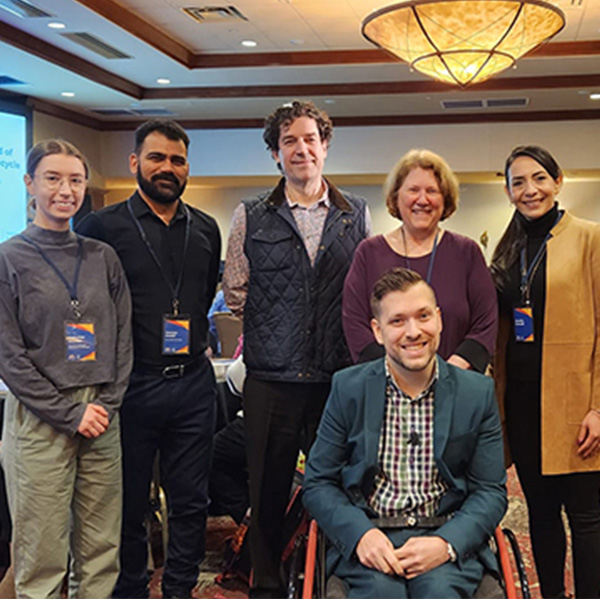
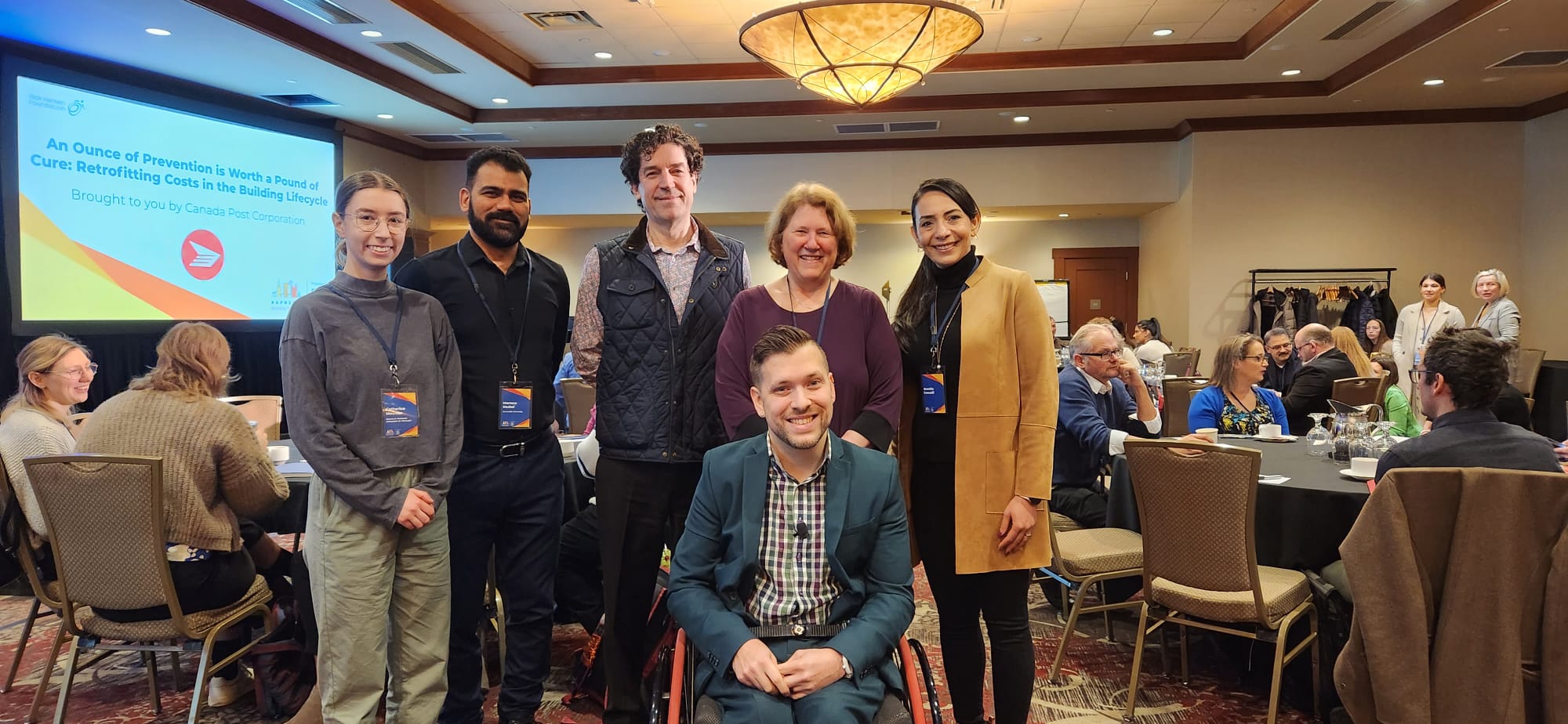
Students from Concordia, UdeM and Calgary participate in the Accessibility Professional Network 2023 (RHF) National Forum

From left to right: Catherine Gauthier (MArch, Université de Montréal), Morteza Hazbei (PhD candidate, Concordia University), Jean-Pierre Chupin (UdeM), Doramy Ehling (CEO, Rick Hansen Foundation), Marco Pasqua (Rick Hansen Foundation), Nooshin Esmaeili (UCalgary)

On March 1-2, 2023, several student members of the SSHRC Quality Partnership were invited to participate in person or online in the annual APN2023 Building Together Symposium, which brought together industry leaders, accessibility professionals, and global thought leaders to discuss how we can continue to build an inclusive and accessible world for people of all ages and abilities. [Accessibility Professional Network 2023.](On March 1-2, 2023, several student members of the SSRC Quality Partnership were invited to participate in person or online in the annual APN2023 Building Together Symposium, which brought together industry leaders, accessibility professionals, and global thought leaders to discuss how we can continue to build an inclusive and accessible world for people of all ages and abilities. Accessibility Professional Network 2023.

A new LEAP seminar: “Material Cultures through the filter of the Cecobois and Woodworks Awards” by Izabel Amaral. March 16, 2023.

A seminar presented by Izabel Amaral (UdeM) around a SSHRC Insight Development Grant: (in collaboration with Carmela Cucuzzella (Concordia) and Jean-Pierre Chupin (UdeM)

An Ecology of Wood Cultures in Canada (20032020): comparing constructive cultures through awarded architectural designs

At the  intersection of  architectural theory and  cultural studies, this  research investigates wood  architecture as a symbolic universe that allows us to study the presence of nature in human culture. This research will theorize the diversity of expressions of quality in Canadian architecture, from the standpoint of environmental preoccupation, building culture and architectural expression. Considering wood architecture as a form of “cultural ecology”, it has the potential to reveal how Canadian cultures represent and symbolize their relations to the land and natural resources, as well as the cultures of its founding peoples.

Notwithstanding the interest in wood as a major alternative to fossil fuelbased construction materials, this research will highlight the symbolic spectrum of wood buildings, which ranges from local and indigenous traditions to ecological aesthetics, representing forms of making that rely both on traditional architectural practice or recent building technologies and computeraided design. We aim to better interpret and understand how advancements in architectural practice and building techniques affect the way architecture is envisioned and materialized in Canada during the past decades. In parallel to studying the influence of environmental considerations to  architectural forms in  Canada, we  will make sense of  a  dissonance within the theory of architecture between ideas about the interdependency or autonomy of architectural form (visual appearance), material (what it is made of) and meaning (messages and ideals expressed).

Conference-debate on the history of architecture schools in France and Quebec

Date: January 31, 2023, 5:30 pm.

Location: Amphitheatre 1120, Faculté de l’aménagement, Université de Montréal.

On the occasion of the publication in 2022 of L’architecture en ses écoles, une encyclopédie, we welcome Daniel Le Couédic, architect and historian, professor at the University of Western Brittany, and co-director of the book. Around Lucie K. Morisset, professor at UQAM and holder of the Canada Research Chair in Urban Heritage, this conference-debate will also bring together two Quebec contributors to the encyclopedia, François Giraldeau, honorary professor at UQAM’s School of Design, and Jean-Pierre Chupin, professor at UdeM’s School of Architecture and holder of the Canada Research Chair in Architecture, Competitions and Mediation of Excellence,

  • Anne-Marie Châtelet, Amandine Diener, Marie-Jeanne Dumont and Daniel Le Couédic, (under the direction of), L’architecture en ses écoles (une encyclopédie de l’enseignement de l’architecture au XXe siècle), Châteaulin, Éditions Locus Solus, 2022.
  • Jean-Pierre Chupin and François Giraldeau, article Québec, relations et échanges. p. 568.

Summary

With its 704 pages and 341 notes written by 147 authors, this work is the result of a vast collective effort to gather and deepen, in an unprecedented way, a state of knowledge that was fragmentary until now. This history of architectural education in France in the twentieth century addresses multiple dimensions – pedagogical, professional, territorial, political, institutional and material – and covers a range of institutions involved in architectural education, such as engineering schools.

In France, the history of architectural education was long reduced to its alleged shortcomings and to the story of the struggle of the champions of modernity against the École des Beaux-Arts in Paris. The earthquake of 1968 buried even the memory of that bygone era. The revival came from the United States, where the École had once enjoyed great prestige, but at first it concerned only the nineteenth century. It was not until the 1980s that the complexity of the things debated and experienced in the twentieth century began to be illuminated and, above all, that the investigations of architecture, its teaching, the profession and its practice were correlated.

In this movement, one rediscovered the long exacerbated debate between the architects defending the Parisian monopoly and their provincial colleagues, which had preluded the creation of the first regional schools in 1903. The Regional School of Rennes – which became the Regional School of Brittany in 1984 – was the second to open its doors; its history thus allows us to understand all the stages of this bumpy path which, well beyond architecture, provides information on the reinvention of higher education in France and on the role it played in the structuring of the national territory.

The discussion will also be based on another book by our guest: Le Couédic Daniel, Sauvage André, L’École d’architecture de Bretagne : Un siècle de fabrique des architectes, Châteaulin, Locus Solus, 2022.

Video of the roundtable: What is an architecture award worth?

This debate was organized at the BAnQ’s National Archives in Montreal (535 Viger Avenue East) on November 24, 2022.

Once a symbol of excellence and exception, architecture and design awards, which aim to reward achievements, have multiplied exponentially in recent years. We no longer count the number of companies, associations, municipalities and specialized publications that have set up their own awards, many of which have greatly multiplied their categories over the years. The situation is such that we can now speak of a veritable awards “industry”, both in Quebec and internationally.
In this context, we may wonder about the value of these awards. Do they always reward excellence? Do the entries focus excessively on aesthetics, or even the “Instagrammable” side of architecture, rather than on the public experience? Why do architectural firms feel the need to participate? How can we ensure the real value of an architecture award?

The event was organized by Kollectif, in partnership with Jean-Pierre Chupin, Canada Research Chair in Architecture, Competitions and Mediations of Excellence (Université de Montréal) and co-editor of the collective book The Rise of Awards in Architecture (Vernon Press, 2022) with Carmela Cucuzzella and Georges Adamczyk.

Presenter: Marc-André Carignan, Content Manager for Kollectif
Moderator: Jean-Pierre Chupin, Canada Research Chair in Architecture, Competitions and Mediations of Excellence, Université de Montréal

Our panelists:

Our guests of honour:

Video production:

  • Video editing and recording: Jonathan Haxhe, M.A. in communication, Université de Montréal.
  • Recording: Théo Pagé-Robert, Bachelor of Architecture, Université de Montréal.

Funding: Canada Research Chair in Architecture, Competitions and Mediations of Excellence.

Two CRC-ACME doctoral grants for Paloma Castonguay-Rufino and Shantanu Biswas-Linkon

Two grants to support two doctoral students of the Canada Research Chair in Architecture, Competitions and Mediations of Excellence: Paloma Castonguay-Rufino and Shantanu Biswas-Linkon.

These two $12,000 scholarships are awarded by the Canada Research Chair in Architecture, Competitions and Mediations of Excellence for the quality of their academic record. Paloma Castonguay-Rufino is working on a redefinition of the notion of “industrial heritage” in the Canadian context, while Shantanu Biswas-Linkon is studying the notion of “social value” (Re-evaluating the Social Value of Architecture in the Public Realms through Inclusiveness and Environmental Justice).

Two grants awarded to Aurélien Catros, Ph.D. candidate at UdeM

Under the supervision of professors Jean-Pierre Chupin and Bechara Helal in the Individualized Doctoral Program in Architecture, Aurélien Catros has received two prestigious grants for his thesis:

  • Daniel Arbour and Associates excellence grant

Amount: 20 000$CAD (Travel grant for England and Japan)
Title of funded topic: “Projection between design models in the era of the second digital revolution

  • Doctoral grant from the Fonds de Recherche du Québec Société et Culture

Amount: 28 000$CAD (spread over 16 months)
Title of funded subject: “Epistemology of the model in architecture and the transfer of project design in the era of the second digital revolution

The CRC-ACME coordinates a major research partnership funded by the SSHRC

Funded by the Social Sciences and Humanities Research Council of Canada until 2027, a major research partnership on quality in the built environment brings together – for the first time – 14 universities, 70 researchers and 68 public and private organizations at the municipal, provincial and national levels.

The total value of this partnership will be $8.6M ($2.5M from SSHRC, $6.1M from partners including $4.2M in-kind contributions). Such an investment confirms the commitment of all partners and the importance of the collaborative process.

The partnership will stimulate a vital dialog demonstrating how those active in considering and creating the built environment across Canada can contribute to a redefinition of quality that moves us to heightened equity, more social value and greater sustainability at a critical moment for our societies and for our planet.


Coordinated, from the University of Montreal, by the Canada Research Chair in Architecture, Competitions and Mediations of Excellence (CRC-ACME), the partnership Quality in Canada’s Built Environment: Roadmaps to Equity, Social Value and Sustainability addresses the diversity of public environments impacting the everyday life of millions of Canadians in urban spaces, buildings and landscapes.


The program has three aims:

  1. Analyzing the current limitations of environmental norms and sustainability models to bring us closer to the United NationsSustainable Development Goals (SDGs).
  2. Co-designing new paths to equity, diversity and inclusion in the built environment.
  3. Defining new frameworks for the definition of quality so as to enhance the social value of the built environment through roadmaps to quality.


To achieve these objectives, the partnership brings together methodologically 4 sets of stakeholders concerned with the use, scientific study, planning, design, construction and management of built environments:

  • Citizens (representatives of communities including minorities and underrepresented populations).
  • Cities (national, provincial and municipal actors in the public procurement of built environments).
  • Organizations assessing quality (professional associations, award granting institutions, councils, cities).
  • Universities (interdisciplinary research teams).


For the first time and at an unprecedented scale in the design disciplines in Canada, the project gathers 14 universities including all of the schools of architecture as well as most landscape architecture and environmental design departments. It mobilizes 23 disciplines concerned with the impact of built environments on citizens. Sixty-eight partner organizations including national institutions and not-for-profit will join in a conversation pertaining to 4 thematic clusters to address urgent considerations on quality relative to:

  1. Spatial justice and heightened quality of life.
  2. Integrated resilience, material culture and adaptative reuse.
  3. inclusive design for health, wellness, aging and special needs.
  4. processes and policies supporting the reinvention of built environments.


This extraordinary collaborative effort will stimulate training, internships and connections between hundreds of students and communities of practice. The partnership will engage in cross-sectoral co-creation of knowledge whose outcomes will take the form of “roadmaps to quality” (guidebooks, analyses of exemplary case studies, resources for design thinking and proposals for public policies, etc.). These will constitute a bilingual Living Atlas on Quality in the Built Environment set on a digital platform created with the support of the Canada Foundation for Innovation. Designed as a public forum on the social, economic and environmental value of quality, the Living Atlas will offer open access to repertories of award-winning projects, case studies, comparative analyses, scientific resources and articles, interpretative didactic podcasts, analogical maps and visualizations.

SSHRC Partnership Grant # 895-2022-1003


To see the full list of official co-applicants, collaborators, and partners:

Link to the SSHRC platform: 

https://www.sshrc-crsh.gc.ca/results-resultats/recipients-recipiendaires/2021/pg-sp-eng.aspx


Steering Committee (2022-2023)


Josie C. Auger, PhD, Adjunct professor, Athabasca University
Jean-Pierre Chupin, PhD, Professor, Université de Montréal, SSHRC partnership director
Carmela Cucuzzella, PhD, Professor, Concordia University
Doramy Ehling, CEO, Rick Hansen Foundation
Terrance Galvin, PhD, Professor, Laurentian University
Thierry Montpetit, OAQ OAA, Public Services and Procurement Canada
Lyne Parent, Directrice, Association des architectes en pratique privée du Québec
Brian Robert Sinclair, PhD, Professor, University of Calgary
Federica Goffi, PhD, Professor, Carleton University
Robert M. Wright, MLA, Professor, University of Toronto


Dimitri Weibel, MSc Pol. Sc., SSHRC partnership coordinator

The FRQSC renews LEAP’s team subvention until 2027

The project, entitled Potentials of Architectural Quality: Equity, Sustainability and Cultural Openness, will have Jean-Pierre Chupin (Ph. D.) as team coordinator. The amount of the subvention granted to the LEAP by the FRQSC (support to research teams/university renewal) for this project is $423,420 and will be spread over a 4-year period, thus until 2027!

For 2022-2027, the programming of the Laboratoire d’étude de l’architecture potentielle is based on three research chairs to address a central issue that directly impacts the daily lives of millions of citizens: the quality of built environments.

The program of the Potentials of Architectural Quality: Equity, Sustainability and Cultural Openness project is based on three axes:

  • Axis 1: Equity, spatial justice and improvement of the quality of life (linked to the Canada Research Chair (2) on spatial justice, McGill);
  • Axis 2: Sustainability imperatives and material qualities of built environments (linked to the Research Chair in ecological and integrated design, Concordia);
  • Axis 3: Cultural openness and the process of recognizing architectural quality (linked to the Canada Research Chair (1) in Architecture, Competitions and Mediations of Excellence, Montreal).

The collective reflection on quality intends to paint a global and coherent portrait of our discipline and its renewal, but also, and perhaps more importantly, to demonstrate how actors in the built environment can contribute to a redefinition of quality at a critical moment in our collective history. The team is composed of researchers from four Montreal universities.

  • Université de Montréal: Jean-Pierre Chupin, Georges Adamczyk, Izabel Amaral, Denis Bilodeau, Anne Cormier, Bechara Helal, Virginie LaSalle
  • Concordia University: Carmela Cucuzzella, Cynthia Hammond
  • McGill University: Ipek Türeli
  • UQÀM: Thomas Bernard Kenniff, Louis Martin

The Rise of Awards in Architecture, a new book edited by Chupin, Cucuzzella and Adamczyk

This book is the first scientific study to focus on awards in architecture and the built environment investigating their exponential growth since the 1980s. The celebration of excellence in architecture and related fields remains a phenomenon on which there is strangely little scientific scrutiny. It is now necessary to take a critical distance to question what awards are meant to embody, symbolize, and perhaps measure. Each of the 10 chapters in this volume is centered on one question related to themes as varied as the comparison of Pritzker and Nobel Prizes, the Prix de Rome, the redefinition of quality through awards, green awards and sustainability, the multiplication of sustainable awards, heritage awards, architecture book awards, the awarding of school architecture, awards as mediations and awards as pedagogical devices. [vc_btn title=”ACCESS THIS BOOK’S INFORMATIONS” align=”center” button_block=”true” link=”url:https%3A%2F%2Fvernonpress.com%2Fbook%2F1507|target:_blank”]

Praise

This book offers an in-depth analysis of the widespread practice of acknowledging the quality of architecture works with prizes, awards, and project competitions given to individuals, collective works, and constructions. This timely study considers a contemporary culture of recognition that is largely taken for granted and not yet grasped as a global and rising phenomenon that has seen exponential growth since the 1980s. The contributors thus address the controversies, ambiguities, and shortcomings surrounding this context, including issues of gender biases, cultural diversity, transparency, and how media, politics, and financial prizes impact architectural awards. The authors provide scholarly insights that cannot be found elsewhere, proving a timely contribution to knowledge that will further our understanding of the context in which contemporary architecture practices operate.

Federica Goffi, Ph.D.,
School of Architecture (Carleton University)

This book raises, in quite a healthy and rational fashion, the vexed question of the judgment of quality in the arts, lifting the lid on the very human and sometimes unseemly tendency to favor winners and follow the money, while yet allowing some hope for continuing development of mechanisms that permit valid judgments, promote genuine quality, and encourage current and future practitioners. This is an unusually balanced point of view. This is a useful guide to understanding how things have worked and to acting intelligently to make things fairer.

David Vanderburgh, Ph.D.,
Laboratory of Architecture and the Built Environment (Université catholique de Louvain)

Authors and Editors

Jean-Pierre Chupin, Carmela Cucuzzella, Georges Adamczyk (Eds.)

by Dana Buntrock (University of California, Berkeley), Marco Polo (Ryerson University), Jean-Pierre Chupin (Université de Montréal), Carmela Cucuzzella (Concordia University), Sherif Goubran (The American University in Cairo, Egypt), Aurélien Catros (Université de Montréal), Adélie de Marre (Université de Montréal), Lucie Palombi (Université de Montréal), Alexandra Paré (Université de Montréal), Typhaine Moogin (Université Libre de Bruxelles), Georges Adamczyk (Université de Montréal)

Block 2 design competition

Hello,
The Canada Research Chair in Architecture, Competitions and Mediations of Excellence having had the honor of being associated with the preparation and implementation of this historic competition, I am pleased to extend to you this invitation to the public presentations of the 6 internationally renowned teams that will take place online on April 11, 2022.
Jean-Pierre Chupin
http://crc.umontreal.ca[vc_separator color=”black”]In May 2021, Public Services and Procurement Canada (PSPC) launched an architectural design competition to redevelop Block 2, a full city block directly opposite Canada’s parliament buildings, just south of Parliament Hill.

The renewal of Block 2 is a critical piece of PSPC’s Long Term Vision and Plan for the Parliamentary Precinct. The design competition ensures that the final design for this city block brings forward new vitality to a significant part of Confederation Boulevard. The goal is to transform this mix of buildings into an innovative complex that will meet the needs of Parliament and the public now and into the future.

On April 11, the six design team finalists will present their design concepts for Block 2 through a virtual public presentation. We would be grateful if you would share the invitation below about the public presentation with your networks.[vc_single_image image=”24481″ img_size=”large” alignment=”center”]Few sites carry the significance of Block 2, a full city block directly opposite Canada’s parliament buildings, just south of Parliament Hill. To the north, it faces the Centre Block and its Peace Tower.
The renewal of Block 2 is a critical piece of PSPC’s Long Term Vision and Plan (LTVP) for the Parliamentary Precinct. The design competition, launched in spring 2021, ensures that the final design for this city block brings forward new vitality to a significant part of Confederation Boulevard. The goal is to transform this mix of buildings into an innovative complex that will meet the needs of Parliament and the public now and into the future.
Join us to hear the competitors speak to their vision for this prominent space in Canada’s capital. The six finalist design teams will present their design concepts for Block 2.

PRESENTERS:

  • Zeidler Architecture Inc., in association with David Chipperfield Architects
  • Diamond Schmitt Architects, in a joint venture with Bjarke Ingels Group, KWC Architects and ERA Architects
  • Provencher Roy + Associés Architectes Inc.
  • Watson MacEwen Teramura Architects, in a joint venture with Behnisch Architekten
  • WilkinsonEyre, in association with IDEA Inc.
  • NEUF architect(e)s, in a joint venture with the Renzo Piano Building Workshop

JOIN US
April 11, 2022
10:00 a.m. to 1:00 p.m. (EDT)

This event will be held virtually via Facebook Live  (with audio interpretation). A Facebook account is not required to view the event.

Do you know someone who would like to view this presentation? Please share this invitation.

ABOUT THE COMPETITION:

Following an extensive prequalification process, twelve architectural teams were invited to submit design proposals for Block 2 that would complement the image of Canada and its capital on the international stage. Of these, six finalists were invited to develop their designs which will be presented at this public presentation. The winning team and design will be recommended to the department by an independent jury. This design competition was endorsed by the Royal Architectural Institute of Canada (RAIC) and has designated professional advisors to oversee the overall competition process.

“It’s not about humans being above the place, or building their buildings to look down upon the place. It’s about the people and place being one and the same.”— John Ralston Saul, RAIC Honorary Advisor, Block 2 Design Competition[vc_single_image image=”24486″ img_size=”large” alignment=”center”]