

Carly Ziter holds the Concordia University Research Chair in Urban Ecology and Sustainability (2021-2026)
Non classé
New article by Yolene Handabaka Ames: What’s behind the demolition of the Chocolats favoris building in Vieux-Lévis?
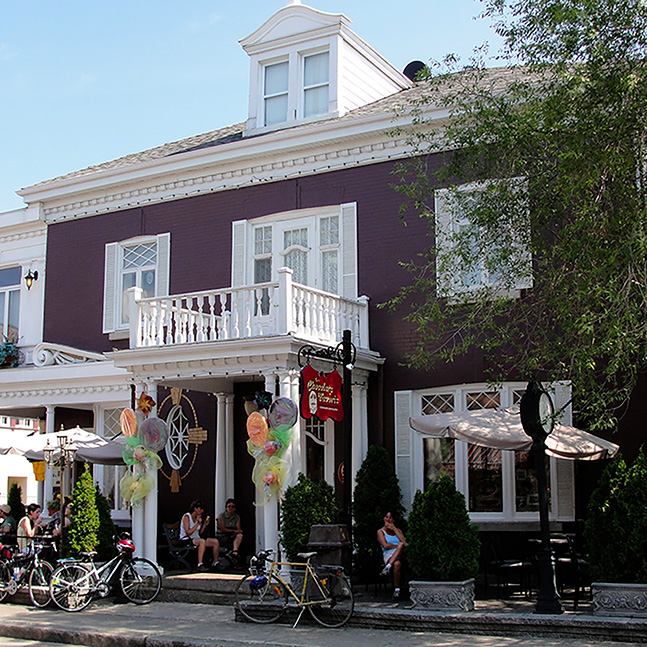
New article published in Le Devoir by Yolene Handabaka Ames, student of the individualized doctorate in architecture at the École d’architecture de la Faculté de l’aménagement: What’s behind the demolition of Chocolats favoris’ building in Vieux-Lévis?
“The case of the imminent demolition of Chocolats favoris has been making headlines since October 2023, when a public notice of demolition request from the City of Lévis was posted on the building’s façade.
The saga, which lasted almost two years, revealed recurring conservation issues surrounding Quebec’s built heritage. So much so that the Lévis residence has become an emblematic case of what lies behind most heritage building demolition projects: the social value of a “living” heritage.
In autumn 2022, the house that had housed Chocolats favoris since 1996 was closed due to water infiltration and deteriorating masonry. After professional appraisals, letters signed by heritage advocates, requests for review and the active participation of Lévis residents at public hearings, demolition was approved on December 16. A request for a one-year moratorium did not change the building’s fate either. On June 19, at a regular meeting of the municipal council, elected officials voted against accepting the request. The house of Chocolats favoris will soon fall under the demolition pick… ”
Read more on Le Devoir’s website.
Photo by René Bélanger (Flickr).
Discover the CANADIAN MAP OF AWARD-WINNING BUILDINGS AND PLACES
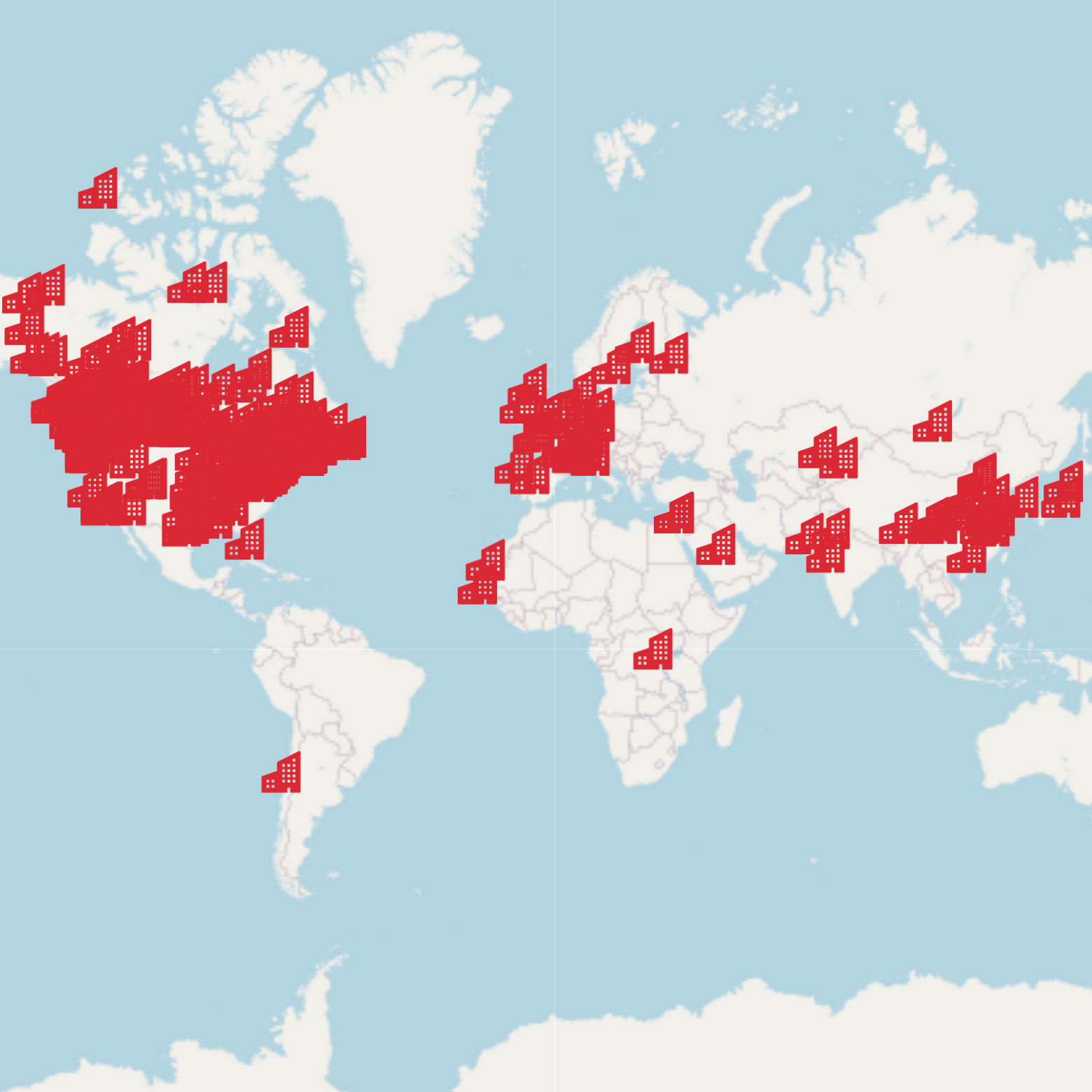
The Atlas of Research on Exemplarity in Architecture and the Built Environment (AREA-BE) is an open construction site!
AREA-BE is an initiative of the Canada Research Chair in Architecture, Competitions and Mediations for Excellence (CRC-ACME), held by Jean-Pierre Chupin, Ph.D. , architect MOAQ, MIRAC, DPLG, DipArch (2), Professor at Université de Montréal. This initiative is actively supported by a network of Canadian and international scholars.
The current website of the AREA (www.architecture-excellence.org) has been officially launched in November 2019 for information purposes.
The AREA website foreshadows an important documentation and research platform to be launched in 2021 / 2022
This long-term initiative is supported by the Canada Foundation for Innovation and the Social Sciences and Humanities Research Council of Canada through the Canada Research Chairs Program.
In the coming years, the establishment of an AREA partnership of researchers based in Canadian schools of architecture and research universities will ensure the reliability, regular updating and sustainability of this scientific platform regrouping resources, knowledge transfers and analyzes on best examples of architectural design, landscape design and urban design in Canada.
Thanks to the contribution of institutions delivering awards and to professional teams giving access to data on projects and buildings, researchers and students will be able to contribute to a better understanding of the current evolution of quality in the built environment. The data, information, analyzes, comparisons, visualizations that will be progressively delivered – in open access – on the AREA platform will take advantage of award-winning projects and buildings in Canada, from year to year, in order to identify and better understand best practices.
The AREA collective platform will be meant to provide scientific data in order to support education, policies, actions and mediations aiming at excellence in the built environment.
Jean-Pierre Chupin (Université de Montréal)
Discover ArchiQualiData! A new database bringing together lived experiences and case studies in Canada’s living environments
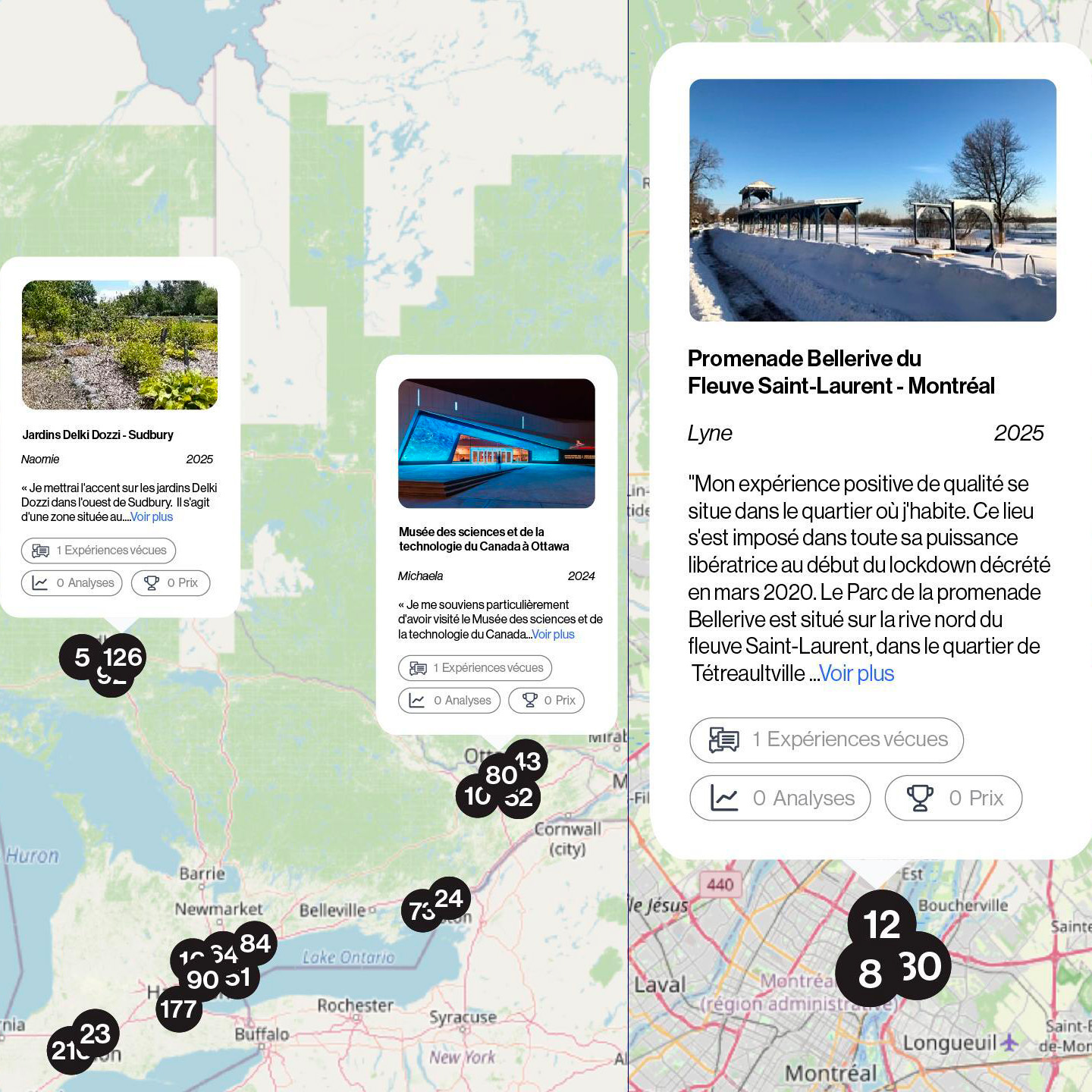
The ArchiQualiData database provides analyses and studies of exemplary and award-winning living environments, real-life experiences and case studies.
DISCOVER detailed studies conducted by researchers, providing unique insights into exceptional buildings and places.
ACCESS testimonials from people who have directly interacted with these entities, enriching understanding through authentic stories.
FIND precise information on each exemplary entity, thanks to a simple interface and advanced search system.
Final Program for the 2025 Toronto Convention Now Available!

Toronto 2025 Convention Program : Toward a White Paper on Quality…
DOWNLOAD THE PROGRAM IN PDF FORMAT The final program for the 2025 Annual Convention is now available. From April 30 to May 2 in Toronto, the event will bring together experts, researchers, and practitioners to advance a national strategy for quality in Canada’s built environment. We are happy to share with you this program and hope you are as excited as we are for those great speakers, roundtables discussions and site visits that will take place during the convention.
Jean-Pierre Chupin, PhD, Professor, Architect MOAQ, MIRAC. Holder of the Canada Research Chair in Architecture, Competitions and Mediations of Excellence at Université de Montréal and Principal Investigator of the SSHRC Research Partnership on Quality in Canada’s Built Environment.
Public conference presented by Léa-Catherine Szacka: Crossed Histories, Phyllis Lambert, Ada Louise Huxtable and Gae Aulenti on architecture and the city
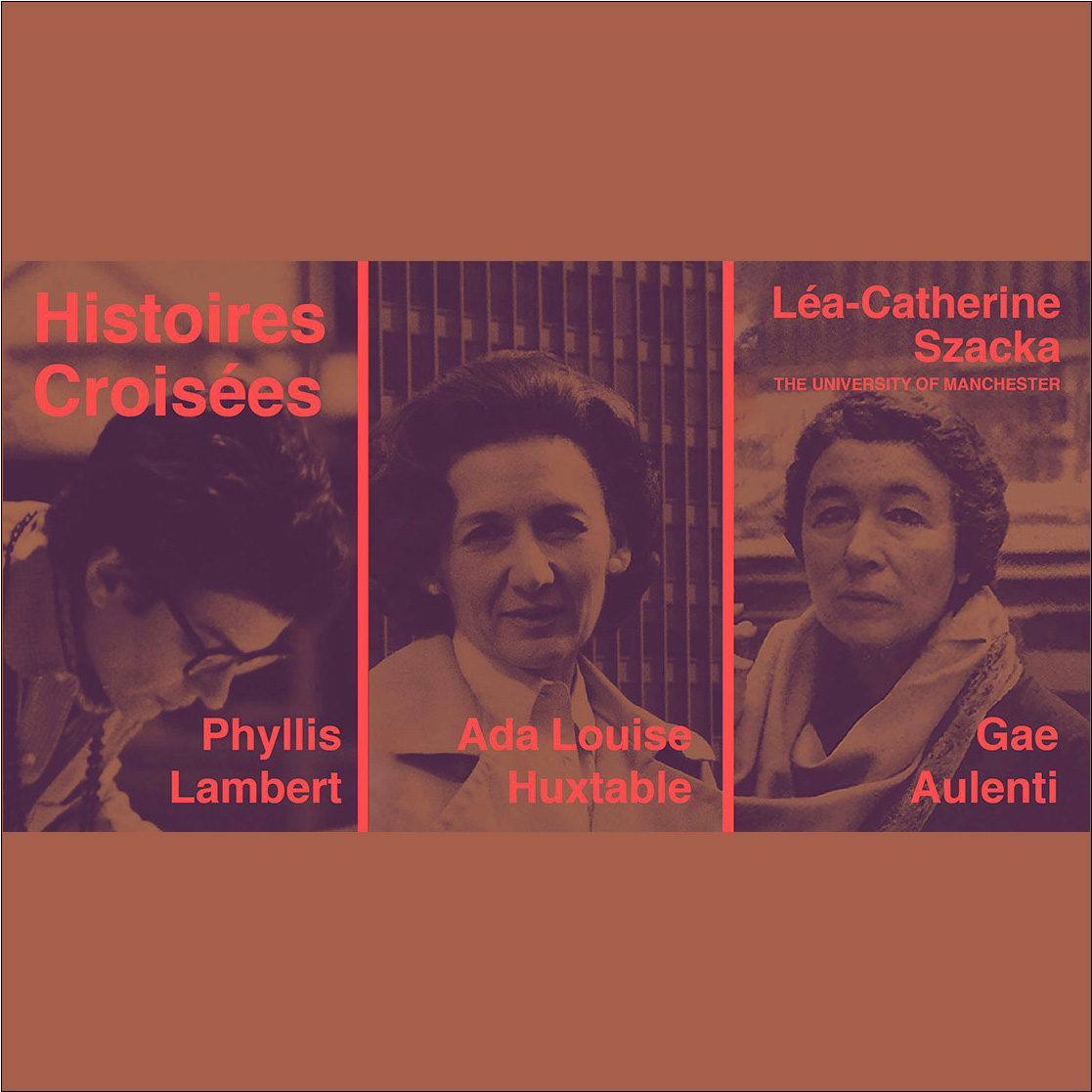
Conference by Léa-Catherine Szacka , University of Manchester
Date: Tuesday, April 1st at 5:30 pm.
Location: Amphitheatre 1120, Faculté de l’aménagement, Université de Montréal
Lecture series of the Laboratoire d’étude de l’architecture potentielle
Crossed Histories
Phyllis Lambert, Ada Louise Huxtable and Gae Aulenti on architecture and the city
Summary:
Born in the 1920s, architects Gae Aulenti and Phyllis Lambert and critic Ada Louise Huxtable were among the most influential figures in post-war architecture and design. Pioneers in a largely male-dominated field at the time, and key players in the transition from modernism to postmodernism, they set out to conquer and shape public space. This talk retraces the history and careers of these three women, who are the focus of the exhibition Crossed Histories, presented until May 2025 at the Canadian Cultural Centre in Paris.
Léa-Catherine Szacka:
Senior Lecturer (Associate Professor) in Architectural Studies, University of Manchester
Director of the Manchester Architecture Research Group (MARG)
Vice-President, European Architectural History Network (EAHN)
Co-Founder, PASZA – Platform for Architectural Research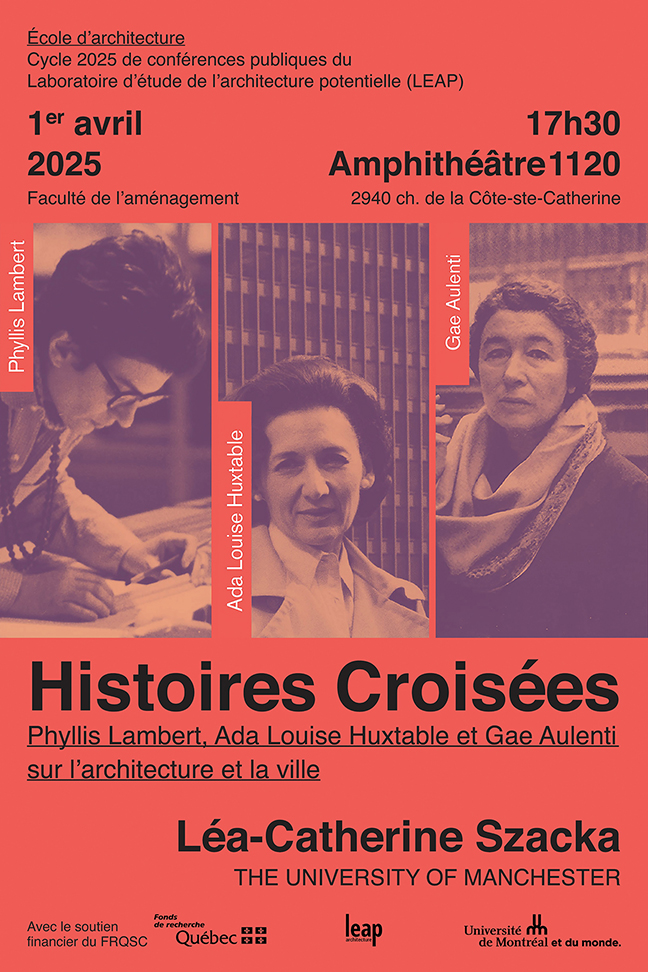
Jean-Pierre Chupin Named Fellow of the Royal Architectural Institute of Canada, Class of 2025
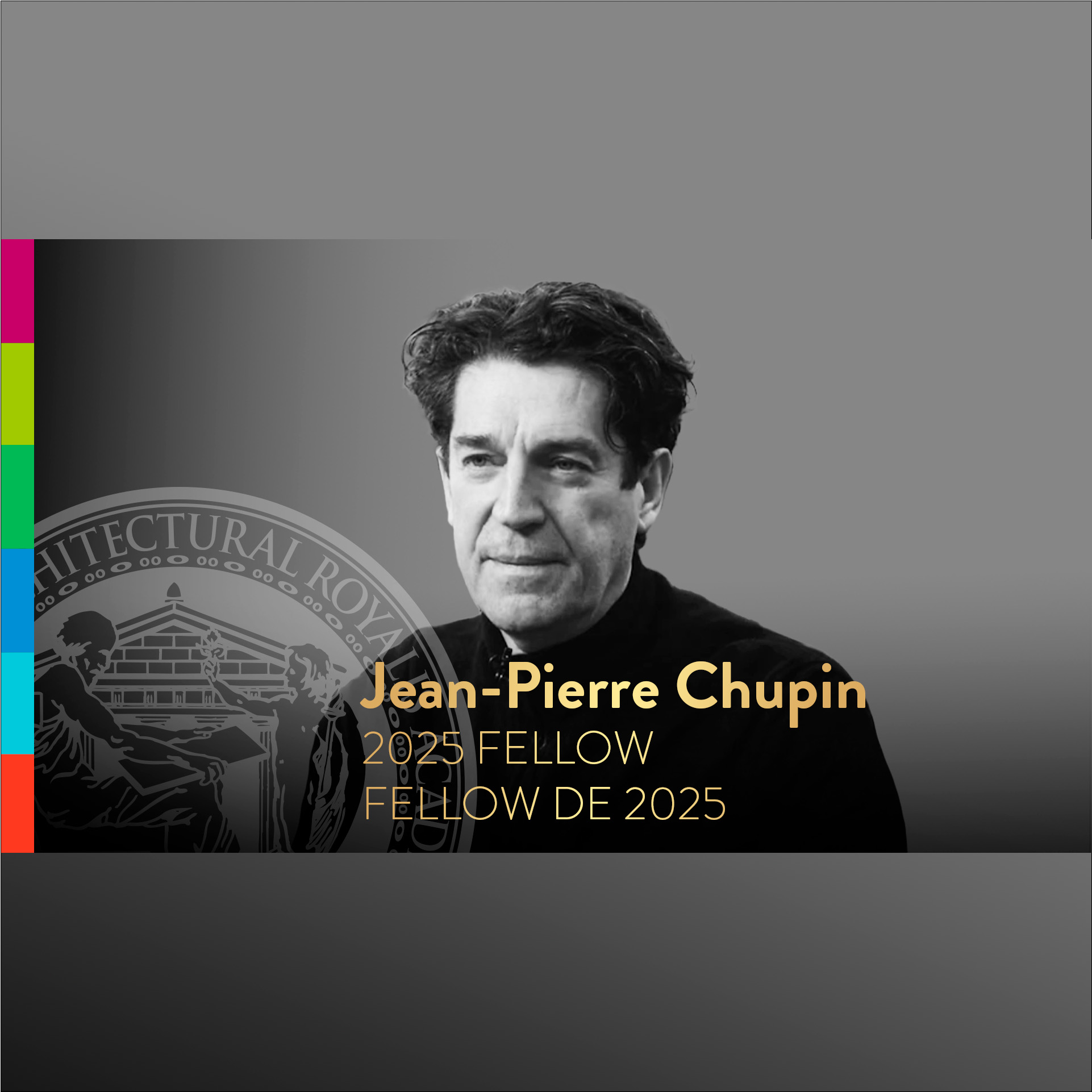
Professor Chupin was nominated by Thierry Montpetit, FRAIC, and letters of support were submitted by five renowned Quebec architects: Anik Shooner, FIRAC, Nathalie Dion, FIRAC, Gilles Prud’homme, FIRAC, Maxime Frappier, FIRAC, and Renée Daoust, FIRAC, in the category of : Outstanding scholarly contributions supported by research, publications or teaching in the field of architecture, and, Outstanding contributions to the profession fostering excellence in architectural practice through leadership in public service or industry organizations.
Fellows will be formally inducted into the RAIC College on Tuesday, June 3, 2025 at an induction ceremony held in conjunction with the RAIC Conference on Architecture in Montreal, Quebec.
Visit the RAIC website to see the 43 new Fellows 2025.
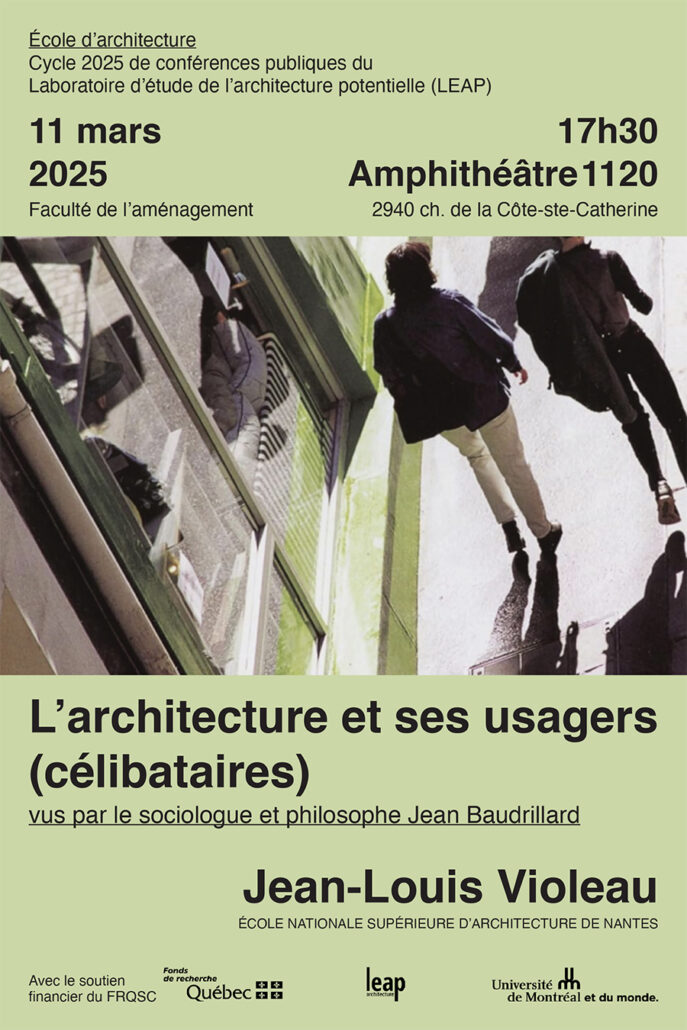
Public conference presented by Jean-Louis Violeau: Architecture and its (Single) Users as Seen by Sociologist and Philosopher Jean Baudrillard
Conference by Jean-Louis Violeau, École Nationale Supérieure d’Architecture de Nantes
Date: Tuesday, March 11th at 5:30 pm.
Location: Amphitheatre 1120, Faculté de l’aménagement, Université de Montréal
Lecture series of the Laboratoire d’étude de l’architecture potentielle
Architecture and its (Single) Users as Seen by Sociologist and Philosopher Jean Baudrillard
Summary:
How does one go about exploring Jean Baudrillard’s intimate yet suspicious relationship with architecture? One begins, as one should, with Disney, moves on to the duck and the Venturis, stops at the figure of the (architectural) monster, moves on to Jean Nouvel and the ambiguities of transparency, and finally arrives at some contemporary projects, notably the highly condemned Europacity. Along the way, Baudrillard raises two questions: what has become of architectural postmodernism, and the persistence of the notion of the author in architecture. Baudrillard was more of an imaginary sociologist, intuitive and detached, an interpreter who amused himself by drawing the dotted lines of the present, overdoing it and regularly tending to paroxysms. Hence his interest in architectures that resist interpretation and seem to take on a life of their own, as if detached from their designers: the Twin Towers of the World Trade Center, the Biosphère II project, the Beaubourg, the Guggenheim Bilbao, and some of Jean Nouvel’s architecture. Behind the scenes: obscure and ironic, every stage has its backstage, every scene is reversible, every project calls for its counter-project. The cursed part always bides its time. Culture for Beaubourg, globalization for the WTC, the planet for Biosphère II, the commodification of cities for the Guggenheim Bilbao… The ambivalence grows as these projects strive to saturate reality. What all these untamed concretions have in common, however, is that they seek first and foremost to bring the edge of difference to bear on generalized equivalence. In an age of no-fake and a shared quest for authenticity, this sociological perspective is meeting with renewed interest, particularly in the ambivalent choices and behaviors of digital children.
The sociologist Jean-Louis Violeau is a professor at the Ecole Nationale Supérieure d’Architecture de Nantes and at the Urban School of Sciences Po Paris. He is a researcher at CRENAU (CNRS UMR AAU).
He is a regular contributor to architectural magazines, in particular AMC-Le Moniteur architecture and L’Architecture d’aujourd’hui, as well as more general magazines such as Esprit, Place Publique Nantes-Saint-Nazaire and Urbanisme. He is also a member of the editorial board of the latter two magazines.
His dissertation Les architectes et mai 68 was published in 2005 by Recherches, the distant heirs of the journal of the same name founded under the aegis of Félix Guattari and the CERFI. The sequel, his HDR (Habilitation à Diriger des Recherches) on Les architectes et mai 81, was published by Recherches in 2011.
Video of the public debate on school architecture in the city center!
“From business districts almost exclusively reserved for commercial and professional activities, Canadian downtowns are increasingly becoming living spaces. Yet there are few elementary schools, which are essential to inclusive urban development. And for good reason: the traditional model of the single-purpose, low-rise school building, with a large playground at ground level, is at odds with a high-density, high-value environment. The heart of metropolises attracts developers, all the more so as urban planning regulations allow them to erect high-rise buildings, a source of significant revenue. So what kind of school architecture can we imagine for our city centers? And what might it offer schoolchildren?”
– A. Cormier, A. Paré and G. Adamczyk, En centre-ville : une architecture à hauteur d’enfant, Potential Architecture Books, Montreal, 2024
The Laboratoire d’étude de l’architecture potentielle (LEAP) recognizes the importance of the stakes involved in building schools downtown, and held a round table on this theme to mark the launch of the book En centre-ville : une architecture à hauteur d’enfant.
Moderator
Jean-Pierre Chupin, Architect and Professor at the School of Architecture, Université de Montréal, Chair Holder of the Canada Research Chair in Architecture, Competitions and Mediations of Excellence and Director of the LEAP
Panelists
- Robert Beaudry, Montréal city councillor, Member of the Executive Committee, Responsible for OCPM urban planning and homelessness
- Carol Bélanger, Chief Architect, City of Edmonton
- Anne Cormier, Architect, Professor at the School of Architecture, Université de Montréal, Researcher at the LEAP
- Ève Desrosiers, Architect, Héloïse Thibodeau architecte
- Maryse Laberge, Architect, nfoe
- Claude Laurin, Architect, Real Estate Planning and Development Coordinator, Centre de services scolaires de Montréal
- Jordan Owen, Junior Developer, Mondev
The round table is supported by the Social Sciences and Humanities Research Council of Canada (SSHRC), the Vice-rectorat à la recherche, à la découverte, à la création et à l’innovation de l’Université de Montréal (VRRCDI) and the Laboratoire d’étude de l’architecture potentielle (LEAP).
New book publication: —in Drawing. Inquiry, Time, Dialogue and Materiality
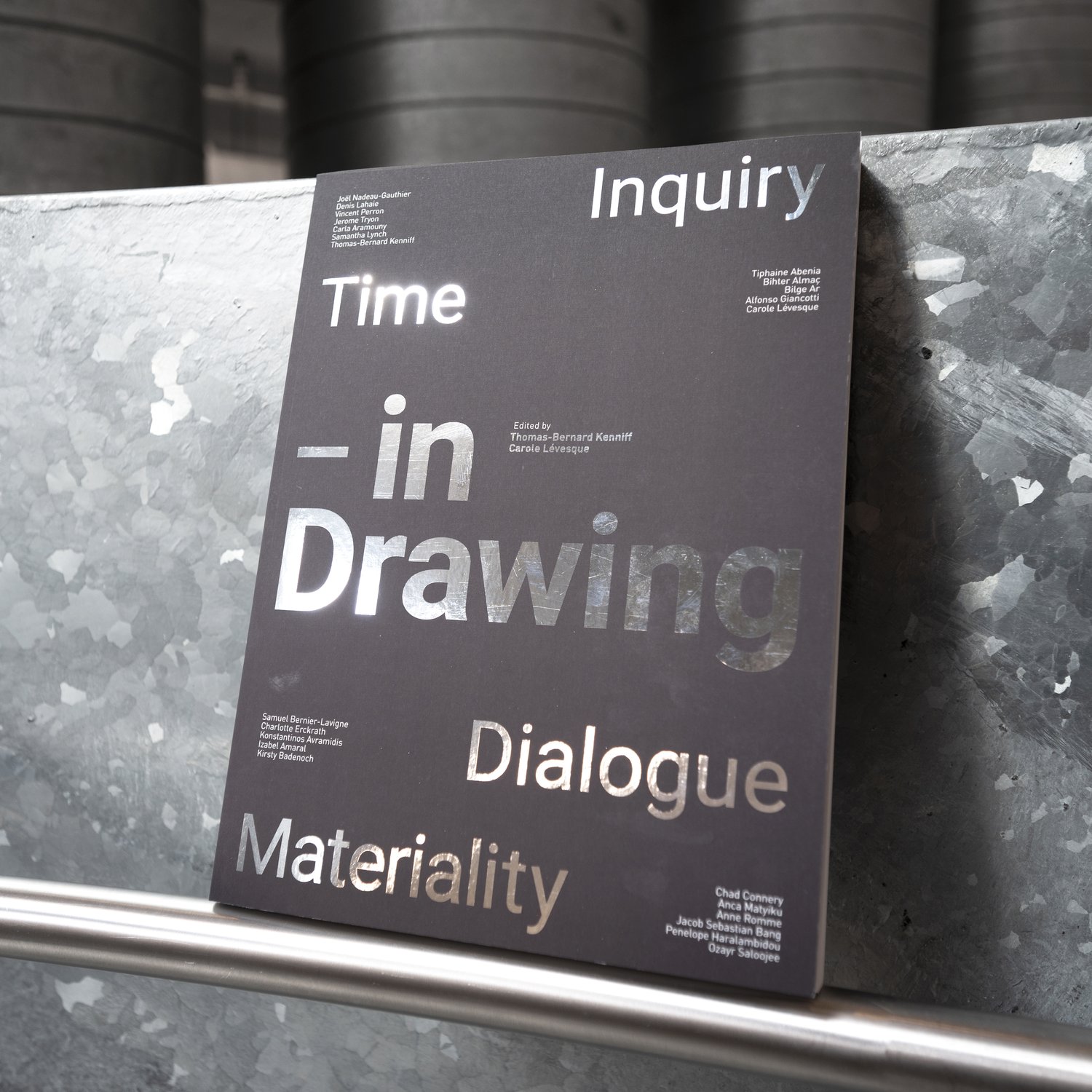
—in Drawing. Inquiry, Time, Dialogue and Materiality
Edited by Thomas-Bernard Kenniff and Carole Lévesque
Montréal : Bureau d’étude de pratiques indisciplinées, 2024
Drawing is a form of research, a means to investigate, explore and gain a better understanding of an idea, a condition or a phenomenon. Drawing is a practice of representation, one that inquires, explores materiality, and establishes its own time and dialogue. This book brings together 23 authors who represent 18 critical and reflexive practices of drawing in design. The assembled texts engage drawing aesthetics (spatial, temporal, and material) and drawing ethics (investigating and making sense together) as well as four overarching themes: inquiry, time, dialogue and materiality —in drawing. Taken as a collective conversation on drawing practice, this book offers a shared reflection on the agency of drawing, on its potential to explore issues raised by our built and cultural environment, and on the ability of drawing to support and contribute to design research. It farmes drawing as a research practice, one that is both deeply rooted in its disciplinary context and openly challenging its limits and conventions. —in Drawing adds to a continuing conversation on design research methods and the ethics and aesthetics of representation. It seeks to further establish the significance of drawing as a legitimate mode of inquiry across design disciplines and beyond.
With contributions from:
- Tiphaine Abenia
- Bither Almac & Bilge Ar
- Alfonso Giancotti
- Carole Lévesque
- Joël Nadeau-Gauthier, Denis Lahaie & Vincent Perron
- Jerome Tryon
- Carla Aramouny
- Samantha Lynch
- Thomas-Bernard Kenniff
- MOTE (Chad Connery & Anca Matyiku)
- Anne Romme & Jacob Sebastian Bang
- Penelope Haralambidou
- Ozayr Saloojee
- Samuel Bernier-Lavigne
- Charlotte Erckrath
- Konstantinos Avramidis
- Izabel Amaral
- Kirsty Badenoch
Book design by Mia Rochon Bissonnette and Laurent Daignault