LOG BOOK

| Date | Description |
|---|---|
| June 10, 2016 |  Jean-Pierre Chupin, Carmela Cucuzzella et Bechara Helal codirigent la production d’un nouveau livre sur les concours internationaux – enJune 10, 2016 Jean-Pierre Chupin, Carmela Cucuzzella et Bechara Helal, codirigent la production d’un livre collectif sur les concours internationaux, faisant suite au colloque de 2012 et qui aura pour titre : Architecture Competitions and The Production of Culture, Quality and Knowledge: An International Inquiry. Il rassemblera une vingtaine de textes d’experts internationaux et sera publié aux nouvelles éditions : Potential Architecture Books, Montréal, à l’automne 2014 |
| March 19, 2025 | 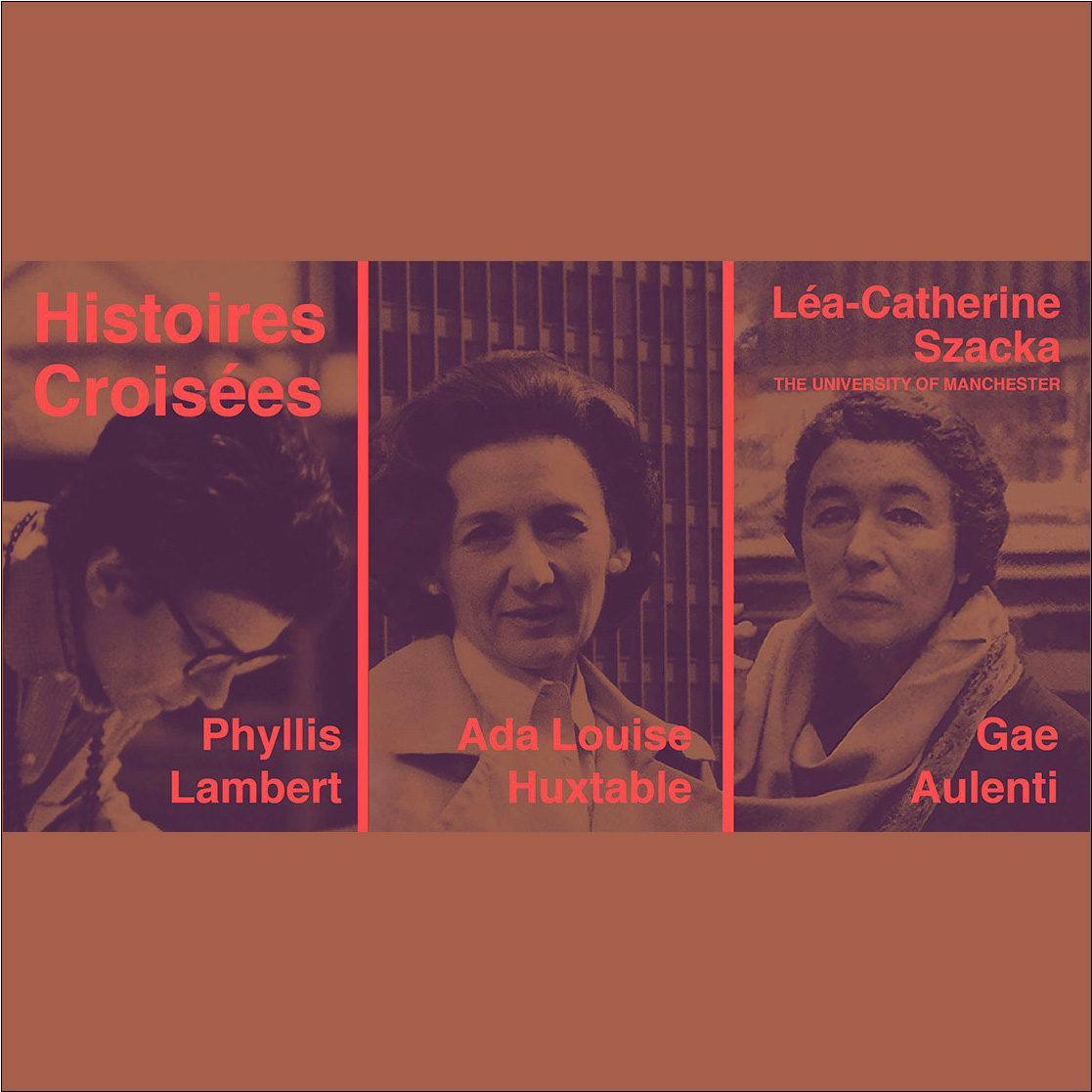 Public conference presented by Léa-Catherine Szacka: Crossed Histories, Phyllis Lambert, Ada Louise Huxtable and Gae Aulenti on architecture and the cityMarch 19, 2025 Conference by Léa-Catherine Szacka , University of Manchester
Date: Tuesday, April 1st at 5:30 pm.
Location: Amphitheatre 1120, Faculté de l’aménagement, Université de Montréal
Lecture series of the Laboratoire d’étude de l’architecture potentielle
Crossed HistoriesPhyllis Lambert, Ada Louise Huxtable and Gae Aulenti on architecture and the city Summary: Born in the 1920s, architects Gae Aulenti and Phyllis Lambert and critic Ada Louise Huxtable were among the most influential figures in post-war architecture and design. Pioneers in a largely male-dominated field at the time, and key players in the transition from modernism to postmodernism, they set out to conquer and shape public space. This talk retraces the history and careers of these three women, who are the focus of the exhibition Crossed Histories, presented until May 2025 at the Canadian Cultural Centre in Paris. Léa-Catherine Szacka: Senior Lecturer (Associate Professor) in Architectural Studies, University of Manchester Director of the Manchester Architecture Research Group (MARG) Vice-President, European Architectural History Network (EAHN) Co-Founder, PASZA - Platform for Architectural Research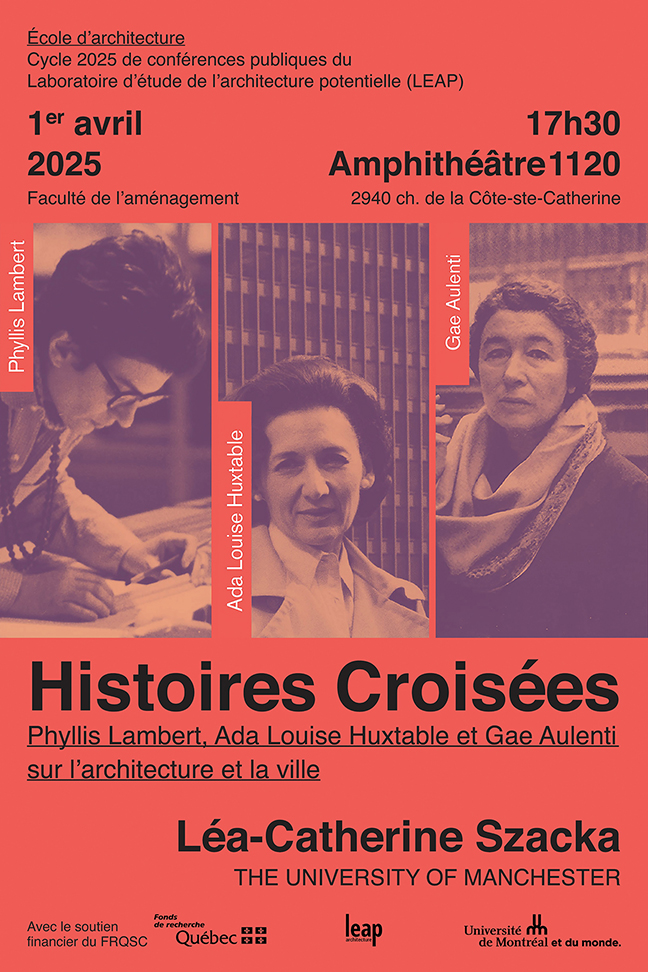 |
| March 18, 2026 | 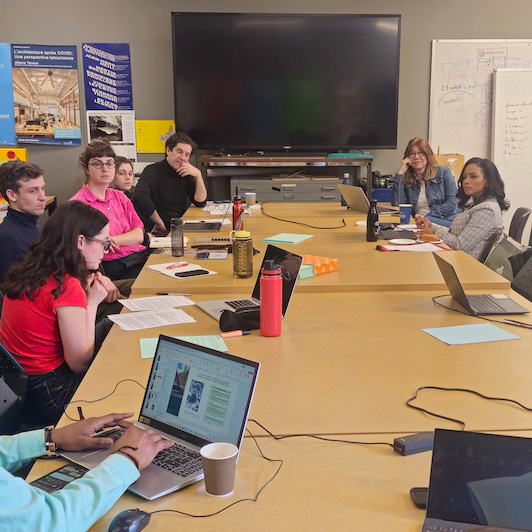 Graduate Seminar with Dr Marie Cecile KotykMarch 18, 2026 Date and time: March 18, 2026 from 1:30 to 5:00 pm. / With Dr. Marie Cecile Kotyk, Assistant Professor, School of Architecture, Planning and Landscape Architecture (SAPL), University of Calgary and member of the Design Justice Research Chair And in discussion with Dr. Jean-Pierre Chupin, Professor, School of Architecture, Université de Montréal / Presenting PhD Students: Juliane Alexandre Colmado, étudiante au doctorat individualisé en architecture, Université de Montréal The Phonotope : shaping sound for a (un-)silenced architecture Olivia Daigneault Deschênes, étudiante au doctorat individualisé en architecture, Université de Montréal From Tlachiuak, Montreal (Tiohtià :ke) to Lucha y Siesta, Roma : Architecture as complicit in emancipatory struggles Yolene Handabaka Ames, étudiante au doctorat individualisé en architecture, Université de Montréal Between demolition and adaptative reuse : social value as a lever of bottom-up heritage-making Paloma Castonguay-Rufino, étudiante au doctorat individualisé en architecture, Université Montréal From post-industrial obsolescence to civic space : reconversion cultures and the architectural reuse of industrial heritage in Canada Shantanu Biswas Linkon, étudiant au doctorat individualisé en architecture, Université de Montréal Indexing social value in architecture : comparing community centers and libraries both in Bangladesh and Canada through inclusiveness and spatial justice Raquel Fernandez, étudiante au doctorat individualisé en architecture, Université de Montréal Women’s collective housing : a feminist approach to housing Cyrille Jérôme Tchango Ngamaleu , étudiant au doctorat individualisé en architecture, Université de Montréal The intention to support care through architecture : a comparative study of the tectonics of the Maggie Centers’ Pavilions |
| April 2, 2026 | 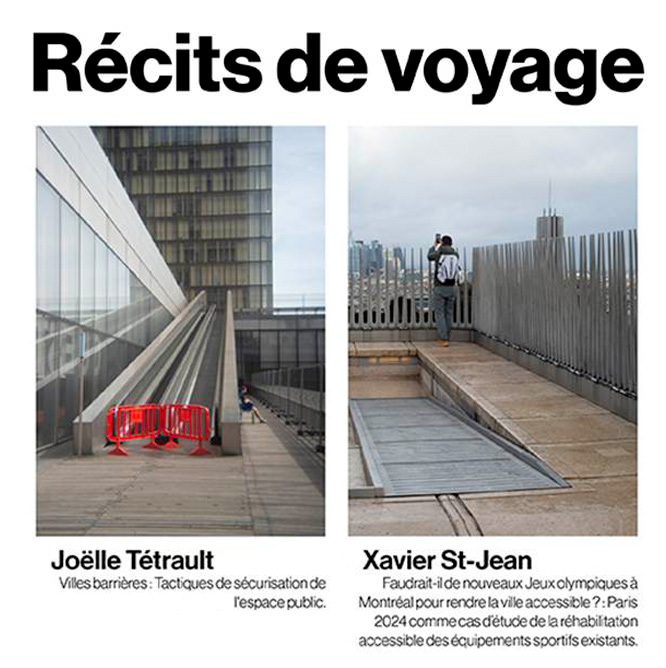 Travel NarrativesApril 2, 2026 Date: Tuesday, April 7, 2026 Event moderated by Paloma Castonguay-Rufino, PhD candidate at the Canada Research Chair in Architecture, Competition, and Quality (CRC-ACQUA) and the Laboratoire d'Étude de l'Architecture Potentielle (LEAP) Travel narratives serve as tools for capturing the various aspects of the travel experience, as a form of cultural immersion. In the field of architecture, they are accompanied by various means of capturing these experiences through texts, sketches, architectural details, photographs, collages, etc. Thus, the travel narrative allows us to explore a culture and its contexts through a personal and intimate perspective, as well as an architectural vision. Maria Moreno Ramirez Xavier St-Jean, former student member of CRC-ACQUA and LEAP Frédérick Langevin Joëlle Tétrault, former student member of CRC-ACQUA and LEAP |
| November 2, 2021 | 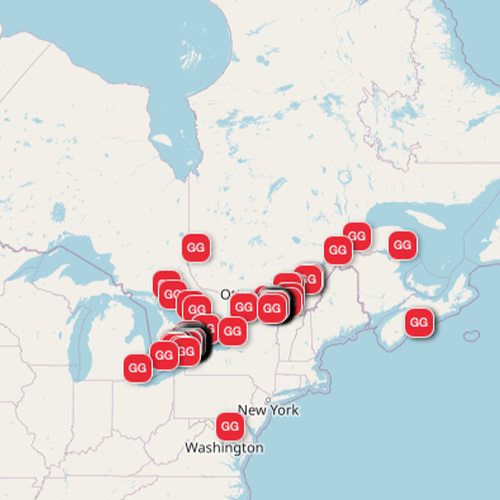 All Governor General’s Medals in Architecture in Canada gathered on a map and a visual galleryNovember 2, 2021 Wednesday, October 27, 2021.
The Atlas of Research on Exemplarity in Architecture and the Built Environment, in collaboration with the Canada Council for the Arts and the Royal Architectural Institute of Canada, presents all buildings and places recipient of a Governor General Medal in Architecture since 1982 on a single interactive map and in a visual gallery of over 250 items.
A new classification system by typological categories allows for more precise queries in the database. A table of "unlocated items" collects cases that cannot appear on the map because they are private residences.
The realization of this map and the entry of data in the AREA system is funded by the Canada Research Chair in Architecture, Competitions and Mediations of Excellence directed by Jean-Pierre Chupin (https://crc.umontreal.ca/en/ ), as well as by the Social Sciences and Humanities Research Council of Canada (SSHRC). This corpus was collected by the team of M.Arch. students coordinated by Lucas Ouellet at the Université de Montréal: Charles Cauchon and Anna Zakharova.For direct access to the map of all Governor General Medals in architecture since 1982:[vc_btn title="GOVERNOR GENERAL'S MEDALS MAP" align="center" button_block="true" link="url:https%3A%2F%2Farchitecture-excellence.org%2Fgovernor-general-map%2F|target:_blank"]For direct access to the visual gallery:[vc_btn title="VISUAL GALLERY" align="center" button_block="true" link="url:https%3A%2F%2Farchitecture-excellence.org%2Fgovernor-general%2F|target:_blank"] |
| April 10, 2022 | Block 2 design competitionApril 10, 2022 Hello,
The Canada Research Chair in Architecture, Competitions and Mediations of Excellence having had the honor of being associated with the preparation and implementation of this historic competition, I am pleased to extend to you this invitation to the public presentations of the 6 internationally renowned teams that will take place online on April 11, 2022.
Jean-Pierre Chupin
http://crc.umontreal.ca[vc_separator color="black"]In May 2021, Public Services and Procurement Canada (PSPC) launched an architectural design competition to redevelop Block 2, a full city block directly opposite Canada’s parliament buildings, just south of Parliament Hill.
The renewal of Block 2 is a critical piece of PSPC’s Long Term Vision and Plan for the Parliamentary Precinct. The design competition ensures that the final design for this city block brings forward new vitality to a significant part of Confederation Boulevard. The goal is to transform this mix of buildings into an innovative complex that will meet the needs of Parliament and the public now and into the future.
On April 11, the six design team finalists will present their design concepts for Block 2 through a virtual public presentation. We would be grateful if you would share the invitation below about the public presentation with your networks.[vc_single_image image="24481" img_size="large" alignment="center"]Few sites carry the significance of Block 2, a full city block directly opposite Canada’s parliament buildings, just south of Parliament Hill. To the north, it faces the Centre Block and its Peace Tower.
The renewal of Block 2 is a critical piece of PSPC’s Long Term Vision and Plan (LTVP) for the Parliamentary Precinct. The design competition, launched in spring 2021, ensures that the final design for this city block brings forward new vitality to a significant part of Confederation Boulevard. The goal is to transform this mix of buildings into an innovative complex that will meet the needs of Parliament and the public now and into the future.
Join us to hear the competitors speak to their vision for this prominent space in Canada’s capital. The six finalist design teams will present their design concepts for Block 2.
PRESENTERS:
|
| January 29, 2023 |  Video of the roundtable: What is an architecture award worth?January 29, 2023 This debate was organized at the BAnQ's National Archives in Montreal (535 Viger Avenue East) on November 24, 2022. Once a symbol of excellence and exception, architecture and design awards, which aim to reward achievements, have multiplied exponentially in recent years. We no longer count the number of companies, associations, municipalities and specialized publications that have set up their own awards, many of which have greatly multiplied their categories over the years. The situation is such that we can now speak of a veritable awards "industry", both in Quebec and internationally. The event was organized by Kollectif, in partnership with Jean-Pierre Chupin, Canada Research Chair in Architecture, Competitions and Mediations of Excellence (Université de Montréal) and co-editor of the collective book The Rise of Awards in Architecture (Vernon Press, 2022) with Carmela Cucuzzella and Georges Adamczyk. 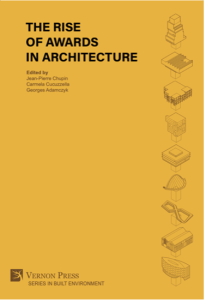 Presenter: Marc-André Carignan, Content Manager for Kollectif Our panelists:
Our guests of honour:
Video production:
Funding: Canada Research Chair in Architecture, Competitions and Mediations of Excellence. |
| September 25, 2023 |  Conférence de Carmela Cucuzzella : Le design au croisement de la durabilité, du didactisme et de l’accessibilité – enSeptember 25, 2023 Date : Le jeudi 28 septembre, 2023 à 12h15-13h15 Lieu : Salle 1150, Faculté de l’aménagement de l’Université de Montréal |
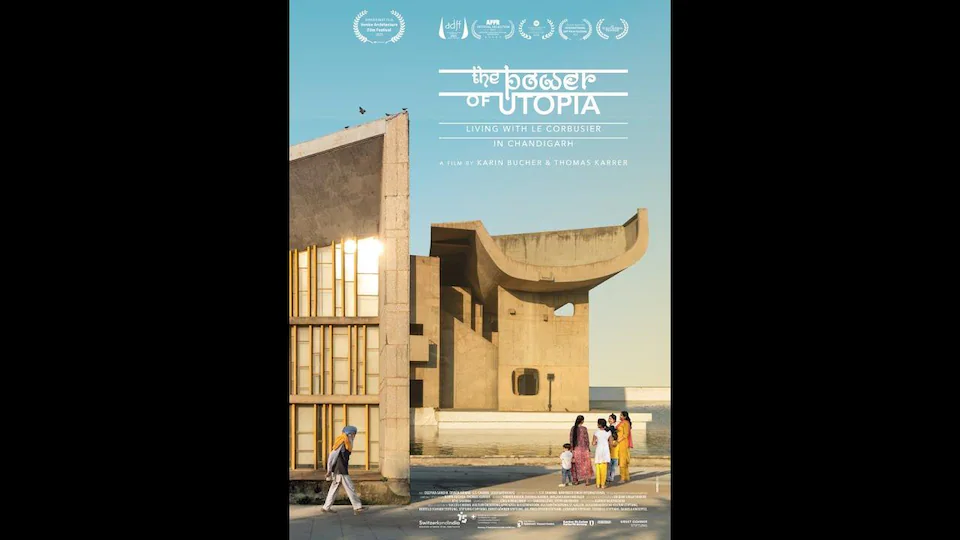
| March 21, 2024 | 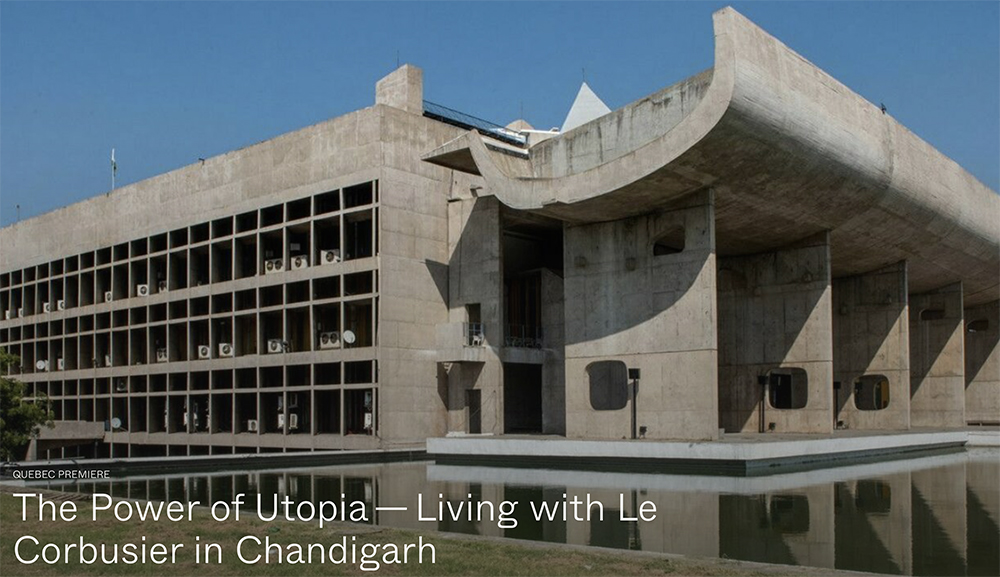 Jean-Pierre Chupin talks to Radio Canada about the Chandigarh principles and the derivatives of the Corbusé utopiaMarch 21, 2024 Jean-Pierre Chupin is invited to Radio Canada's Tout Terrain (Janic Tremblay) to reflect on the current state of affairs and the derivatives of Le Corbusier's concepts of architecture and the city in Chandigarh, India. On the occasion of the Festival international du film sur l'art (FIFA) in Montreal, the film The Power of Utopia - Living with Le Corbusier in Chandigarh will be shown. When architect Le Corbusier designed the city of Chandigarh, India, he imagined a city that would enable harmonious interaction between its inhabitants and the environment. For some, this represented progress and success, while for others it was a failure. Janic Tremblay discusses the case of Chandigarh and, more broadly, Le Corbusier's approach to architecture and urban planning with Jean-Pierre Chupin, Professor at the School of Architecture of the Université de Montréal and holder of the Canada Research Chair in Architecture, Competitions and the Mediations of Excellence. To listen to the episode on Sunday, March 10, 2024: |
| January 18, 2025 |  Video of the public debate on school architecture in the city center!January 18, 2025 “From business districts almost exclusively reserved for commercial and professional activities, Canadian downtowns are increasingly becoming living spaces. Yet there are few elementary schools, which are essential to inclusive urban development. And for good reason: the traditional model of the single-purpose, low-rise school building, with a large playground at ground level, is at odds with a high-density, high-value environment. The heart of metropolises attracts developers, all the more so as urban planning regulations allow them to erect high-rise buildings, a source of significant revenue. So what kind of school architecture can we imagine for our city centers? And what might it offer schoolchildren?” - A. Cormier, A. Paré and G. Adamczyk, En centre-ville : une architecture à hauteur d'enfant, Potential Architecture Books, Montreal, 2024
The Laboratoire d'étude de l'architecture potentielle (LEAP) recognizes the importance of the stakes involved in building schools downtown, and held a round table on this theme to mark the launch of the book En centre-ville : une architecture à hauteur d'enfant.
Moderator Jean-Pierre Chupin, Architect and Professor at the School of Architecture, Université de Montréal, Chair Holder of the Canada Research Chair in Architecture, Competitions and Mediations of Excellence and Director of the LEAP
Panelists
The round table is supported by the Social Sciences and Humanities Research Council of Canada (SSHRC), the Vice-rectorat à la recherche, à la découverte, à la création et à l'innovation de l'Université de Montréal (VRRCDI) and the Laboratoire d'étude de l'architecture potentielle (LEAP). |
| March 7, 2025 |  Public conference presented by Jean-Louis Violeau: Architecture and its (Single) Users as Seen by Sociologist and Philosopher Jean BaudrillardMarch 7, 2025 Conference by Jean-Louis Violeau, École Nationale Supérieure d’Architecture de Nantes
Date: Tuesday, March 11th at 5:30 pm.
Location: Amphitheatre 1120, Faculté de l’aménagement, Université de Montréal
Lecture series of the Laboratoire d’étude de l’architecture potentielle
Architecture and its (Single) Users as Seen by Sociologist and Philosopher Jean BaudrillardSummary: How does one go about exploring Jean Baudrillard's intimate yet suspicious relationship with architecture? One begins, as one should, with Disney, moves on to the duck and the Venturis, stops at the figure of the (architectural) monster, moves on to Jean Nouvel and the ambiguities of transparency, and finally arrives at some contemporary projects, notably the highly condemned Europacity. Along the way, Baudrillard raises two questions: what has become of architectural postmodernism, and the persistence of the notion of the author in architecture. Baudrillard was more of an imaginary sociologist, intuitive and detached, an interpreter who amused himself by drawing the dotted lines of the present, overdoing it and regularly tending to paroxysms. Hence his interest in architectures that resist interpretation and seem to take on a life of their own, as if detached from their designers: the Twin Towers of the World Trade Center, the Biosphère II project, the Beaubourg, the Guggenheim Bilbao, and some of Jean Nouvel's architecture. Behind the scenes: obscure and ironic, every stage has its backstage, every scene is reversible, every project calls for its counter-project. The cursed part always bides its time. Culture for Beaubourg, globalization for the WTC, the planet for Biosphère II, the commodification of cities for the Guggenheim Bilbao... The ambivalence grows as these projects strive to saturate reality. What all these untamed concretions have in common, however, is that they seek first and foremost to bring the edge of difference to bear on generalized equivalence. In an age of no-fake and a shared quest for authenticity, this sociological perspective is meeting with renewed interest, particularly in the ambivalent choices and behaviors of digital children. The sociologist Jean-Louis Violeau is a professor at the Ecole Nationale Supérieure d'Architecture de Nantes and at the Urban School of Sciences Po Paris. He is a researcher at CRENAU (CNRS UMR AAU). He is a regular contributor to architectural magazines, in particular AMC-Le Moniteur architecture and L'Architecture d'aujourd'hui, as well as more general magazines such as Esprit, Place Publique Nantes-Saint-Nazaire and Urbanisme. He is also a member of the editorial board of the latter two magazines. His dissertation Les architectes et mai 68 was published in 2005 by Recherches, the distant heirs of the journal of the same name founded under the aegis of Félix Guattari and the CERFI. The sequel, his HDR (Habilitation à Diriger des Recherches) on Les architectes et mai 81, was published by Recherches in 2011.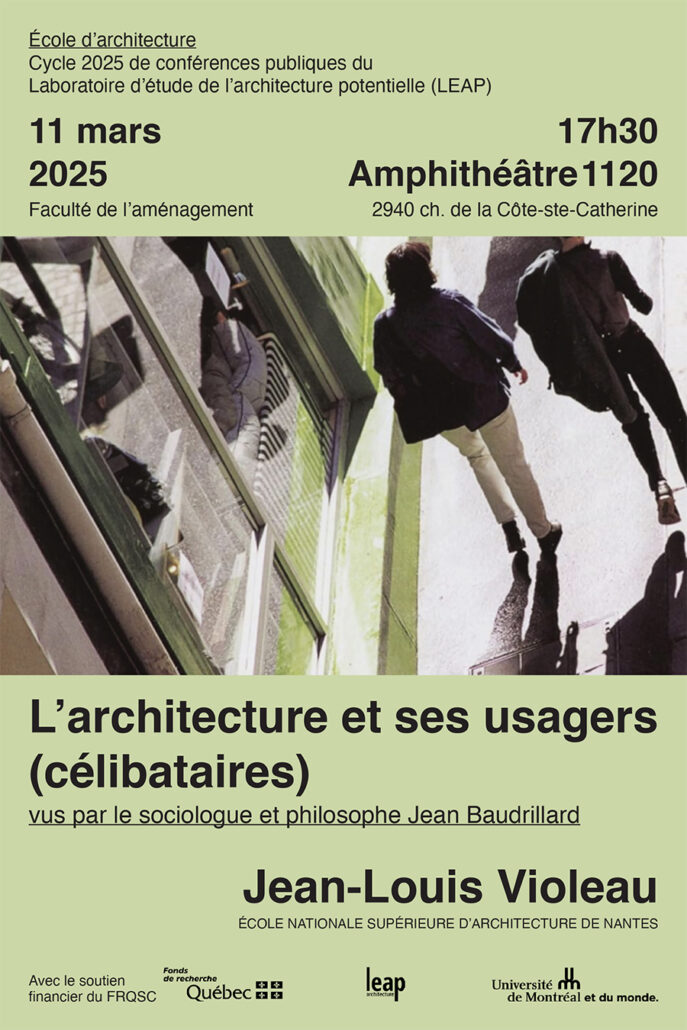 |
| March 10, 2025 |  Jean-Pierre Chupin Named Fellow of the Royal Architectural Institute of Canada, Class of 2025March 10, 2025 Professor Chupin was nominated by Thierry Montpetit, FRAIC, and letters of support were submitted by five renowned Quebec architects: Anik Shooner, FIRAC, Nathalie Dion, FIRAC, Gilles Prud'homme, FIRAC, Maxime Frappier, FIRAC, and Renée Daoust, FIRAC, in the category of : Outstanding scholarly contributions supported by research, publications or teaching in the field of architecture, and, Outstanding contributions to the profession fostering excellence in architectural practice through leadership in public service or industry organizations.
Fellows will be formally inducted into the RAIC College on Tuesday, June 3, 2025 at an induction ceremony held in conjunction with the RAIC Conference on Architecture in Montreal, Quebec.
Visit the RAIC website to see the 43 new Fellows 2025. |
| February 27, 2026 | 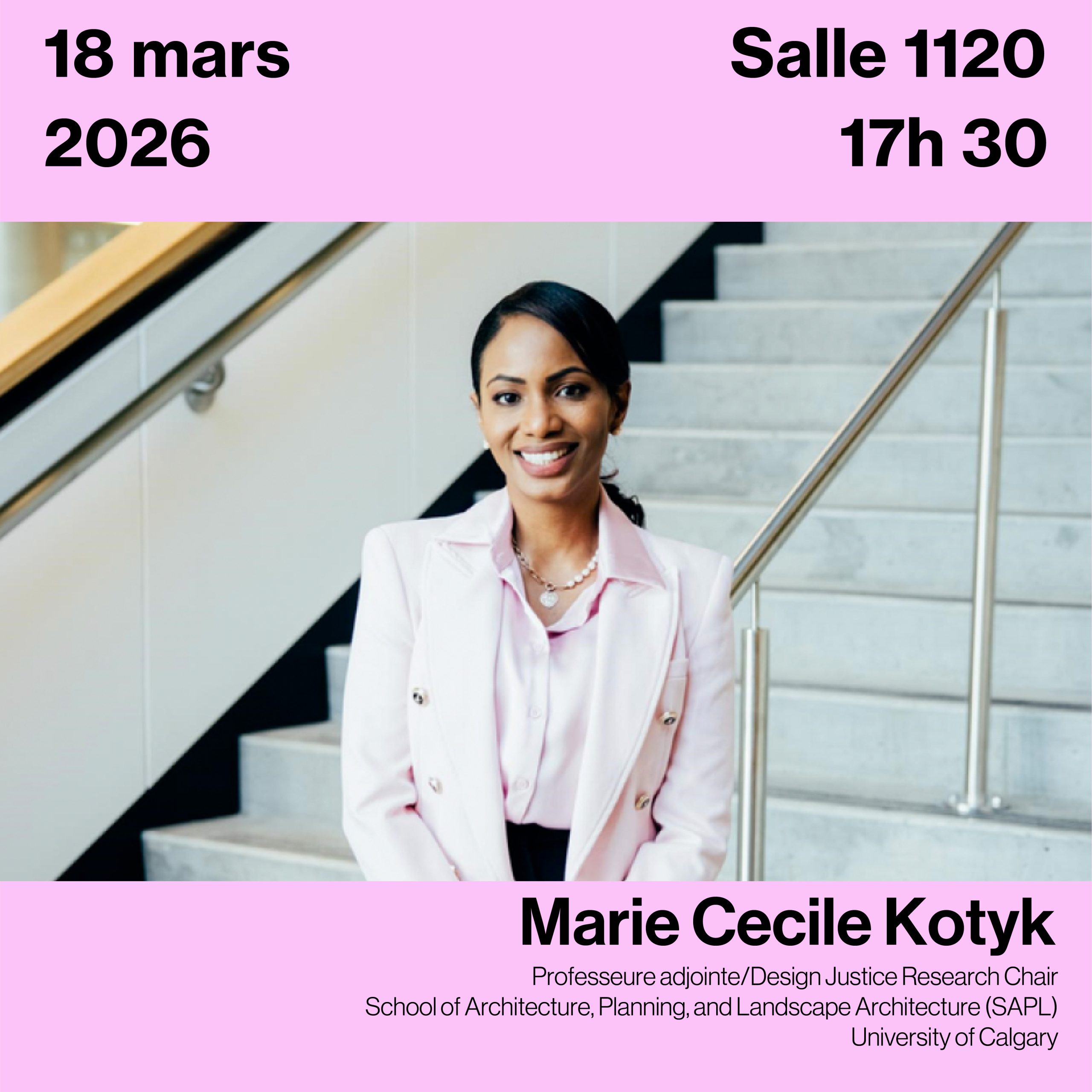 From Design Injustice to Design Justice: Why the Built Environment Must ChangeFebruary 27, 2026 Lecture by Marie Cecile Kotyk, University of Calgary Date : Wednesday, March 18th at 5.30pm Location : Université de Montréal, Faculté de l’Aménagement, Amphi 1120 Lecture series of the LEAP and the École d’architecture Architecture and urban planning have historically produced inequalities, but designing projects from a “spatial justice” perspective makes it possible to envision more equitable, inclusive, and community-oriented built environments. Design is never neutral. From outright discrimination through urban renewal to hostile architecture and exclusive zoning, the built environment has historically been used to reinforce inequalities in access to housing, safety, mobility, and opportunity. This presentation introduces the concept of “justice through design” as a critical framework for confronting this legacy and transforming the way we plan, design, and govern cities. Historical examples, contemporary case studies, and community initiatives in the areas of housing, public spaces, climate resilience, and education show how design can shift from perpetuating injustice to actively redistributing power. Based on lived experience and participatory practice, the lecture explains why justice in design is not optional, but essential to creating inclusive, equitable, and just communities. Dr. Marie Cecile Kotyk Assistant Professor / Design Justice Research Chair School of Architecture, Planning, and Landscape Architecture (SAPL) University of Calgary 
Marie Cecile Kotyk is an award-winning urban planner, housing professional, and spatial justice researcher with over 15 years of experience promoting equity in the public and nonprofit sectors. As a leading figure in community-based research and spatial justice, her work addresses the systemic forces that produce racial inequalities in the built environment, particularly for Black, Indigenous, and structurally marginalized communities. Her doctoral research led to the creation of the Black Housing Equity Framework, which aims to combat anti-Black racism in housing policy and design. Through her leadership in creating the UDesign Justice initiative at the University of Calgary, Dr. Kotyk is establishing a transdisciplinary center that brings together academics, community members, and practitioners to co-create equity-focused solutions for spatial, social, and systemic transformation. Contact : Jean-Pierre Chupin, Chaire de recherche du Canada en architecture, concours et qualité (CRC-ACQUA) + Laboratoire d’étude de l’architecture potentielle (LEAP) |
| March 24, 2025 |  Final Program for the 2025 Toronto Convention Now Available!March 24, 2025
Toronto 2025 Convention Program : Toward a White Paper on Quality...DOWNLOAD THE PROGRAM IN PDF FORMAT The final program for the 2025 Annual Convention is now available. From April 30 to May 2 in Toronto, the event will bring together experts, researchers, and practitioners to advance a national strategy for quality in Canada’s built environment. We are happy to share with you this program and hope you are as excited as we are for those great speakers, roundtables discussions and site visits that will take place during the convention.
Jean-Pierre Chupin, PhD, Professor, Architect MOAQ, MIRAC. Holder of the Canada Research Chair in Architecture, Competitions and Mediations of Excellence at Université de Montréal and Principal Investigator of the SSHRC Research Partnership on Quality in Canada’s Built Environment. |
| April 7, 2026 | 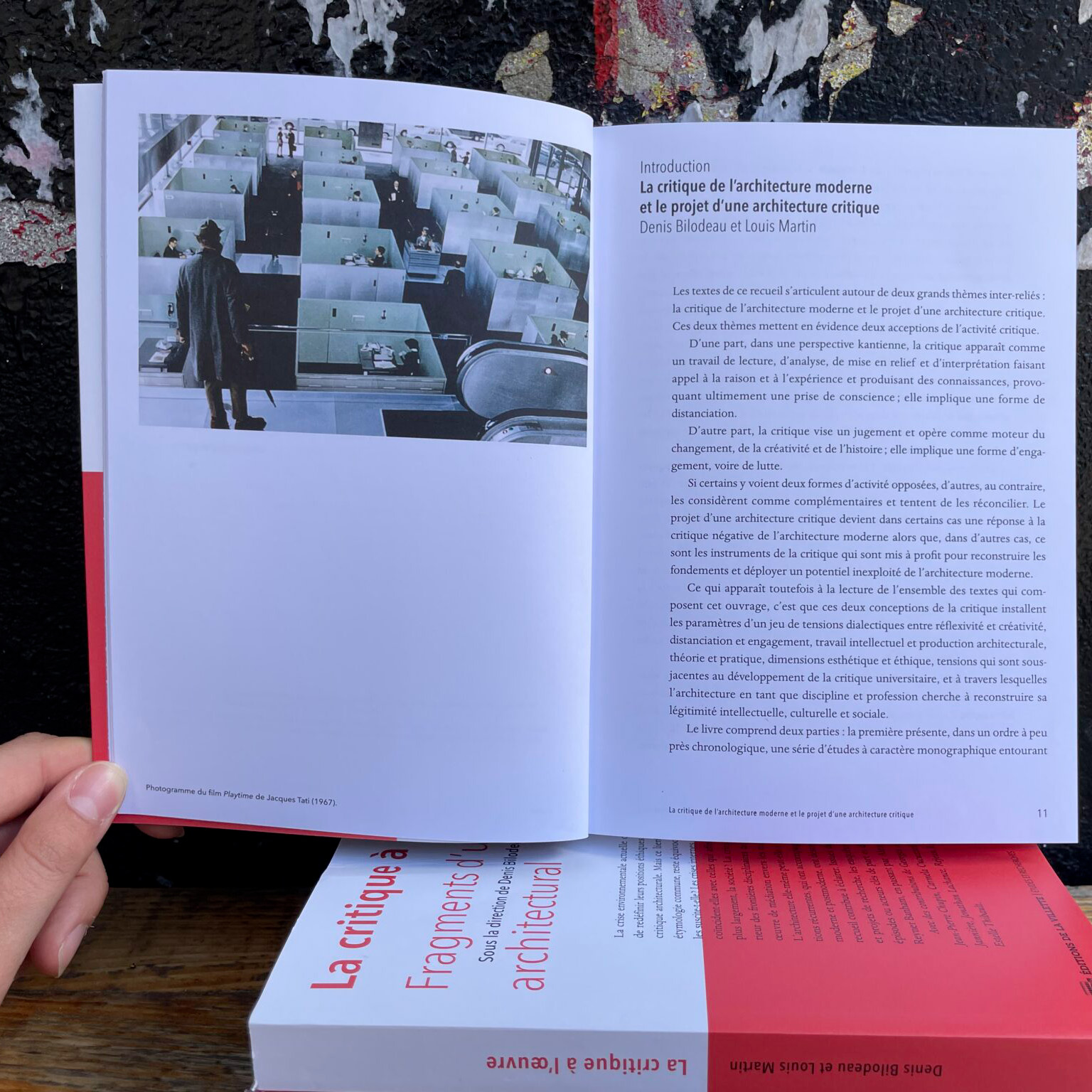 New book publication edited by Denis Bilodeau (UdeM) and Louis Martin (UQAM): La critique à l’œuvre. Fragments d’un discours architecturalApril 7, 2026 La critique à l’œuvre. Fragments d’un discours architectural
Edited by Denis Bilodeau and Louis Martin
Paris: Éditions de la Villette, 2025
The current environmental crisis confronts architects with the need to redefine their ethical positions, giving a renewed role to architectural criticism. But this link between crisis and criticism, beyond a common etymology, remains equivocal. Does criticism react to crises, or does it provoke them? Do the internal crises that regularly plague criticism coincide with those affecting architecture, its institutions and, more broadly, society? Is the purpose of criticism to act within the disciplinary boundaries of architecture or, on the contrary, to mediate the worlds it is supposed to transform? Can architecture itself arm itself with critical potential? These recurring questions, which have accompanied the development of modern and postmodern architecture, now have a long history that the present collection helps to illuminate. Stemming from a number of symposia, study days and research projects, the investigations it brings together detail certain episodes or key players on both sides of the Atlantic, from Bruno Zevi to Reyner Banham, via Alexander Tzonis and Kenneth Frampton.
With contributions from:
 |
| June 23, 2025 | 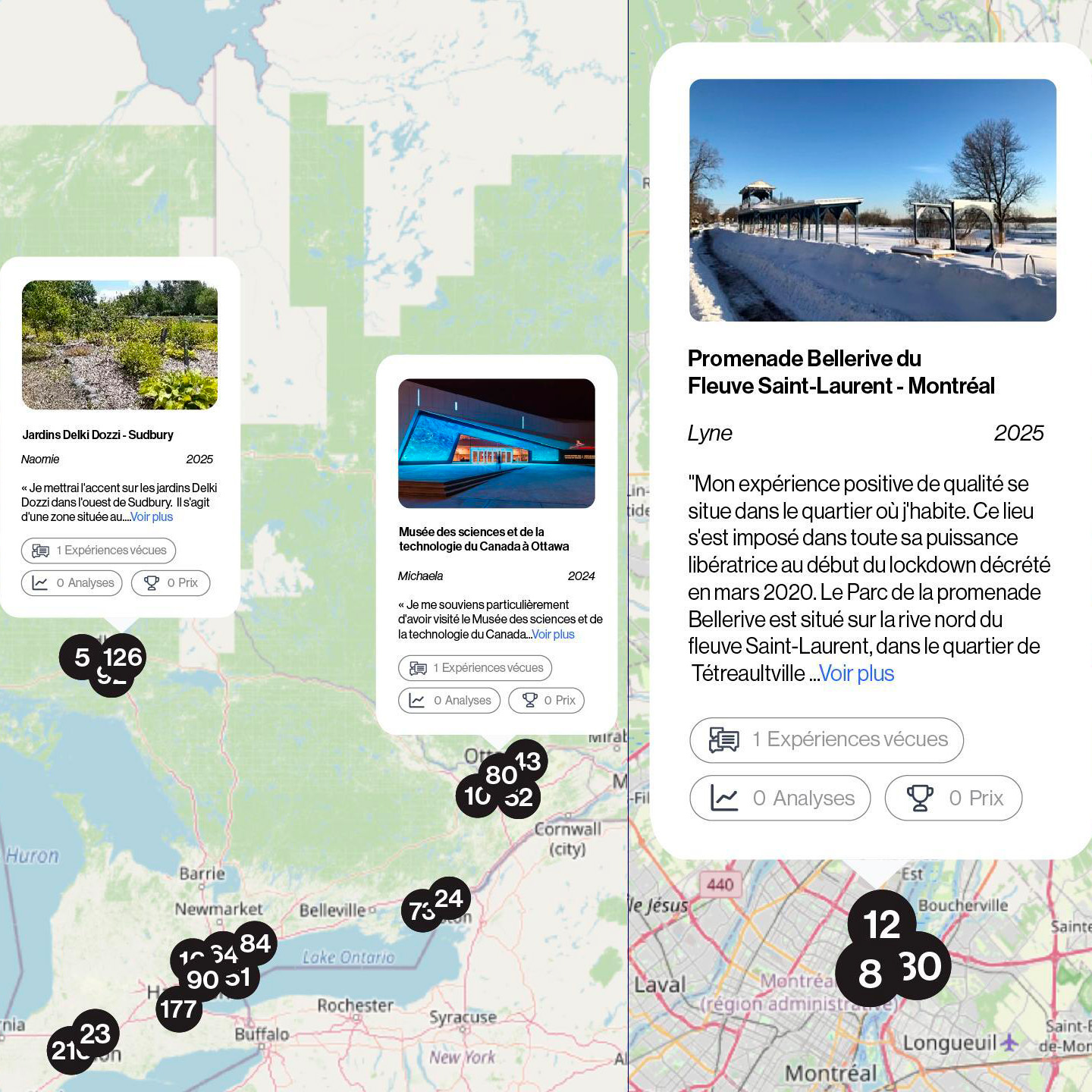 Discover ArchiQualiData! A new database bringing together lived experiences and case studies in Canada’s living environmentsJune 23, 2025
The ArchiQualiData database provides analyses and studies of exemplary and award-winning living environments, real-life experiences and case studies.
DISCOVER detailed studies conducted by researchers, providing unique insights into exceptional buildings and places.
ACCESS testimonials from people who have directly interacted with these entities, enriching understanding through authentic stories.
FIND precise information on each exemplary entity, thanks to a simple interface and advanced search system. |
| June 23, 2025 | 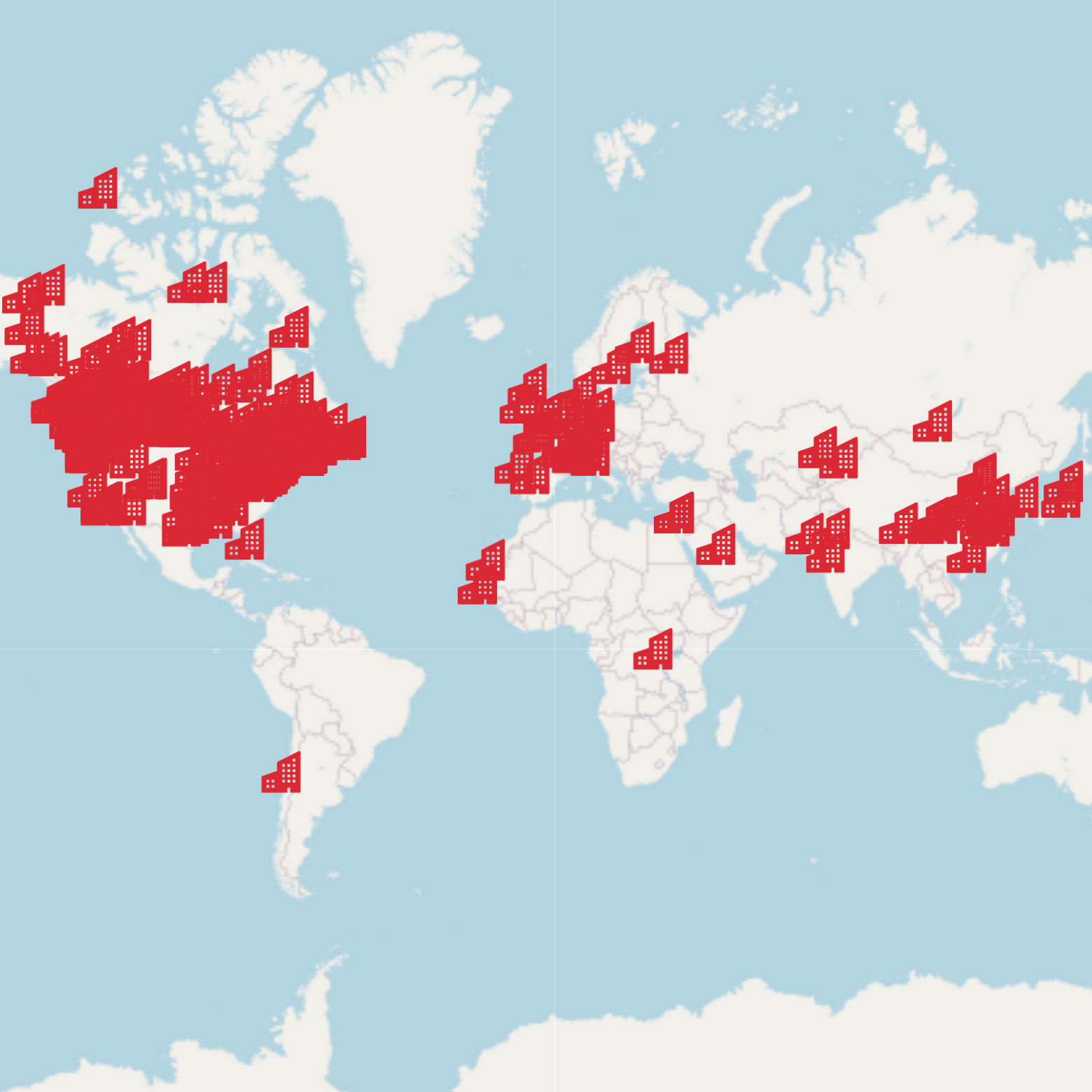 Discover the CANADIAN MAP OF AWARD-WINNING BUILDINGS AND PLACESJune 23, 2025 The Atlas of Research on Exemplarity in Architecture and the Built Environment (AREA-BE) is an open construction site!
AREA-BE is an initiative of the Canada Research Chair in Architecture, Competitions and Mediations for Excellence (CRC-ACME), held by Jean-Pierre Chupin, Ph.D. , architect MOAQ, MIRAC, DPLG, DipArch (2), Professor at Université de Montréal. This initiative is actively supported by a network of Canadian and international scholars.
The current website of the AREA (www.architecture-excellence.org) has been officially launched in November 2019 for information purposes.
The AREA website foreshadows an important documentation and research platform to be launched in 2021 / 2022
This long-term initiative is supported by the Canada Foundation for Innovation and the Social Sciences and Humanities Research Council of Canada through the Canada Research Chairs Program.
In the coming years, the establishment of an AREA partnership of researchers based in Canadian schools of architecture and research universities will ensure the reliability, regular updating and sustainability of this scientific platform regrouping resources, knowledge transfers and analyzes on best examples of architectural design, landscape design and urban design in Canada.
Thanks to the contribution of institutions delivering awards and to professional teams giving access to data on projects and buildings, researchers and students will be able to contribute to a better understanding of the current evolution of quality in the built environment. The data, information, analyzes, comparisons, visualizations that will be progressively delivered – in open access – on the AREA platform will take advantage of award-winning projects and buildings in Canada, from year to year, in order to identify and better understand best practices.
The AREA collective platform will be meant to provide scientific data in order to support education, policies, actions and mediations aiming at excellence in the built environment.
Jean-Pierre Chupin (Université de Montréal) |
| July 14, 2025 | 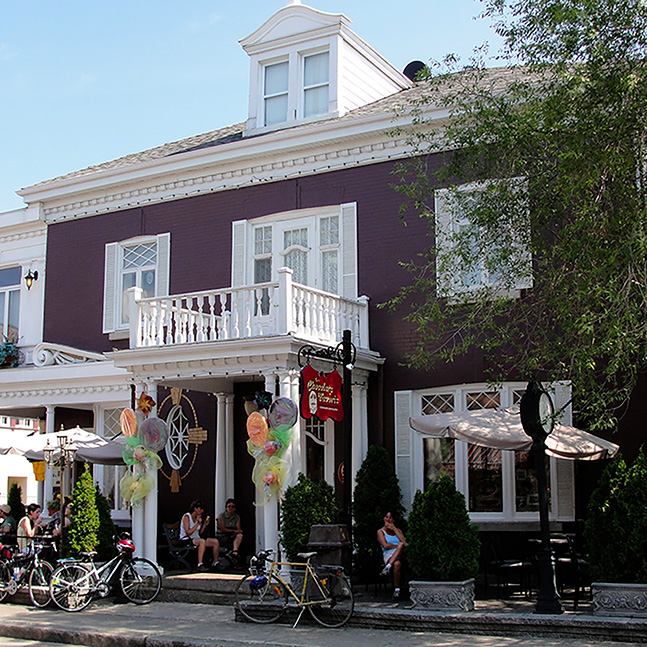 New article by Yolene Handabaka Ames: What’s behind the demolition of the Chocolats favoris building in Vieux-Lévis?July 14, 2025
New article published in Le Devoir by Yolene Handabaka Ames, student of the individualized doctorate in architecture at the École d'architecture de la Faculté de l'aménagement: What's behind the demolition of Chocolats favoris' building in Vieux-Lévis?
"The case of the imminent demolition of Chocolats favoris has been making headlines since October 2023, when a public notice of demolition request from the City of Lévis was posted on the building's façade.
The saga, which lasted almost two years, revealed recurring conservation issues surrounding Quebec's built heritage. So much so that the Lévis residence has become an emblematic case of what lies behind most heritage building demolition projects: the social value of a “living” heritage.
In autumn 2022, the house that had housed Chocolats favoris since 1996 was closed due to water infiltration and deteriorating masonry. After professional appraisals, letters signed by heritage advocates, requests for review and the active participation of Lévis residents at public hearings, demolition was approved on December 16. A request for a one-year moratorium did not change the building's fate either. On June 19, at a regular meeting of the municipal council, elected officials voted against accepting the request. The house of Chocolats favoris will soon fall under the demolition pick... "
Read more on Le Devoir’s website.
Photo by René Bélanger (Flickr). |
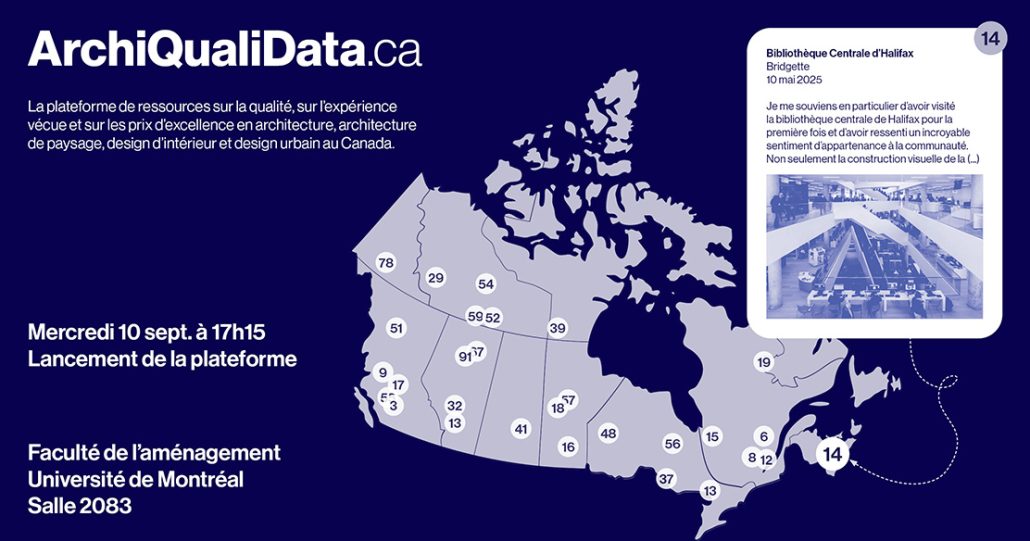
| August 28, 2025 | 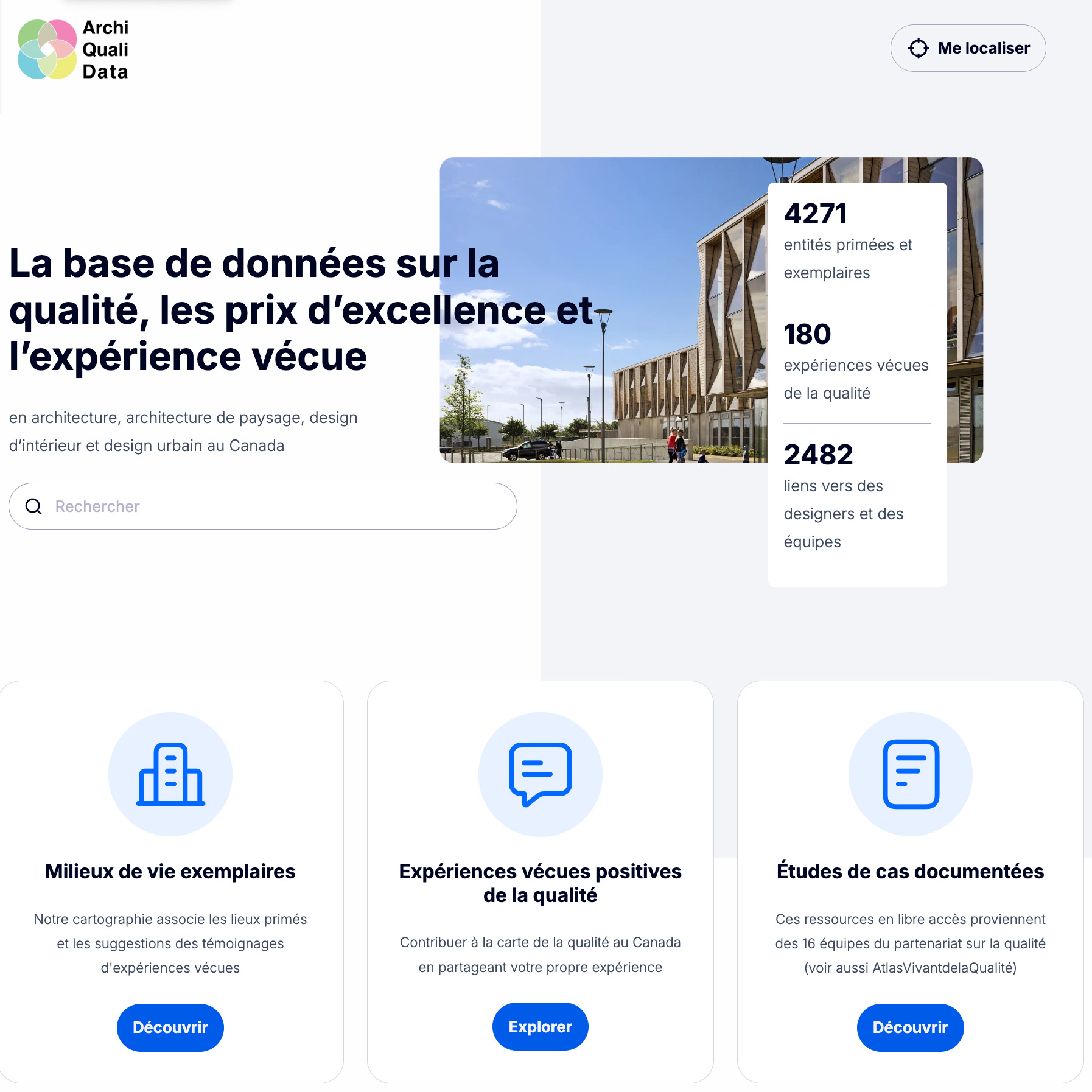 Launch of the ArchiQualiData.ca platform!August 28, 2025 On Wednesday, September 10, at 5:15 p.m. in rooms 2081 and 2083 of the Faculty of Environmental Design, the Canada Research Chair in Architecture, Competition, and Quality, led by Professor Jean-Pierre Chupin at the University of Montreal, will present the large open-access digital platform: ArchiQualiData.
ArchiQualiData is being launched as part of the traveling exhibition “Quality Issues in Canada's Built Environment,” on display from August 29 to September 19.
ArchiQualiData is the resource platform for quality, lived experience, and awards of excellence in architecture, landscape architecture, interior design, and urban design in Canada.
This major national collaboration has received funding from the Canada Foundation for Innovation, the Quebec Ministry of Education, the University of Montreal, the Canada Research Chairs Program, and the Social Sciences and Humanities Research Council of Canada.
ArchiQualiData is hosted on the secure servers of the Digital Research Alliance of Canada.
 |
| August 28, 2025 | 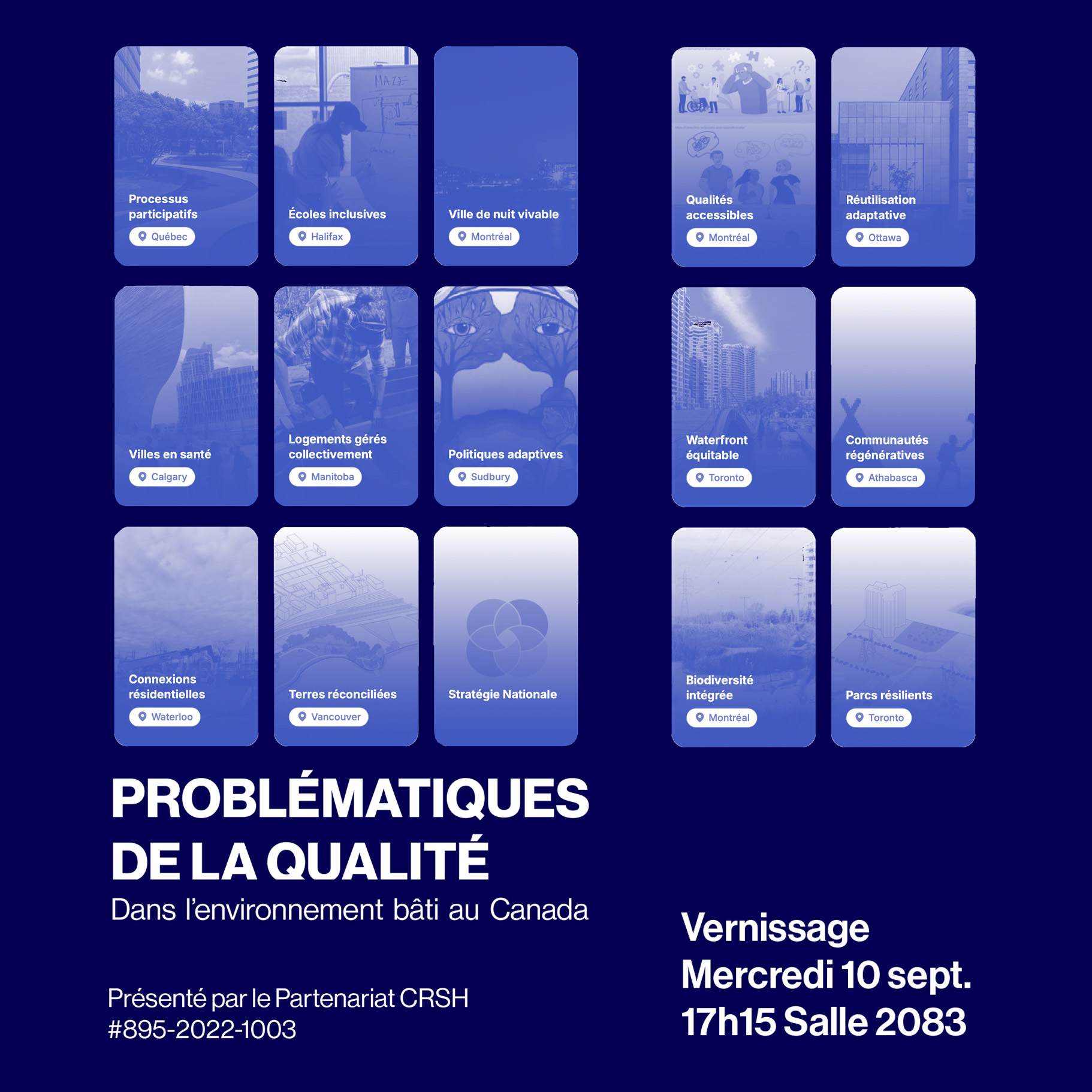 Exhibition: “Quality Issues in Canada’s Built Environment”August 28, 2025 Traveling exhibition showcasing the work in progress on roadmaps developed by 15 cross-sector teams from coast to coast
As part of a research partnership funded by the Social Sciences and Humanities Research Council of Canada and numerous partners, the Canada Research Chair in Architecture, Competition and Quality at the Université de Montréal, under the direction of Professor Jean-Pierre Chupin, brought together 14 universities and more than 60 academics. Together, they convinced the Rick Hansen Foundation, Public Services and Procurement Canada, the Royal Architectural Institute of Canada, and more than 60 citizen groups, professional organizations, and municipal services to form 15 collaborative research teams, including a team of young Indigenous leaders.
In May 2025, these cross-sector groups presented an initial status report on their roadmaps toward more equitable, sustainable, and socially valuable quality at the annual convention at the University of Toronto and then, in June, at Place Bonaventure during the RAIC's annual conference.
In Room 2081 of the Faculty of Environmental Design, from August 29 to September 19, 2025, this exhibition of work in progress provides an overview of research undertaken since 2022 and which will continue until 2027. This is an ongoing national project and not a finished product. Videos made by students accompany the panels, which summarize the major issues of quality, the steps taken, and the actions proposed.
A roadmap outlines key elements such as the initial problem, overall objectives, resources, process steps, and proposed short-, medium-, and long-term actions. There are many gray areas in our current definitions of quality: accessible quality, adaptive reuse, participatory processes, resilient parks, inclusive schools, integrated biodiversity, etc. Following a bottom-up process, these stakeholder teams conduct analyses and consultations in specific contexts, addressing issues that challenge current definitions of quality in architecture, landscape, design, and urban planning. The research highlights the importance of collecting lived experiences to break down silos while updating expertise. 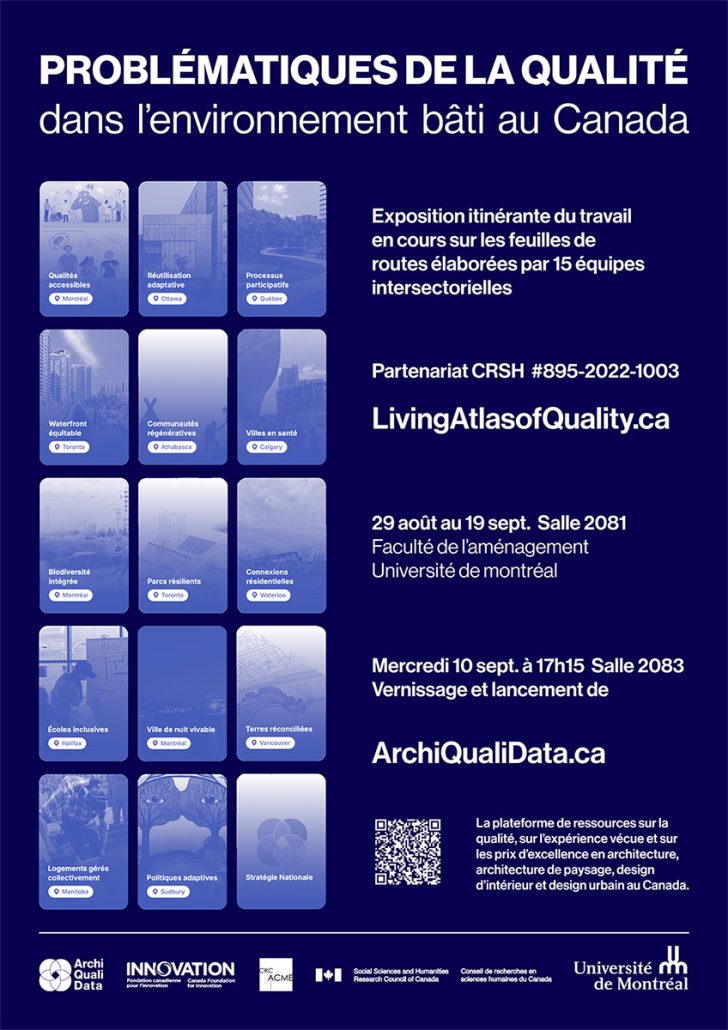 Don't miss the launch of the ArchiQualiData.ca platform on September 10 at 5:15 p.m. Don't miss the launch of the ArchiQualiData.ca platform on September 10 at 5:15 p.m. |
| September 18, 2025 | 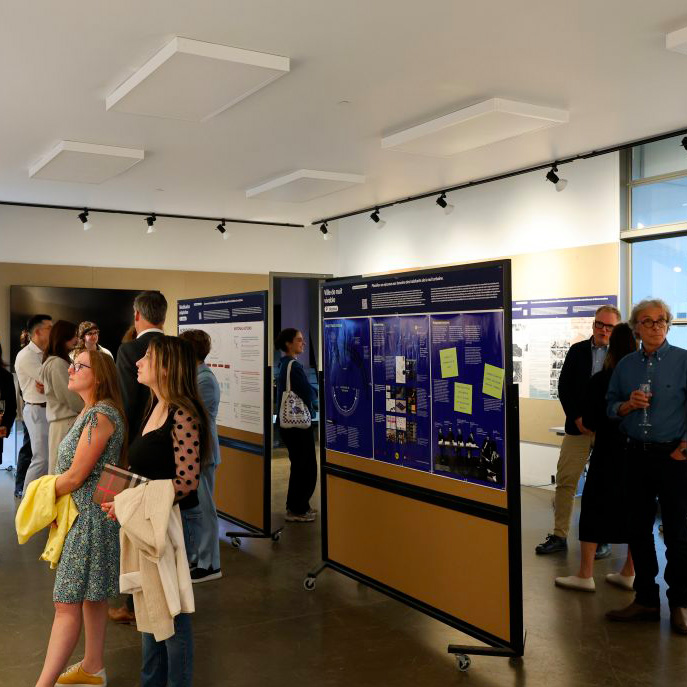 Exhibition “Quality Issues in Canada’s Built Environment” and Launch of ArchiQualiData.caSeptember 18, 2025 As part of a research partnership funded by the Social Sciences and Humanities Research Council of Canada and numerous partners, the Canada Research Chair in Architecture, Competition and Quality at the Université de Montréal, under the direction of Professor Jean-Pierre Chupin, brought together 14 universities and more than 60 academics. Together, they convinced the Rick Hansen Foundation, Public Services and Procurement Canada, the Royal Architectural Institute of Canada, and more than 60 citizen groups, professional organizations, and municipal services to form 15 collaborative research teams, including a team of young Indigenous leaders.
In May 2025, these cross-sector groups presented an initial status report on their roadmaps toward more equitable, sustainable, and socially valuable quality at the annual convention at the University of Toronto and then, in June, at Place Bonaventure during the RAIC’s annual conference.
In Room 2081 of the Faculty of Environmental Design, from August 29 to September 19, 2025, this exhibition of work in progress provides an overview of research undertaken since 2022 and which will continue until 2027. This is an ongoing national project and not a finished product. Videos made by students accompany the panels, which summarize the major issues of quality, the steps taken, and the actions proposed.
A roadmap outlines key elements such as the initial problem, overall objectives, resources, process steps, and proposed short-, medium-, and long-term actions. There are many gray areas in our current definitions of quality: accessible quality, adaptive reuse, participatory processes, resilient parks, inclusive schools, integrated biodiversity, etc. Following a bottom-up process, these stakeholder teams conduct analyses and consultations in specific contexts, addressing issues that challenge current definitions of quality in architecture, landscape, design, and urban planning. The research highlights the importance of collecting lived experiences to break down silos while updating expertise.
The exhibition vernissage, held on September 10, 2025, also marked the launch of ArchiQualiData.ca, the resource platform on quality, experience, and awards of excellence in architecture, landscape architecture, interior design, and urban design in Canada.  |
| October 22, 2025 | 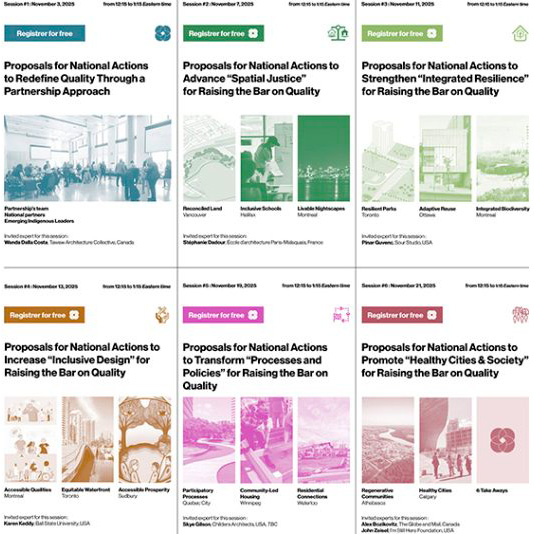 Join the online public debate on quality in Canada!October 22, 2025
Six one-hour sessions from November 3 to 21 (12:15 p.m. ET) (GMT-4)
Topics: 1 – Redefining quality in a partnership approach (Nov. 3) 2 – Advancing spatial justice (Nov. 7) 3 – Building more integrated resilience (Nov. 11) 4 – Accelerating inclusive design (Nov. 13) 5 – Transforming processes and policies (Nov. 19) 6 – Promoting urban health (Nov. 21)
It is with great pleasure that we invite the public to join the Public Forum on Quality organized by the SSHRC Partnership on Quality. In November, no less than 6 one-hour sessions will stimulate cross-site thematic clusters addressed to Canadians and beyond. Research sites have been asked to select their most impactful proposed national action to raise the bar on quality. But they will only get 3 minutes to present their proposal in a pitch designed to convince you, the public, of its urgency, modalities and seeked impact. For each session, Canadian and international invited experts will join members of the steering committee to share comments during a maximum of 10 minutes per proposed action. Everything will happen very quickly, and your reactions will be welcome. For this public forum on Quality, we aim to target the wider public. We invite everyone to join as many of the sessions you find interesting, you do not have to be affiliated to the research project to join this event, the broader public is very much welcome. This event is public and is completely free.
Please register to as many sessions as you can. Registration is free but mandatory to receive the appropriate link. Follow this link to register: https://forms.office.com/r/q7mJqsyENh |
| November 18, 2025 | 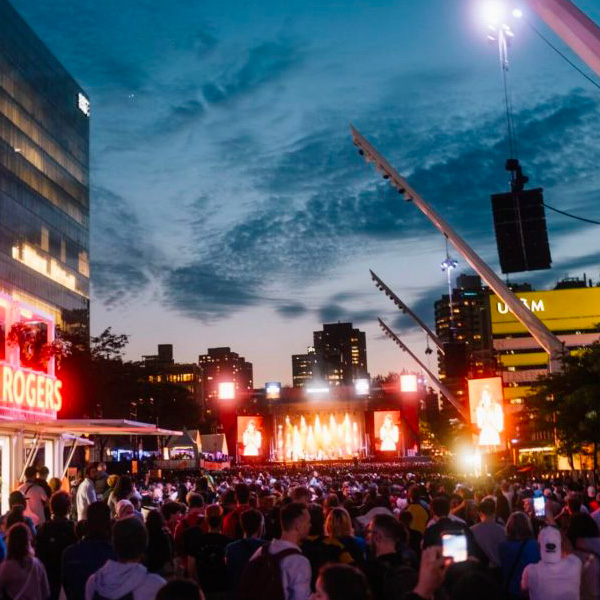 For an inclusive festive city: Article published on the Entretiens Jacques Cartier study day held in LyonNovember 18, 2025 Professor Jean-Pierre Chupin and student Laurène Smith presented UdeM's research on the concept of inclusion in festive activities at the Entretiens Jacques Cartier conference in Lyon.
"Montreal and Lyon are both known as festive cities, hosting multiple events each year. But not everyone has the right to celebrate. “Festivals are places of contradiction. They are celebrations that are supposed to be open to everyone, yet they exclude people,” says Laurène Smith, a master's student in architecture under the supervision of Professor Jean-Pierre Chupin at the University of Montreal.
In an attempt to answer the question “Is the festive city inclusive?” and to discuss their research, these representatives from the UdeM School of Architecture participated in the Entretiens Jacques Cartier 2025, which took place this year in Lyon from October 6 to 8. “Last year, I organized a series of round tables on universal accessibility awareness for the Entretiens. As a continuation of this reflection, the organization Cité anthropocène suggested that we look at the festive city,” summarizes the professor, who works on the issue of inclusion in the organization of cities..."
Read more on the UdeMNouvelles website.
This event, dedicated to festive cities and their mechanisms of inclusion or exclusion, was also documented by the Cité Antropocène and McGill's Night-time Design Research Group. These resources provide further insights from the collaborating institutions:
|