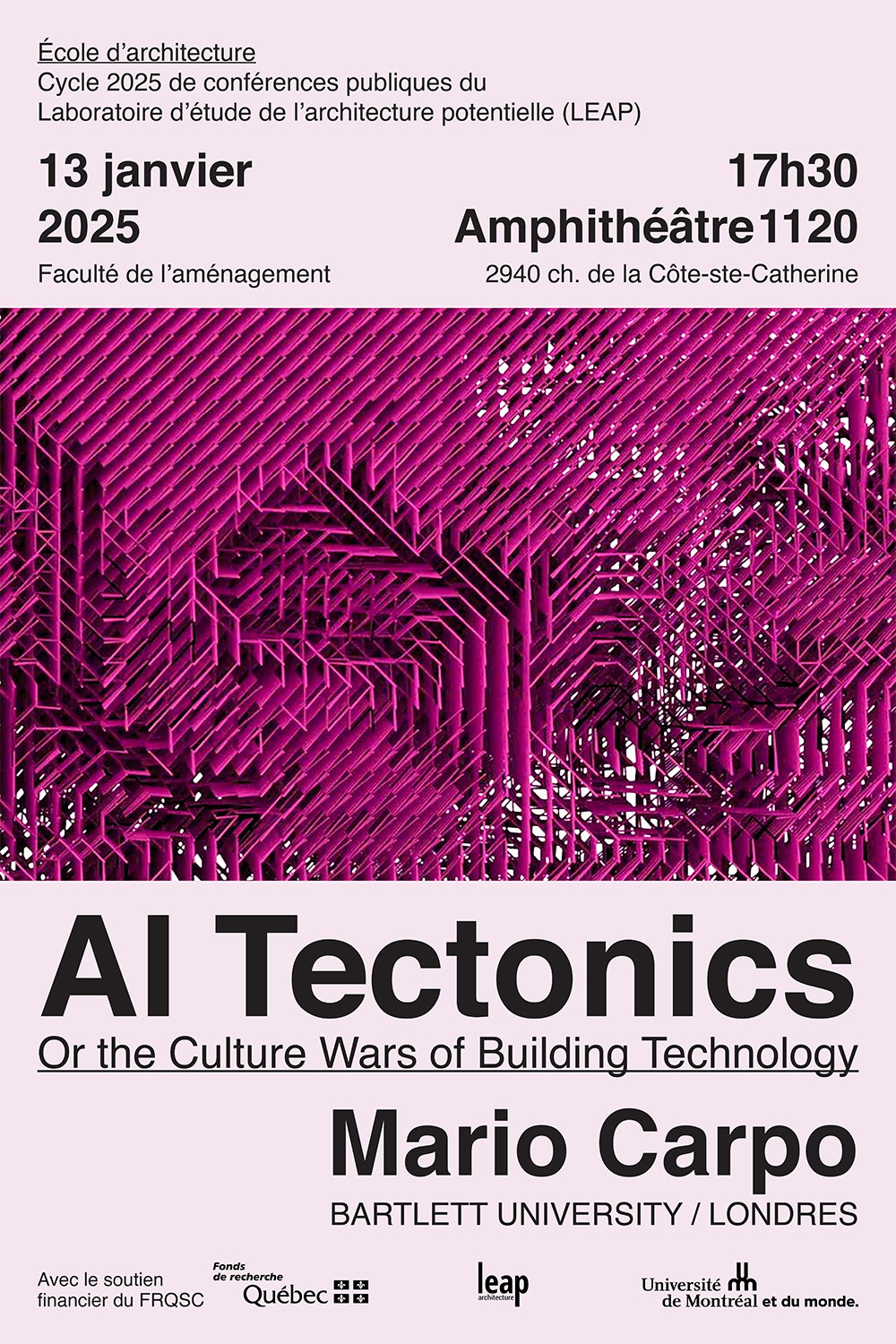
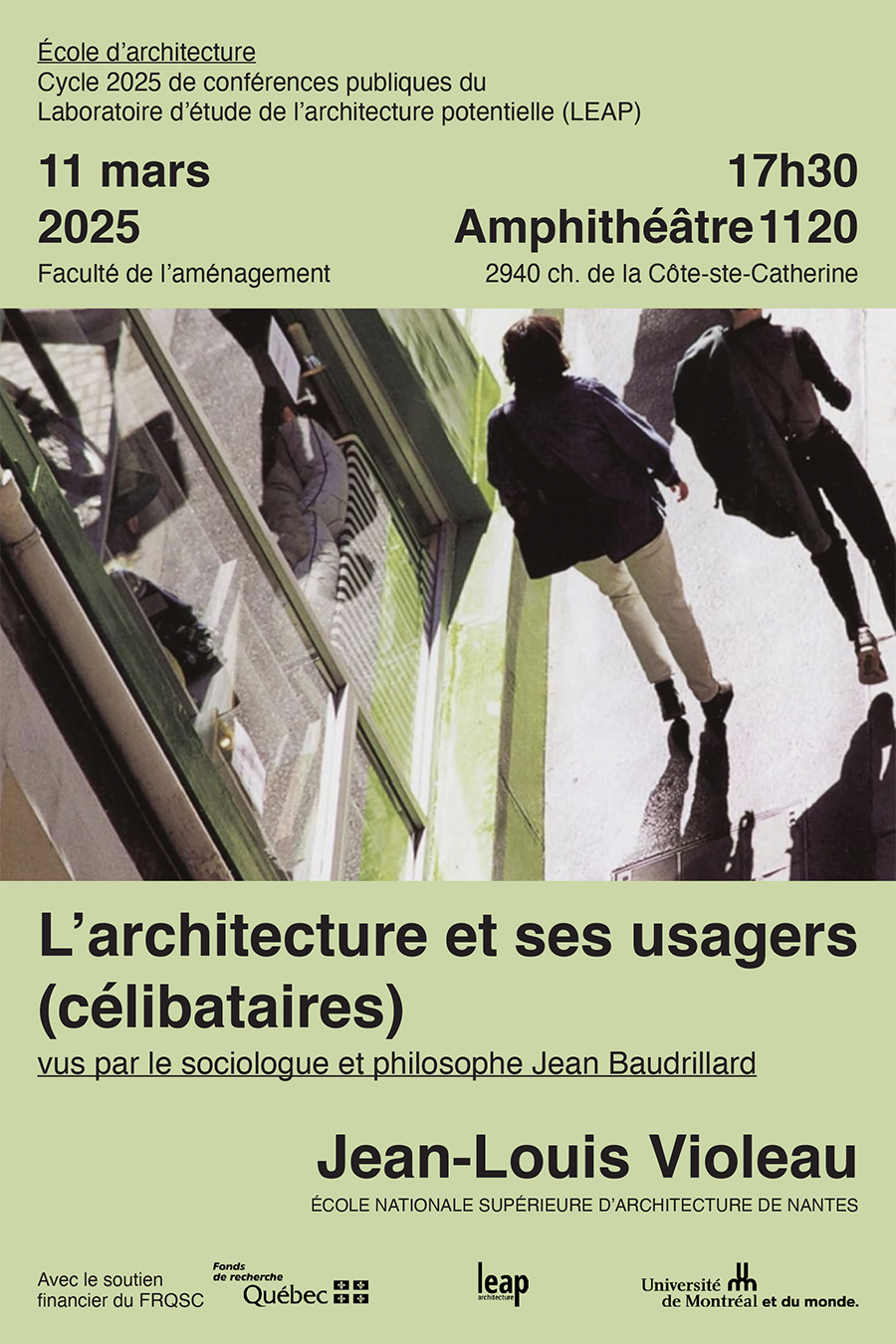
LEAP Seminar @UdeM (2025/03/11): Jean-Louis Violeau, Architecture and its (Single) Users as Seen by Sociologist and Philosopher Jean Baudrillard

Conference by Jean-Louis Violeau, École Nationale Supérieure d’Architecture de Nantes

Date: Tuesday, March 11th at 5:30 pm.

Location: Amphitheatre 1120, Faculté de l’aménagement, Université de Montréal

Lecture series of the Laboratoire d’étude de l’architecture potentielle


Architecture and its (Single) Users as Seen by Sociologist and Philosopher Jean Baudrillard


Summary:

How does one go about exploring Jean Baudrillard’s intimate yet suspicious relationship with architecture? One begins, as one should, with Disney, moves on to the duck and the Venturis, stops at the figure of the (architectural) monster, moves on to Jean Nouvel and the ambiguities of transparency, and finally arrives at some contemporary projects, notably the highly condemned Europacity. Along the way, Baudrillard raises two questions: what has become of architectural postmodernism, and the persistence of the notion of the author in architecture. Baudrillard was more of an imaginary sociologist, intuitive and detached, an interpreter who amused himself by drawing the dotted lines of the present, overdoing it and regularly tending to paroxysms. Hence his interest in architectures that resist interpretation and seem to take on a life of their own, as if detached from their designers: the Twin Towers of the World Trade Center, the Biosphère II project, the Beaubourg, the Guggenheim Bilbao, and some of Jean Nouvel’s architecture. Behind the scenes: obscure and ironic, every stage has its backstage, every scene is reversible, every project calls for its counter-project. The cursed part always bides its time. Culture for Beaubourg, globalization for the WTC, the planet for Biosphère II, the commodification of cities for the Guggenheim Bilbao… The ambivalence grows as these projects strive to saturate reality. What all these untamed concretions have in common, however, is that they seek first and foremost to bring the edge of difference to bear on generalized equivalence. In an age of no-fake and a shared quest for authenticity, this sociological perspective is meeting with renewed interest, particularly in the ambivalent choices and behaviors of digital children.

The sociologist Jean-Louis Violeau is a professor at the Ecole Nationale Supérieure d’Architecture de Nantes and at the Urban School of Sciences Po Paris. He is a researcher at CRENAU (CNRS UMR AAU).

He is a regular contributor to architectural magazines, in particular AMC-Le Moniteur architecture and L’Architecture d’aujourd’hui, as well as more general magazines such as Esprit, Place Publique Nantes-Saint-Nazaire and Urbanisme. He is also a member of the editorial board of the latter two magazines.

His dissertation Les architectes et mai 68 was published in 2005 by Recherches, the distant heirs of the journal of the same name founded under the aegis of Félix Guattari and the CERFI. The sequel, his HDR (Habilitation à Diriger des Recherches) on Les architectes et mai 81, was published by Recherches in 2011.
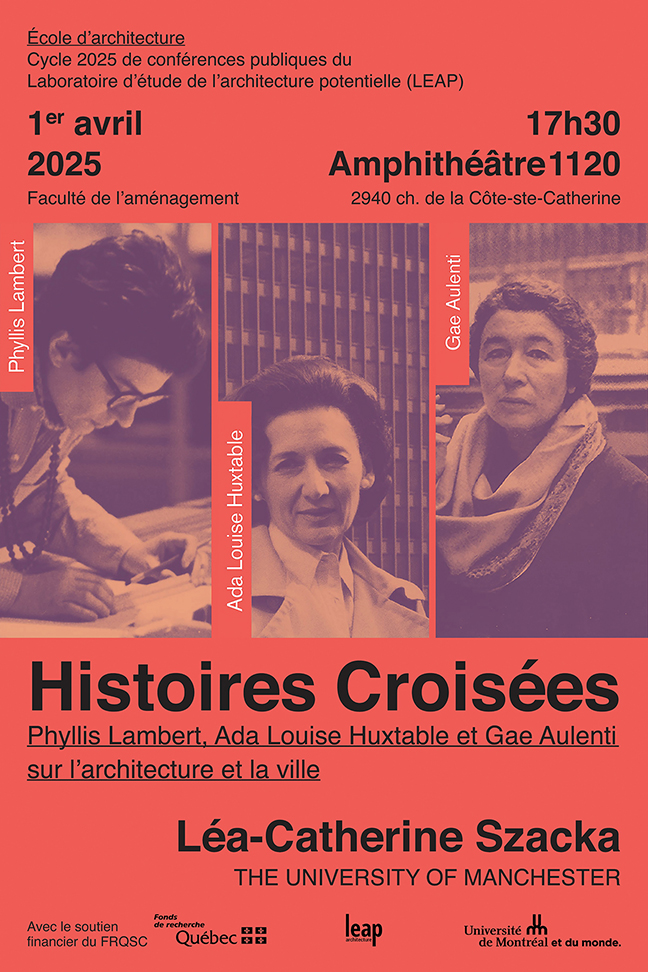
LEAP Seminar @UdeM (2025/04/01): Léa-Catherine Szacka, Crossed Histories. Phyllis Lambert, Ada Louise Huxtable and Gae Aulenti on Architecture and the City

Conference by Léa-Catherine Szacka , University of Manchester

Date: Tuesday, April 1st at 5:30 pm.

Location: Amphitheatre 1120, Faculté de l’aménagement, Université de Montréal

Lecture series of the Laboratoire d’étude de l’architecture potentielle


Crossed Histories
Phyllis Lambert, Ada Louise Huxtable and Gae Aulenti on Architecture and the City


Summary:

Born in the 1920s, architects Gae Aulenti and Phyllis Lambert and critic Ada Louise Huxtable were among the most influential figures in post-war architecture and design. Pioneers in a largely male-dominated field at the time, and key players in the transition from modernism to postmodernism, they set out to conquer and shape public space. This talk retraces the history and careers of these three women, who are the focus of the exhibition Crossed Histories, presented until May 2025 at the Canadian Cultural Centre in Paris.


Léa-Catherine Szacka:

Senior Lecturer (Associate Professor) in Architectural Studies, University of Manchester
Director of the Manchester Architecture Research Group (MARG)
Vice-President, European Architectural History Network (EAHN)
Co-Founder, PASZA – Platform for Architectural Research

LEAP Seminar @UdeM (2024/04/03): Research in situation: But where is the knowledge on traditional architecture in Central Kongo (Democratic Republic of Congo)?

Date: April 3, 2024, 4-6 p.m.

Location: Room 2064, Faculté de l’aménagement, Université de Montréal

Seminar presented by Judith le Maire, professor at the La Cambre Horta faculty of architecture at the Université libre de Bruxelles and director of  CLARA – Centre des Laboratoires Associés pour la Recherche en Architecture and the Clara magazine, accompanied by professor Victor Brunfaut.


Description

Visits to architectural archives from the colonial and contemporary periods will help us to understand how they are classified and inventoried. The LEAP and CCA centers visited will enable us to determine and discuss epistemologically the specificities of architectural archiving. The architectural archive is founded on a paradox: the impossibility of archiving buildings on a 1:1 scale necessitates mediation due to their scale, drawings, models, objects with a sibylline status…

The decolonization of archives and the question of their restitution and my research projects imply an ethical and reflexive positioning. This relates to my research object, named by V.Y. Mudimbe “the colonial library,” which brings together all the documents archived by the colonizers in the Congo and brought back to Belgium. Thinking about the archiving of post-colonial or pre-colonial (traditional) architecture, reflecting on its reception, omission or restitution is usefully done by comparison, for example with Canadian institutions at the forefront of these issues. The aim is to submit a PDR in July with colleagues from the ULB Faculty of Architecture, and then to be able to propose a G3 project.

Our faculty is strongly positioned in the research and doctoral training of students from North Africa, Benin and Congo. For this reason, their research training and management requires reflection that goes well beyond Belgian borders, and indicates this research in innovative institutions on these subjects.

I’m looking for traces of traditional Congolese architecture, a vernacular architecture that has been depreciated to the point where it is today unknown, unstudied and unhistoriographed. Where, for example, is Kongo architecture to be found in the archives of Belgian explorers in the Congo? Prince Albert of Belgium, for example, stayed in the Congo and made virtually no mention of the traditional buildings or villages he visited. His archives and the archives of the Belgian state nevertheless contain numerous traces and representations of traditional Congolese architecture from the early 20th century.

Study Day @UQAM (2024/05/21) : Designing proximity

Date: May 21, 2024, 9 a.m. to 5 p.m.

Location: École de design de l’UQAM, 1440, rue Sanguinet, Montréal

Aménager la proximité (Designing proximity) is an activity organized as part of the L’Architecture municipale comme interface citoyenne project led by the Bureau d’étude de pratiques indisciplinées (BēPI), at UQAM’s École de design. The project is funded by the Social Sciences and Humanities Research Council of Canada (Développement savoir grant) and supported by the Union des municipalités du Québec. The activity was also supported by the Villes Régions Monde (VRM) network, the Laboratoire d’étude de l’architecture potentielle (LEAP) and the École de design de l’UQAM.


Senior Researcher

  • Thomas-Bernard Kenniff, École de design, UQAM, BēPI, VRM, LEAP

Collaborating Researchers

  • Anne Cormier, Architecture, Université de Montréal, LEAP
  • Hiên Pham, Études urbaines et touristiques, ESG, UQAM, VRM

Assistants, Research Assistants from the École de design de l’UQAM

  • Lucas Azar (Baccalauréat en design de l’environnement)
  • Emmanuelle Bergeron (Maîtrise en design de l’environnement)
  • Alexie Gauthier-Lefebvre (Maîtrise en design de l’environnement)
  • Phélicia Gingras (Maîtrise en design de l’environnement)
  • Joëlle Kelzi (Maîtrise en design de l’environnement)
  • Agathe Parent-Corriveau (Maîtrise en design de l’environnement)
  • Alexandre Rocheleau (Maîtrise en design de l’environnement)


PROGRAM OF MAY 21

9 a.m.

Introduction to the day and presentation of the project

9:30 a.m. – Architectural forms of citizen interaction

Moderator: Anne Cormier, Université de Montréal

  • Olivier Bourgeois, Bourgeois Lechasseur
  • Manon Cyr, Ville de Chibougamau
  • Dominique Laroche, BGLA
  • Virginie Lasalle, Université de Montréal

11 a.m. – Municipal cores and their urban context

Moderator: Guillaume Éthier, UQAM

  • Marc-Alexandre Brousseau, Ville de Thetford Mines
  • Simon Carrothers, Ville de Rimouski
  • François Dufaux, Université Laval
  • Audrey Girard, Lemay
  • David Paradis, Vivre en ville

1:30 a.m. – The future of local municipal services

Moderator: Hiên Pham, UQAM

  • Laurence Bherer, Université de Montréal
  • Sinisha Brdar, UQAM
  • Martin Brière, BGLA
  • Maxime Pedneaud-Jobin
  • Jean-François Sabourin, Union des municipalités du Québec

3 p.m. – Towards new research questions and challenges

Moderator: Thomas-Bernard Kenniff, UQAM

  • Sandra Breux, INRS
  • Aurélien Catros, Université de Montréal
  • Jean-Pierre Chupin, Université de Montréal
  • Camille Lefebvre, UQAM
  • Madeleine Lefebvre, UQAT

5 p.m.

The day concludes with a 5 à 7 at Espace Ville Autrement, 201 rue Sainte-Catherine Est.


For further information: https://amenagerlaproximite.info/#journeedetude

LEAP Round Table @UdeM (2024/06/04): What kind of school architecture in the city center?

Date: Tuesday, June 4th, 2024 at 6:00 p.m.

Location: Room 3110, Faculté de l’aménagement, Université de Montréal

“From business districts almost exclusively reserved for commercial and professional activities, Canadian downtowns are increasingly becoming living spaces. Yet there are few elementary schools, which are essential to inclusive urban development. And for good reason: the traditional model of the single-purpose, low-rise school building, with a large playground at ground level, is at odds with a high-density, high-value environment. The heart of metropolises attracts developers, all the more so as urban planning regulations allow them to erect high-rise buildings, a source of significant revenue. So what kind of school architecture can we imagine for our city centers? And what might it offer schoolchildren?”

– A. Cormier, A. Paré and G. Adamczyk, En centre-ville : une architecture à hauteur d’enfant, Potential Architecture Books, Montreal, 2024

The Laboratoire d’étude de l’architecture potentielle (LEAP) recognizes the importance of the stakes involved in building schools downtown, and held a round table on this theme to mark the launch of the book En centre-ville : une architecture à hauteur d’enfant.

Moderator

Jean-Pierre Chupin, Architect and Professor at the School of Architecture, Université de Montréal, Chair Holder of the Canada Research Chair in Architecture, Competitions and Mediations of Excellence and Director of the LEAP

Panelists

  • Robert Beaudry, Montréal city councillor, Member of the Executive Committee, Responsible for OCPM urban planning and homelessness
  • Carol Bélanger, Chief Architect, City of Edmonton
  • Anne Cormier, Architect, Professor at the School of Architecture, Université de Montréal, Researcher at the LEAP
  • Ève Desrosiers, Architect, Héloïse Thibodeau architecte
  • Maryse Laberge, Architect, nfoe
  • Claude Laurin, Architect, Real Estate Planning and Development Coordinator, Centre de services scolaires de Montréal
  • Jordan Owen, Junior Developer, Mondev

Registration is mandatory: https://forms.gle/7ZwFtNcqvDzw3keB8

The round table is supported by the Social Sciences and Humanities Research Council of Canada (SSHRC), the Vice-rectorat à la recherche, à la découverte, à la création et à l’innovation de l’Université de Montréal (VRRCDI) and the Laboratoire d’étude de l’architecture potentielle (LEAP).

LEAP Seminar @UdeM (2024/01/16): Pierre Chabard, Building, Editing, Thinking. On the Path of a Few Architect-Publishers

Conference by Pierre Chabard, Professor and director of Éditions de la Villette.

Date: Tuesday, January 16th, 2024 at 5:30 pm.

Location: Amphitheatre 1120, Faculté de l’aménagement, Université de Montréal


Building, Editing, Thinking
On the Path of a Few Architect-Publishers


Summary:

While the history of those who write architectural books is now well documented, it often tends to overshadow the history of those who publish them. By investigating the careers of a number of French-speaking architects and publishers, Pierre Chabard will examine the role of this publishing practice in the production of architectural culture, and question the homology between the act of publishing a book and that of designing a building.


Pierre Chabard is an architect, historian and critic. With a doctorate in architecture, he is a lecturer at Ensa Paris-la Villette. A contributor to several art and architecture magazines and author of several books, he was a member of the magazine Le Visiteur (2001-2003), before co-founding Criticat (2007-2018). Since 2019, he has been director of Éditions de la Villette.

LEAP Seminar @Udem (2023/11/06): Claire Petetin, SocialMachine, user-friendly tools for participatory design

Date: November 6th, 2023, 4:30-6:00 pm.

Location: Room 2064, Faculté de l’aménagement, Université de Montréal

Presented by Claire Petetin, professor at ENSA Versailles


SocialMachine, user-friendly tools for participatory design

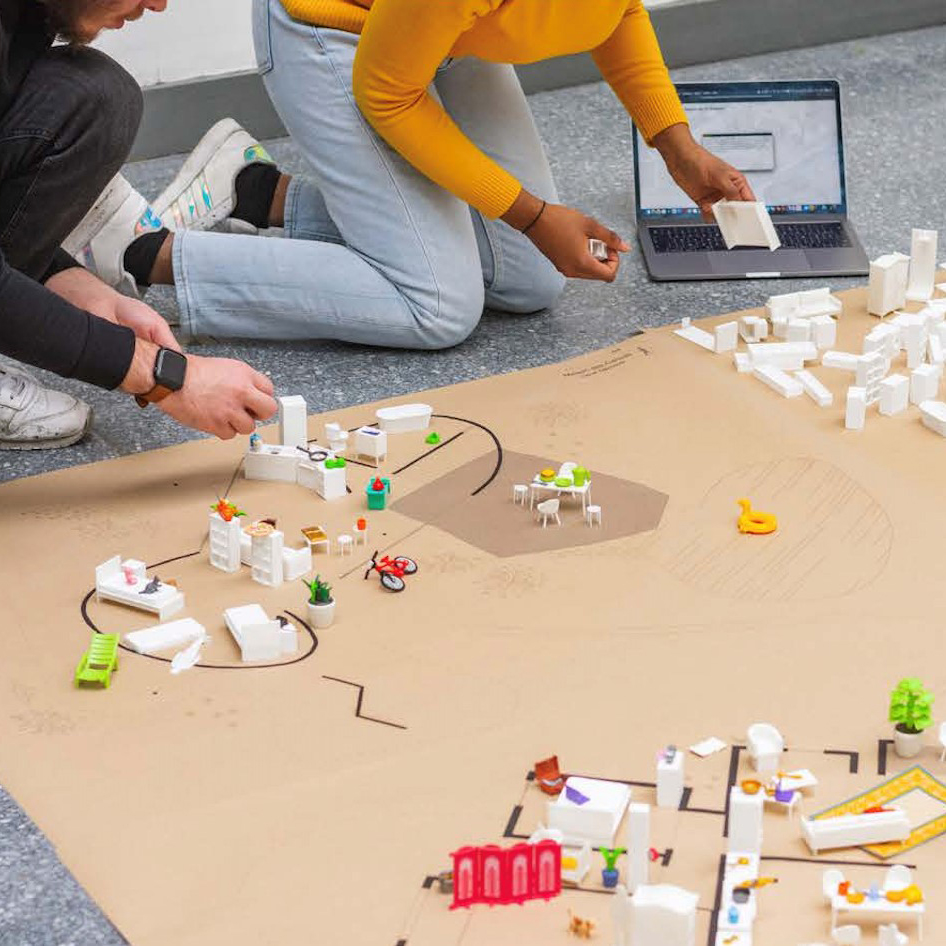
Social Machine is an experimental, interdisciplinary and multiscalar teaching and research project, motivated by the vocation of training architects and designers in the pedagogy of architectural design for civil society. This training is part of the democratization of architectural culture. It questions the architect’s know-how in a society marked by systemic crises, which puts the architect to the test of degrowth and commitment to a sustainable world. These questions open up new perspectives on how to design differently, giving it a new social and collaborative meaning through creative experimentation with architectural pedagogical culture.

We propose that our students design collaborative design protocols that are similar to malleable representations, permeable to the expression of the imaginations of all stakeholders, or playable design aids that draw on the formats and rules of playful interactivity, to invent new dynamics of co-ideation and socialization between the various stakeholders.  Potential design protocols leave room for intuition, randomness, error, dysfunction, feedback and iteration. They take a variety of forms, halfway between collaborative and speculative drawings embellished with models or figurines in the style of tangible board games, computational self-design software for non-specialists, and video games generating architectural drawings in plan or axonometry.

Social Machine is now involved in research, within the Léav (Research Laboratory of the Ecole Nationale Supérieure d’Architecture de Versailles), with the aim of combining the sciences of architecture with those of education. As part of a partnership with the Petite école d’architecture de Versailles (founded by ensav in 2021), the Maréchalerie Centre d’Art Contemporain, and the French Ministry of Culture, prototypes of playful participatory design tools are being tested in various public venues and schools.

This practice of in situ experimentation provides considerable theoretical material for understanding the relational process of the stakeholders involved in the project process, and the role of the architect in creating empathy and dialogue, building a common culture and fostering creativity and the confrontation of ideas between different players.

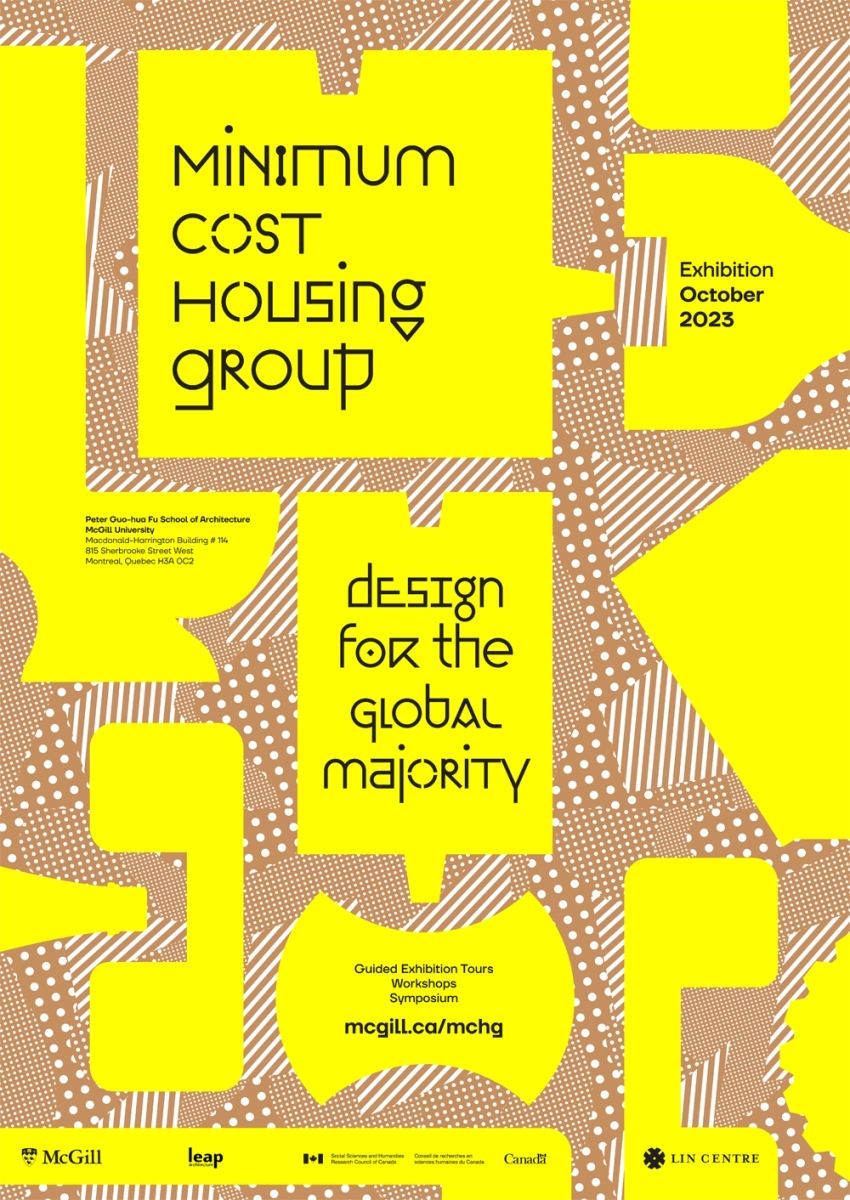
Seminar @McGill (2023/10/19-2023/10/20) : Design for the Global Majority

Event 1

Title: “Thousand Million Clients” Keynote by Vikram Bhatt (McGill) in Conversation with Ipek Türeli (McGill) and Carmela Cucuzzella (UdeM)

Date: Thursday, October 19, 2023

Time:   Vernissage at 5 pm (Room 114) followed by keynote at 6 pm (Room G-10)

Location: Peter Guo-hua Fu School of Architecture, Macdonald-Harrington Building, 815 Sherbrooke St W, Montreal, Quebec H3A OC2

Description: This event is part of the Design for the Global Majority project. Exhibition vernissage will be followed by a keynote talk by Vikram Bhatt, Professor Emeritus, McGill University, and former director of the MCHG, and conversation with Ipek Türeli, Associate Professor and Canada Research Chair in Architectures of Spatial Justice, McGill University, and Carmela Cucuzzella, Dean of the Faculté de l’aménagement, Université de Montréal.


Event 2

Title: “Design for the Global Majority” Symposium

Date: Friday, October 20, 2023

Time: 9 am – 4 pm

Location: Thomson House, 3rd floor, 3650 McTavish St, Montreal, Quebec H3A 1Y2

Description: This event is part of the Design for the Global Majority project. International symposium with presentations by MCHG alumni and scholars.


Event 3

Title: “Green Before Green” Closing keynote by Witold Rybczynski (UPenn)

Date: Friday, October 20, 2023

Time: 6 pm

Location: Faculty of Law, New Chancellor Day Hall (Room 100), 3644 Peel St, Montreal, Quebec H3A 1W9

Description: This event is part of the Design for the Global Majority project. Closing keynote by Witold Rybczynski, Martin and Margy Meyerson Professor Emeritus of Urbanism, University of Pennsylvania, and former director of the MCHG.